Michael Vandi
A borrower can submit a mortgage application in minutes. Reviewing income, collecting documents, and resolving conditions take much longer, especially when lenders switch between multiple systems.
Mortgage loan origination automation software can help with these tasks, from digital borrower applications and AI document review to loan management through closing.
The right tools for automated loan origination depend on what your existing systems already handle and which tasks take the most time. We'll compare eight platforms by their use cases to help you narrow down your options.
TL;DR
Here are eight mortgage loan origination automation software options and what each is best for:
Addy: Best for AI-powered mortgage loan processing.
LoanLogics: Best for income validation and loan quality control.
Floify: Best for customizable mortgage applications.
Ocrolus: Best for financial document analysis.
Blend: Best for digital mortgage applications and pre-qualification.
Mortgage Cadence: Best for configurable end-to-end origination.
Encompass by ICE Mortgage Technology: Best for enterprise loan origination management.
Blue Sage: Best for multichannel mortgage origination.
What Is Mortgage Loan Origination Automation Software?
Mortgage loan origination automation software handles tasks within the loan origination process using digital workflows, business rules, and AI. It helps mortgage lenders verify borrower information and flag outstanding requirements before underwriting.
These mortgage automation tools fall into four main categories:
Point-of-sale (POS) software: Gives applicants access to borrower portals where they can complete forms, upload supporting files, and sign disclosures. Loan officers receive the information without exchanging paperwork through multiple emails.
Document and income automation: Extracts figures from pay stubs, tax returns, and bank statements to calculate qualifying income. It also flags mismatched information so processors can investigate discrepancies before underwriting.
Loan origination system (LOS): Coordinates underwriting workflows by assigning tasks, tracking conditions, and recording compliance activities. Processors and underwriters can follow each application through approval and closing.
AI-powered processing tools: Compare records in the loan file with lending guidelines to identify missing information. They generate processing checklists and send document requests to borrowers, so loan officers don't have to follow up individually.
These categories differ in scope. A full LOS handles core origination activities, while specialized software concentrates on particular tasks within the lending process.
8 Mortgage Automation Software Tools for Different Workflows
The eight platforms below specialize in different stages of mortgage origination. We'll look at how each handles specific tasks and what sets its capabilities apart.
1. Addy: Best for AI-Powered Mortgage Loan Processing
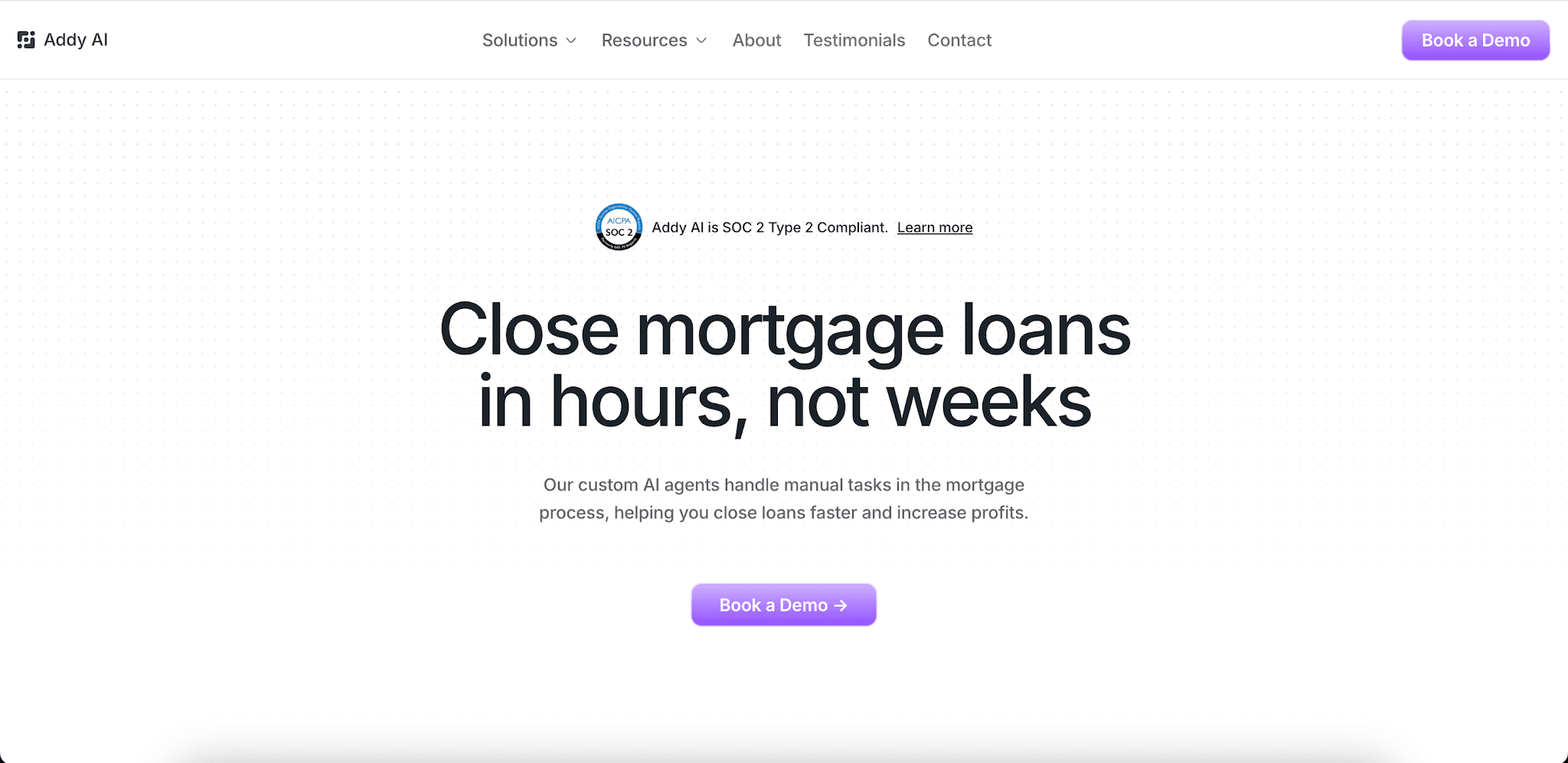
Addy concentrates on the tasks between application intake and underwriting. It helps mortgage brokers and lenders identify outstanding requirements and prepare borrower information through AI agents.
Key Features
Document AI: Pulls borrower records from connected systems and classifies pay stubs, bank statements, and tax returns. It extracts income and asset details so processors don't have to enter figures from each page manually.
AI Processing Checklist: Compares submitted records with lending guidelines and automated underwriting system (AUS) findings. It flags missing documentation and unresolved conditions, giving processors a list of items to address before underwriting.
Automated borrower follow-ups: AI agents request outstanding materials through email, text, or phone. They also send reminders when applicants haven't responded, helping loan officers keep track of pending requests.
Addy connects with existing LOS, POS, and CRM platforms as an additional processing tool. Its two-way synchronization with Arive transfers loan information between systems, while the browser extension provides guideline answers and scenario pricing within the lender's existing applications.
Addy's ChatGPT app offers another way to prepare files for underwriting. Loan officers can assess borrower qualifications, analyze financing scenarios, and obtain pre-underwriting findings in minutes. Licensed mortgage professionals remain responsible for formal underwriting decisions.
2. LoanLogics: Best for Income Validation and Loan Quality Control

Image source: loanlogics.com
Income verification gets complicated when borrowers have several earnings sources or self-employment income. LoanLogics automates calculations and quality control to identify errors before underwriting and investor delivery.
Key Features
LoanBeam: Extracts earnings information and calculates qualifying income for W-2, self-employed, and mixed-income scenarios, reducing manual calculations for underwriters.
IDEA OnDemand: Classifies incoming mortgage documents, captures key information, and applies validation rules. It flags missing or conflicting details that could affect underwriting decisions or loan quality.
LoanBeam Processing Automation: Applies investor-specific eligibility criteria to identify exceptions and incomplete income packages. It also prepares documentation for investor review, helping lenders address outstanding issues before submission.
LoanLogics integrates with major origination platforms and delivery systems through configurable APIs. These connections let lenders use its income verification results within their established quality-control procedures.
3. Floify: Best for Customizable Mortgage Applications

Image source: floify.com
Borrower applications can require different information depending on the financing product. Floify focuses on this stage of mortgage lending, letting lenders configure digital applications for multiple lending products without custom development.
Key Features
Dynamic Apps: Lets teams customize questions according to the product, branch, or borrower type. Lenders can configure applications for HELOCs, non-QM mortgages, and construction financing without coding.
Borrower portal: Applicants complete forms, upload supporting records, and electronically sign authorizations in one place. Status tracking and automated notifications help them follow outstanding tasks throughout the application process.
AI-powered data capture: Extracts information from uploaded records to prefill application fields. Loan officers can verify those entries against the original documents rather than typing the information manually.
Floify integrates with more than 50 platforms, including MeridianLink Mortgage, LendingPad, Jungo, and Surefire. Its APIs and webhooks also let lenders connect application information with downstream mortgage workflows managed through their existing systems.
4. Ocrolus: Best for Financial Document Analysis

Image source: ocrolus.com
Ocrolus analyzes borrower income and assets to help lenders verify financial information before underwriting. Its AI technology also detects discrepancies and signs of document tampering that require further investigation.
Key Features
Document classification and extraction: Sorts bank statements, pay stubs, and tax forms by type, then captures key figures in a standardized format. When automated extraction is uncertain, Ocrolus routes the information to human verifiers.
Income and cash-flow analysis: Calculates earnings for W-2, 1099, gig, rental, and self-employed borrowers. It also analyzes bank transactions to help underwriters assess income that varies from month to month.
Fraud detection: Identifies possible alterations, including edited amounts, invalid dates, and unusual formatting. Each flag includes supporting evidence so lenders can investigate suspicious information before making decisions.
Ocrolus Inspect: Compares borrower-provided records with Encompass 1003 application details. It identifies discrepancies that could require additional documentation or underwriting conditions.
Ocrolus transfers extracted values and calculations to Encompass, a mortgage LOS, through its integration. Lenders can also use its API to map information to custom fields.
Its capabilities center on financial verification, particularly for applications involving irregular earnings or complex income documentation.
5. Blend: Best for Digital Mortgage Applications

Image source: blend.com
Blend provides a digital lending platform that lets borrowers explore financing options before formally applying for a mortgage. Its self-service tools also help lenders collect information and manage early qualification.
Key Features
Guided mortgage applications: Uses dynamic questions based on applicants' responses and pre-fills information when available. This shortens the application process by avoiding unnecessary questions and manual entries.
Pre-qualification tools: Provides a loan scenario simulator and soft credit inquiries to help borrowers explore financing options. Lenders receive preliminary information to assess eligibility before proceeding with a full application.
Autopilot: Reviews documents, calculates income, checks lending guidelines, and generates borrower follow-ups within Blend’s origination workflow.
Blend also provides digital disclosures and electronic signatures. Its Blend Close solution extends these features to hybrid closings and eligible remote online notarization transactions.
The Loan Officer Workspace brings borrower details, pre-approvals, and disclosure tasks into one interface. Banks and credit unions can use these features to manage the borrower experience beyond the initial application.
6. Mortgage Cadence: Best for Configurable End-to-End Origination

Image source: mortgagecadence.com
Mortgage Cadence offers mortgage loan origination software that handles applications through closing. Its Mortgage Cadence Platform (MCP) gives lenders preconfigured options or customizable rules for their processing activities.
Key Features
ACE rules engine: Uses lender-configured rules to trigger tasks at specific stages of origination. This workflow automation assigns activities according to the conditions lenders establish for each processing stage.
Integrated point-of-sale: Collects applications and supporting records through digital intake tools. MCP receives the submitted information, so mortgage loan processors don't have to transfer those details manually.
eClose: Prepares closing packages and coordinates transactions with title agents and notaries. It accommodates hybrid and fully digital closings.
Power BI analytics: Displays pipeline metrics and custom reports within MCP or through the web. Managers can monitor processing volumes and identify stages where loans remain outstanding.
MCP also connects with third-party services through open APIs, including prebuilt integrations with Fannie Mae and Freddie Mac. These connections bring third-party services into the origination workflow, enabling lenders to submit requests and receive results within MCP.
7. Encompass by ICE Mortgage Technology: Best for Enterprise Loan Origination Management

Image source: mortgagetech.ice.com
Encompass by ICE Mortgage Technology serves as a central system of record for mortgage origination. It handles processing, underwriting, closing, and investor delivery while maintaining loan information within one platform.
Key Features
Configurable processing: Automates task assignments, information verification, and document tracking. Processors can monitor outstanding conditions and identify missing items before an application advances.
Compliance management: Applies validation rules and maintains auditable records of processing activities. Lenders can trace completed steps and document how they addressed regulatory requirements affecting the mortgage industry.
Secondary and capital markets: Handles pricing, rate locks, trades, and investor delivery. These functions connect origination with secondary marketing activities without requiring a separate transaction platform.
Encompass integrates with borrower-facing applications, third-party origination portals, and external mortgage services. Its APIs accommodate additional technology, while reporting tools provide pipeline and performance information.
The platform serves financial institutions, including banks and credit unions, as well as independent mortgage bankers managing different origination channels.
8. Blue Sage: Best for Multichannel Mortgage Origination

Image source: bluesageusa.com
Retail, wholesale, and correspondent lending involve different application processes. Blue Sage brings these channels into one cloud-based LOS, where teams manage loans throughout the loan lifecycle, from intake to funding.
Key Features
Channel-specific portals: Consumer Direct supports applications and electronic signatures; the Broker Portal handles submissions, pricing, and conditions. Loan officers track pipelines and contact borrowers through a separate portal.
Automated task management: Uses configurable rules to assign conditions and route tasks according to employee skills. It also calculates fees automatically, helping lenders prepare disclosures without manually entering each charge.
Blue Sage Docs: Classifies records, compares document and application details, and flags missing or conflicting information before closing. Its standalone document management system also works with other LOS platforms.
Blue Sage connects with third-party services through open APIs and two-way integrations. Administrators can also configure compliance rules and role-based permissions to manage user access within multichannel lending operations.
How to Choose Mortgage Loan Origination Automation Software
Evaluate mortgage software against your own processing records rather than relying only on demonstrations.
Identify the Manual Tasks Delaying Loan Origination
Before investing in mortgage process automation, review recently completed applications and note each task requiring manual intervention. Record delays from missing paperwork, income corrections, and unresolved underwriting conditions.
Separate time spent waiting for borrowers from delays caused by internal handoffs. A condition might remain open for days simply because no one assigned the follow-up.
Compare how frequently these problems occur and how much time each consumes. This helps determine whether point solutions can address specific tasks or whether existing procedures require changes.
Check Integrations With Your Existing LOS and POS
Ask providers to explain their integration architecture, including native connections, APIs, and custom field mappings. During a demonstration, update a borrower's information and replace an uploaded statement.
Verify that both changes reach the correct loan record, then repeat the test from the receiving platform. Incomplete connections leave processors reconciling information between separate systems.
With legacy systems, establish who maintains custom mappings after software updates. Community banks should also verify how funded loan information transfers into their core banking systems.
Lenders that service loans in-house should also test whether funded account information transfers into servicing software. Verify that the receiving system has the details required for payment processing.
Run a third-party verification request to confirm the results reach the correct loan record. Inspect user permissions and audit logs to check access to sensitive records and how changes are recorded.
Test Automation Accuracy and Total Costs
Use recently completed residential mortgages to test income calculations, document extraction, and underwriting condition identification. Include incomplete files and self-employed borrowers to see how the software handles exceptions.
Multi-product lenders should test different loan programs, including conventional, non-QM, and HELOC applications. Compare the results against original records, noting missed discrepancies and incorrect flags.
Lenders offering commercial lending should also include commercial mortgage cases with business-income records and property cash-flow statements in their tests. Hard money lenders can assess how the software handles collateral valuations and property-related loan conditions.
Have processors correct any errors identified during the trial. Track how often they have to override automated results or manually re-enter information into the LOS.
Evaluate operational efficiency through processing time per file, manual touches, and repeated document requests. Compare those figures with similar applications handled before the pilot.
Calculate the cost per funded loan, including staff time, subscriptions, implementation, integrations, training, and maintenance. Compare that expense with the key benefits recorded during testing, particularly fewer manual corrections and shorter processing times.
Resolve Missing Loan Requirements Faster With Addy
The deciding factor isn't how many features a platform offers. It's how quickly your team can turn a submitted application into a file ready for underwriting.
That interval deserves attention when choosing mortgage loan origination automation software. Many mortgage lenders already have systems that manage applications and approvals, but processing delays can still affect their turnaround times.
Addy focuses on this gap. When a condition remains unresolved, its AI agents help identify what's missing and request the information from borrowers. Lenders can address these tasks without overhauling the entire mortgage process.
FAQs About Mortgage Origination Automation Software
What is the best loan origination software for mortgage automation?
The top loan origination software options handle different stages of mortgage lending. The right loan origination system manages core activities, while Addy focuses on AI-powered file preparation. Non-bank lenders and private lenders should also confirm compatibility with their loan products.
How much does mortgage loan origination software cost?
Pricing varies by loan volume, user count, selected features, and integration requirements. Ask whether connections to credit bureaus or investor portals carry separate charges. Compare quotes that include implementation, training, maintenance, and any per-loan fees.
How long does mortgage origination automation take to implement?
A loan processing add-on can take days or weeks, while replacing an LOS can take several months. Projects covering the entire mortgage lending process require more planning, especially when connecting origination with loan servicing systems.
Ask providers for timelines covering configuration, data migration, testing, and training.
Can mortgage automation software make final underwriting decisions?
Automated underwriting systems generate eligibility recommendations, while some lenders use approved rules to automate credit decisions.
AI processing tools like Addy prepare files rather than issue final approvals. Lenders remain accountable for their decisions and compliance with consumer lending regulations.
Start closing more loans – Book your demo today
Stay ahead of the competition and discover how AI can accelerate your loan origination process, reduce manual work, and help you close more deals in less time. Book a demo today and start experiencing the future of lending.