Michael Vandi
The loan origination process hasn’t kept up with the rest of fintech. Many lenders still deal with disconnected systems, manual data entry, and overly long review cycles.
Everyone involved feels the pressure to move faster. Borrowers want faster loan decisions, compliance teams need better traceability for regulatory compliance, and product teams want more control without rebuilding existing systems.
Loan origination automation reduces manual processes, shortens review cycles, and improves the customer experience. This guide breaks down what automation really looks like in origination today and how to build it into your stack using the systems you already have.
TL;DR
Loan origination automation uses connected technology to reduce manual steps from application through funding.
Automation can shorten review times by handling document checks, credit analysis, compliance tasks, and borrower follow-up.
Integrated systems keep application data consistent as files move between origination, verification, and customer management platforms.
Clear rules and exception handling help lenders maintain control while reducing delays and processing errors.
Addy adds mortgage-specific AI agents, document intelligence, guideline review, follow-ups, and system integrations to existing workflows.
What Is Automated Loan Origination?
Automated loan origination is the use of connected systems and logic-based workflows to handle the lending process with less manual effort.
It replaces disconnected systems and repetitive reviews with a unified process that moves loan applications from intake to funding faster and more consistently.
The loan origination process usually includes:
Application intake
Borrower data collection and document verification
Credit checks, credit scoring, and risk assessment
The underwriting process and credit decisioning
Offer delivery and funding
When this process is automated, key steps like data entry, credit scoring, and compliance checks happen in the background. Product and operations teams can set predefined criteria, define workflow triggers, and automate workflows, making them easier to manage and update.
An automated loan processing system connects all steps via real-time data, reducing reliance on manual reviews and siloed tools.
Loan origination automation helps teams reduce operational costs, improve risk management, and create a better customer experience without rebuilding their stack.
Why Automation Matters for Origination in 2026
Loan origination is no longer just about moving an application through a checklist. It’s about speed, consistency, and reliable data. Mortgage teams need more control and flexibility without adding more overhead.
Here’s why automation matters now:
Customer expectations are rising - Borrowers expect faster decisions and instant feedback. A slow or confusing loan application process can lead to drop-off and lost volume.
Manual reviews create risk - Every handoff adds the chance of delay or error. When key decisions rely on spreadsheets or disconnected systems, it’s harder to stay compliant and accurate.
Ops teams are stretched thin - Reviewing documents, handling data extraction, double-checking information, and chasing approvals don’t scale. Automation helps processors focus on exceptions that need closer attention.
Consistency is key for compliance - Rules need to be applied the same way for every application. Automation makes it easier to enforce policies and maintain clear audit trails.
Tech debt holds teams back - Patching together tools slows down releases and limits what teams can improve. A connected automation technology layer gives product and engineering teams more flexibility.
Automation enables loan officers to improve operational efficiency and reduce risk during file review.
What the Automated Loan Origination Process Looks Like
Automation changes how lenders handle each stage of the loan lifecycle. Connected workflows reduce manual handoffs and make files easier to manage.
Here’s how the automated loan origination process works in a modern setup.
1. Loan Application and Intake
Borrowers start the process online or through a point-of-sale (POS) platform. Automation checks the application for missing information and pulls in borrower details already on file.
It then sends structured customer information to the loan origination system (LOS) or customer relationship management (CRM) platform. This reduces back-and-forth and keeps application processing moving without unnecessary delays.
2. Borrower Data Collection and ID Verification
Once the application is submitted, automated workflows trigger know-your-customer (KYC) and anti-money laundering (AML) checks. Third-party systems confirm identity and use fraud detection tools to flag suspicious documents or identity patterns.
Anything that cannot be verified automatically is flagged for human intervention. Processors receive verified borrower information faster without repeating the same checks manually.
3. Credit Data and Risk Checks
Application programming interface (API) integrations with credit bureaus can pull credit reports automatically, so risk reviews use current credit information.
Financial records such as bank statements can confirm whether reported income and assets match the borrower’s application.
Rules-based engines then apply credit scoring and defined risk criteria to determine creditworthiness. This supports consistent credit risk management without relying on subjective review.
4. Underwriting and Decision-Making
The risk function sets the logic used for underwriting decisions. These rules can be updated as lending policies or requirements change without reworking the entire technology stack.
Some lenders use internal scorecards. More complex workflows may also incorporate machine learning models. The chosen method can support faster lending decisions when review rules remain clear.
5. Offer Delivery and Disbursement
Approved offers can be automatically generated and sent to the borrower with e-signature options. Once closing documents are signed and funding conditions are satisfied, funds can be disbursed and tracked through integrated systems.
Each step can also be recorded through audit trails to support regulatory compliance.
Automation lets mortgage teams control more of the loan origination process without slowing it down. Instead of chasing missing information or reviewing the same data twice, teams get real-time insights, cleaner records, and fewer delays.
Common Pitfalls That Slow Down Lending Operations
Many businesses face integration problems during automation, and lenders run into similar blockers during origination.
One of the biggest issues is over-customized systems. When business logic is hard-coded or spread between tools, even simple updates require development time and cross-team coordination.
Poor system integration can also undermine loan automation. Tools that don’t communicate seamlessly introduce delays, duplicate customer data, and force teams to piece together borrower data manually. These problems become harder to manage as application volume increases.
Manual reviews also tend to stick around longer than necessary. They become time-consuming when staff repeatedly verify information that automated systems could already check. Unnecessary human checkpoints can delay decisions and produce inconsistent outcomes.
Compliance is another area where operations break down. When audit requirements live in spreadsheets or offline documents, it’s easy to miss steps and hard to prove that rules were followed.
Connected audit trails give lenders a record of completed reviews and help with regulatory compliance.
These issues add up. The solution isn’t more tools; it’s a modular setup with clean workflows, clear logic, and connected systems that you can adjust without rebuilding everything.
How Addy Helps Teams Automate the Loan Origination Process
Addy is an AI-powered mortgage lending platform that brings all your lending workflows together in one connected system.
Instead of managing manual reviews and follow-ups that drag the loan origination process out for weeks, Addy uses specialized AI agents trained on over 20,000 mortgage lending guidelines to automate tasks from application intake through funding.
Most loans take 45–60 days to close, driven by complex manual reviews. Addy reduces this timeline by up to 90%, helping financial institutions and lenders close loans in just days.

Loan processing, which typically accounts for 67% of lending expenses, becomes significantly more efficient.
How Addy Automates the Loan Origination Workflow
Here’s how Addy improves the automated loan origination workflow:
Instant mortgage underwriting - Addy reviews borrower documents, validates income, and completes underwriting analyses in minutes, not days.
AI-driven document processing - Addy uses optical character recognition (OCR) and AI document analysis to extract data such as loan-to-value (LTV) ratio and annual percentage rate (APR) from borrower documents. This reduces repeated data entry and minimizes errors from retyping information.
Automated borrower follow-ups - Addy proactively engages mortgage brokers and borrowers with automated follow-ups, speeding document collection and improving customer satisfaction.
Real-time compliance checks - Addy's proprietary AI agents assess each loan application against lender, federal, and state guidelines in real time, maintaining compliance without extra manual work.
Direct CRM and LOS integration - Addy connects with your existing CRM and LOS, allowing for immediate data synchronization, fewer context switches, and smoother lending operations.
Handling tasks like identity verification, data entry, compliance checking, and underwriting decisions helps Addy improve operational efficiency. Its AI-driven process automation reduces loan processing timelines from weeks to days, giving lenders a competitive advantage.
Lenders using Addy are already seeing dramatic results.
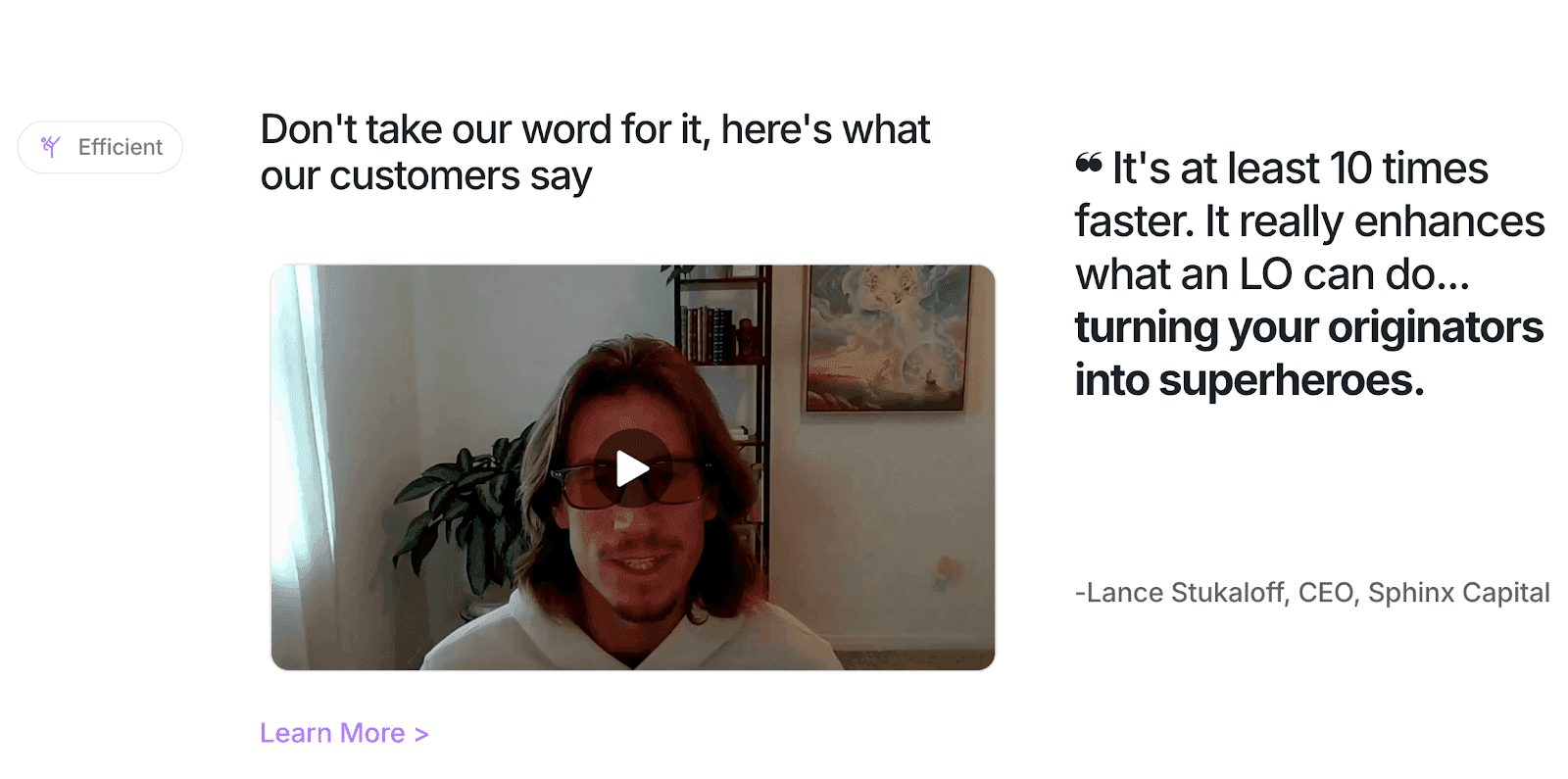
“It’s at least 10 times faster. It really enhances what an LO can do... turning your originators into superheroes.”
— Lance Stukaloff, CEO, Sphinx Capital
Addy Brings Pre-Underwriting Into ChatGPT
On May 28, 2026, Addy launched its ChatGPT app for mortgage pre-underwriting. The app reviews borrower documents and loan scenarios, then flags missing conditions and organizes its findings in roughly five minutes.
Loan officers can use those findings to spot file gaps earlier and prepare the submission before formal underwriting.
Ready to close loans in days, not weeks? Book a demo to see Addy in action.
What a Strong Loan Origination System Should Deliver
A high-quality LOS doesn’t just collect applications. It needs to support speed, compliance, and scale without piling work on employees.
Here’s what to expect from a system designed for modern lending:
Built-in automation – Automation can handle repetitive tasks such as data checks, document parsing, and follow-ups with little manual input. This reduces human errors and leaves more time for files that need closer review.
Custom logic and workflows – Every lender has unique credit rules. A strong LOS lets you adjust workflows without relying on developers or major system changes.
Real-time decision-making – The loan approval process should move fast. Look for systems that can pull credit, verify income, and run compliance checks in minutes. Faster responses can also improve customer experience by reducing unnecessary delays.
Easy integrations – Your LOS should connect with tools like CRM, POS, and KYC vendors to avoid data silos and manual entry.
Audit-ready compliance – All decisions and changes should be logged in one place, making it easy to stay compliant and prepare for audits.
Clear visibility across the funnel – A modern LOS should show exactly where deals get stuck, who’s responsible, and what’s moving forward to help optimize your lending flow.
If your current system depends on legacy systems or disconnected tools, those limitations can slow processing and hold back growth.
Let Addy Handle the Busywork in Your Loan Origination Process
Automating loan origination is no longer optional. Lenders who succeed are the ones who reduce manual work, move faster, and adapt without adding more tech debt.
Addy gives lending businesses a competitive edge by automating document collection, underwriting, compliance checks, and borrower communications. Teams get real-time progress that supports faster data-driven decisions throughout the lending journey.
Faster follow-ups and clearer file progress can also help lenders provide better service without adding more complex manual tasks.
When the loan origination process starts slowing operations down, Addy fits into existing systems without replacing the technology already in place.
Book a demo now to see how Addy can modernize the lending process.
FAQs About Automated Loan Origination
What is automated loan origination?
Automated loan origination uses software and workflows to move applications through key lending steps with less manual work. Artificial intelligence can support document review, data checks, and faster file preparation to help lenders enhance the customer experience.
What is the loan origination process?
The loan origination process covers the steps from application intake through approval, closing, and funding. Lenders verify borrower information and set terms such as the loan amount and interest rate.
What does loan origination software do?
Loan origination software manages applications, borrower data, documents, workflows, decisions, and compliance records in one system. Some platforms use AI-driven decisioning to support risk analysis and help staff review applications faster.
What is RPA in lending?
Robotic process automation (RPA) in lending uses software bots to complete repetitive, rule-based tasks. RPA can transfer data between systems, update records, and trigger routine checks without repeated manual entry.
What types of loans benefit most from automated solutions?
Personal loans, small business loans, and high-volume consumer credit products benefit most from automated solutions. Automated systems help lenders speed up the origination process, reduce manual errors, and manage risk more effectively across different loan portfolios.
Start closing more loans – Book your demo today
Stay ahead of the competition and discover how AI can accelerate your loan origination process, reduce manual work, and help you close more deals in less time. Book a demo today and start experiencing the future of lending.