Michael Vandi
Choosing commercial lending software gets easier when you focus on the work your team handles every day. The right system can bring applications, documents, credit review, approvals, and portfolio activity into a more centralized platform.
This guide compares five options by intake, underwriting, automation, integrations, reporting, and supported financing types.
You’ll also learn how Addy works alongside existing systems to speed up pre-underwriting and document review without replacing your core lending software.
If those workflows still take too much time, book a demo to learn how Addy can help.
TL;DR
Consider these five platforms when comparing lending software for commercial loans:
nCino
Nortridge
Finastra
timveroOS
HES LoanBox
What to Compare When Evaluating Commercial Lending Software
Commercial lenders can compare how each platform handles daily lending work. Pay attention to these areas before narrowing your options:
Intake: Look at how borrowers, guarantors, and related entities submit information. Built-in Know Your Customer (KYC) and Know Your Business (KYB) checks can cut duplicate onboarding work.
Documents: Look beyond file storage. Document management organizes financial records and feeds usable information into spreading, underwriting, and audits.
Underwriting: Consider how analysts assess ratios, collateral, covenants, and policy exceptions. Flexible credit risk assessment gives them room for complex credit reviews.
Automation and decisioning: Compare rules, scorecards, task routing, and automated approvals. Check where human approval remains part of the process.
Reporting and analytics: Compare dashboards, scheduled reports, exports, and portfolio views. These features help teams monitor performance, exceptions, and credit risk.
Product coverage: Confirm the platform handles your business lending mix, including commercial and industrial, commercial real estate, Small Business Administration (SBA), and asset-based lending.
Integrations: Connections with core banking, customer relationship management (CRM), enterprise resource planning (ERP), bureau, and payment systems can cut repeated data entry.
Configuration: Consider how easily your team can adjust rules, workflows, and deployment choices as operations evolve.
Usability: Ask bankers, analysts, and administrators to test whether the interface is user-friendly. An intuitive UI should make routine work easy to complete without hiding exceptions, approvals, or account details
Establish baseline measures for review time, duplicate entry, exception volume, and application handoffs. These measures can show whether the software improves operational efficiency and whether its automation is actually enhancing efficiency.
Top 5 Commercial Lending Software Platforms to Compare in 2026
The five platforms below cover commercial lending from different angles. Comparing their core workflows makes those distinctions easier to understand.
1. nCino
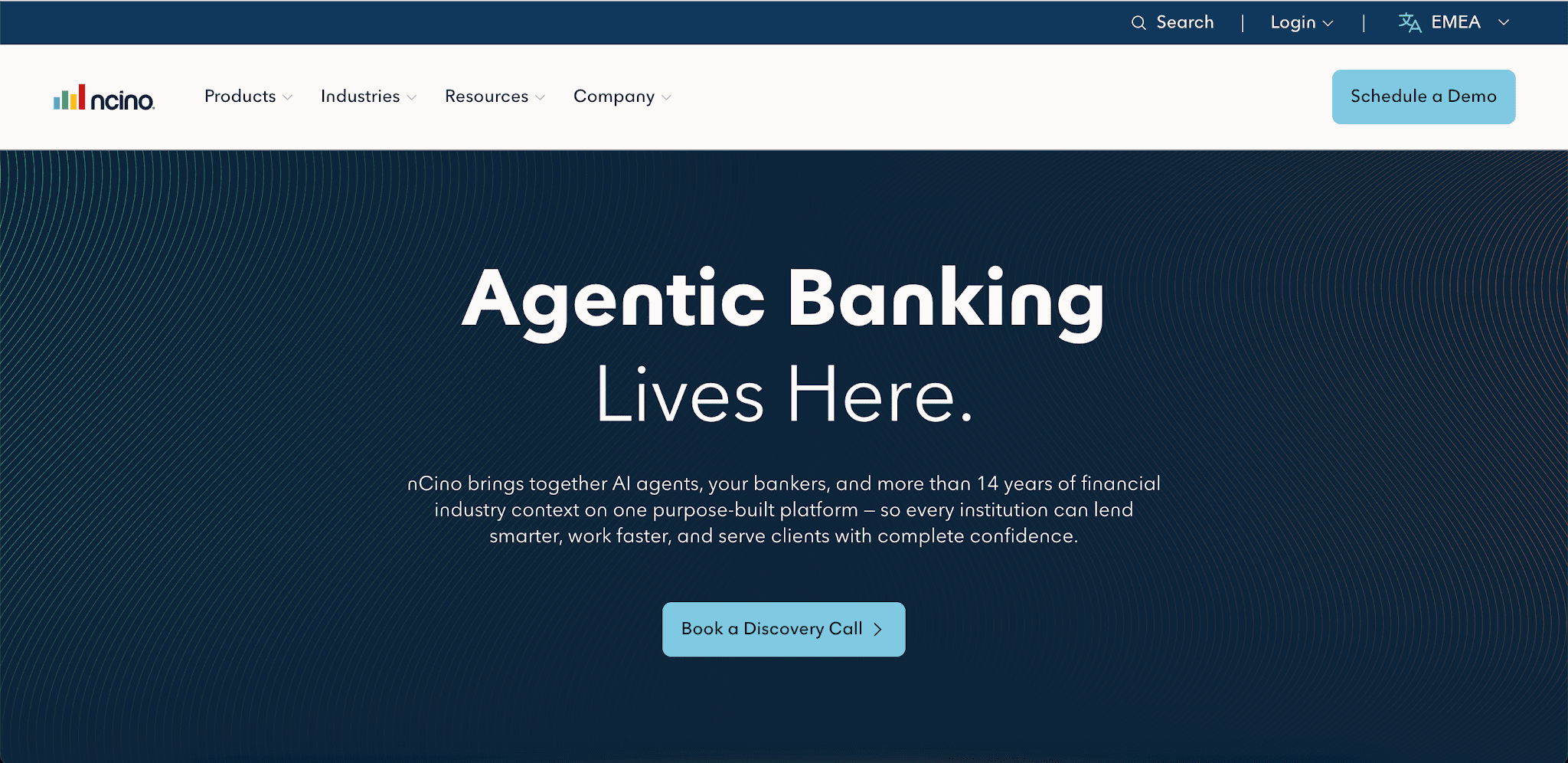
Image source: ncino.com
nCino provides commercial loan origination software for banks and other financial institutions managing business relationships. Its commercial lending capabilities include:
Commercial loan origination
Client lifecycle management
KYC, KYB, and AML workflows
Document Manager
nIQ financial spreading
Commercial Pricing and Profitability
Continuous Credit Monitoring
Intake and Document Handling
Preconfigured onboarding workflows collect client information and handle KYC, KYB, AML, identity, ownership, and fraud checks. Client Lifecycle Management also connects with external sources such as credit bureaus and compliance databases.
Document Manager organizes files with standardized naming, indexing, permission-based access, and activity tracking. Users can also reuse existing files instead of requesting the same material again.
nIQ uses optical character recognition (OCR), artificial intelligence, and machine learning to extract information from financial records. It handles tax returns, audits, internally prepared statements, 10-Ks, 10-Qs, and other files used for spreading.
Underwriting and Decisioning
nCino Spreads provides ratios, trend analysis, and configurable templates for credit analysis. Analysts use these tools to assess financial performance before reaching a credit decision.
Policy rules route an application to automated approval, decline, or manual review. This gives institutions a way to apply internal credit policies while retaining human review where required.
Commercial Pricing and Profitability provides loan and relationship profitability information during pricing and negotiation. Its Quick Price tool can generate an indicative price without opening a loan record.
Portfolio Management and Commercial Loan Coverage
Covenant notifications alert users when due dates approach and retain records for regulatory compliance. Continuous Credit Monitoring adds early warning indicators for deteriorating credit.
Deal Management brings loan and treasury relationships into one view. It also handles credit and non-credit deals, sub-loans, shared information, and bulk record edits.
Real-time reporting gives bankers additional information for portfolio oversight after origination.
2. Nortridge

Image source: nortridge.com
Nortridge covers the entire loan lifecycle from origination through payoff, with extensive post-funding functionality. Institutions can also keep an existing loan origination system (LOS) and connect Nortridge for post-origination management.
Its main commercial lending features include:
Configurable underwriting workflows
Commercial loan servicing
Participations and syndications
Collateral tracking
Integrated collections
150+ standard reports
Intake and Document Handling
Nortridge can receive applications from lender websites, DealerTrack, RouteOne, and other sources. Existing borrower information can prefill applications, which cuts duplicate entry during intake.
The platform can generate agreements, disclosures, risk-based pricing notices, and adverse action notices from existing templates. DocuSign handles electronic signatures, while a structured filing system keeps agreements and collateral records organized.
Nortridge records borrower communication preferences during origination and keeps them available for servicing.
Underwriting and Decisioning
Configurable workflows route applications through rules-based assignments before funding. The underwriting workspace handles re-hashes, counteroffers, and deal-structure changes without opening a separate application record.
Credit bureau integrations bring borrower credit information into the evaluation process. Underwriters can request more details or revise terms before the application reaches a final decision.
Portfolio Management and Commercial Loan Coverage
Nortridge handles participations, syndications, variable interest rates, escrow accounts, commercial fees, and custom payment schedules. Configurable payment rules determine how incoming funds are applied to more complex structures.
After funding, loan servicing tools track balances, collateral, transaction histories, delinquencies, and collections. Automation can process payments, assess fees, schedule Automated Clearing House (ACH) activity, and send notices with less manual work.
If Nortridge connects with another LOS, funded account information transfers into servicing without rebuilding the record manually. This helps maintain data accuracy during the handoff.
More than 150 standard reports, dashboards, scheduled report delivery, and custom exports provide portfolio information for internal analysis. Delinquency and collection reports give risk management teams a view of changing account performance.
Nortridge covers commercial and real estate financing alongside revolving and installment loan products. Institutions can manage different payment terms, rates, and servicing rules within the same system.
3. Finastra
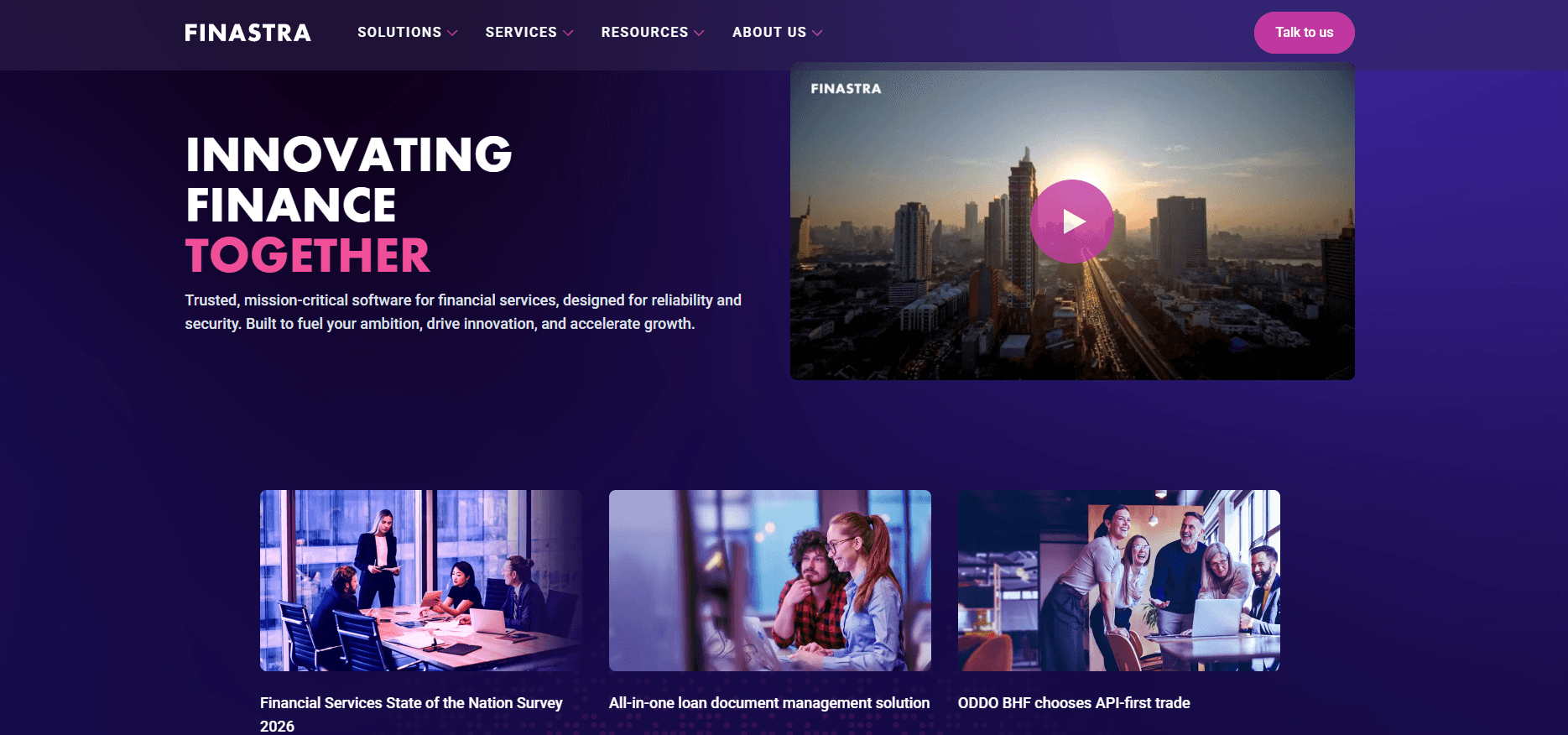
Image source: finastra.com
Finastra delivers commercial lending through several connected products rather than one standalone application. Its tools cover multiple stages for banks and credit unions, with Loan IQ extending its offering into corporate lending.
Finastra’s lending tools include:
Digital loan and deposit applications
Commercial loan origination
Application-to-analysis workflows
Loan documentation
Digital and wet closing
Built-in regulatory content
Core banking integrations
Intake and Document Handling
Finastra Originate gives customers a digital way to apply for loans and deposits. Finastra carries application information into the connected LaserPro workflow.
LaserPro handles documentation later in the process and can generate customized closing documents. Finastra also incorporates regulatory content and updates it as requirements change.
This connection keeps application information available as the file progresses toward analysis and documentation.
Underwriting and Decisioning
Finastra describes its commercial workflow as a sequence from application to analysis, documentation, and closing. LaserPro Analyzer forms part of that process alongside Conductor and Exchange.
The sequence carries information gathered during origination into the analysis stage before documentation begins. Credit teams don't have to treat each step as a separate workflow.
LaserPro also offers self-service setup, maintenance, and automation. Institutions can configure those elements around internal requirements and existing core connections.
Portfolio Management and Commercial Loan Coverage
Finastra covers commercial and industrial, commercial real estate, agricultural, titled-collateral, SBA loans, and specialty financing. Loan IQ adds corporate lending capabilities within Finastra’s commercial lending portfolio.
Renewals, modifications, and post-close activity extend its tools beyond the initial application. Together, these capabilities span the lending lifecycle rather than stopping at closing.
Finastra also connects with more than 70 core systems and platforms, including nCino, allowing banks to retain existing banking technology while connecting lending products with other systems.
4. timveroOS
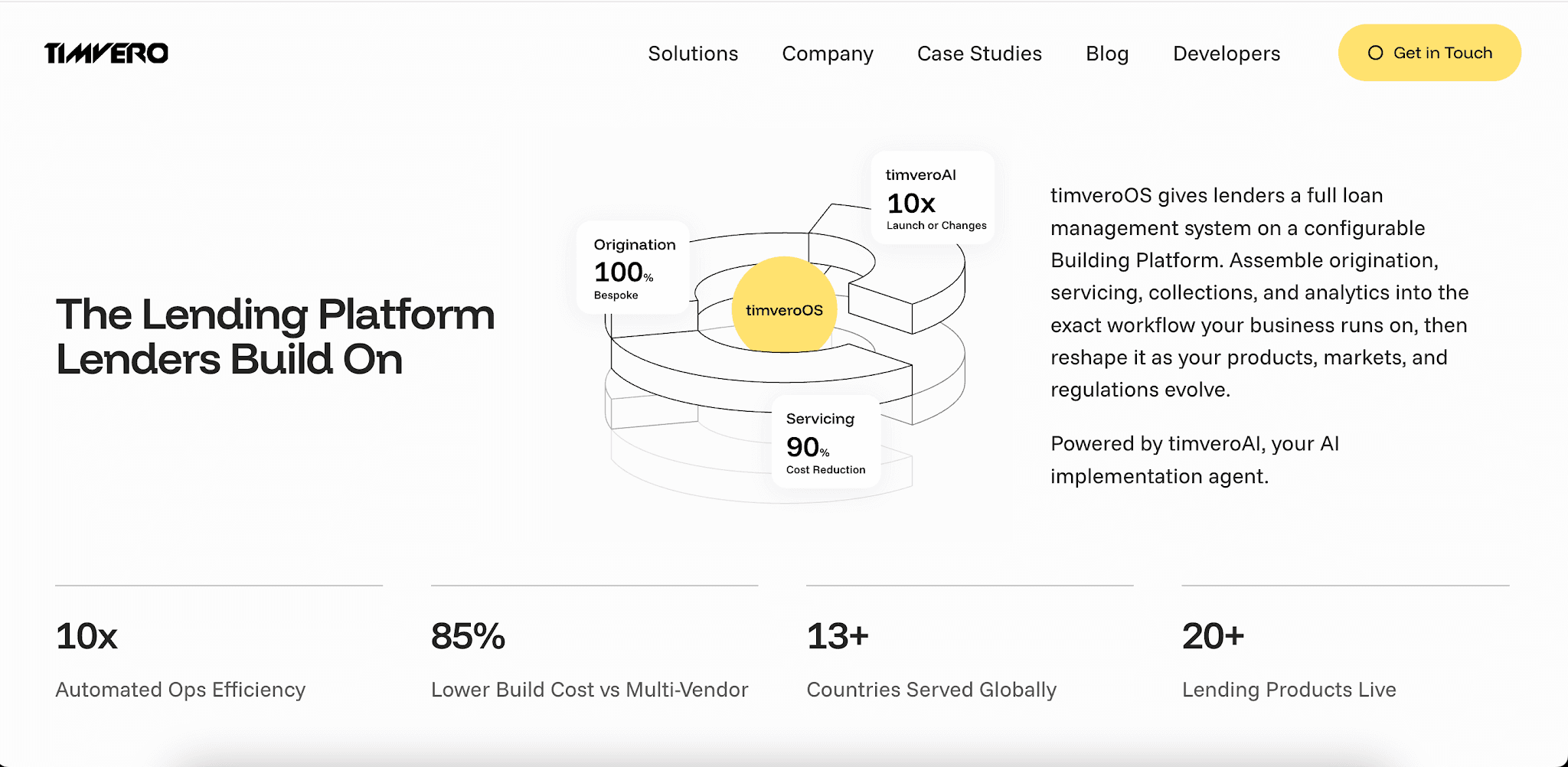
Image source: timvero.com
timveroOS uses a modular Building Platform for banks and specialty finance providers handling complex lending operations. Its architecture combines origination, servicing, collections, and analytics with code-level customization.
timveroAI handles implementation work by generating and testing customizations from business requirements.
The platform brings together:
Modular origination and servicing
Open SDK and APIs
Policies-as-code
Entity-centric data model
Explainable credit models
Cloud, on-premises, or hybrid deployment
Code-level customization
Intake and Document Handling
timveroOS treats borrowing entities, guarantors, beneficial owners, and collateral as separate participants within one financing relationship. This structure gives each party its own attributes and links while preserving how they relate within the deal.
KYC and anti-money laundering (AML) connectors bring verification results into onboarding. The system also covers ultimate beneficial owner verification, sanctions screening, and scheduled rechecks within the same workflow management process.
timveroOS consolidates documents, images, appraisals, and valuations into a single dossier. That record feeds information used later for exposure and pricing rather than leaving collateral files in separate locations.
Underwriting and Decisioning
Credit policies run as versioned code connected with bureaus, enterprise resource planning systems, and financial sources. Ratios, covenants, probability of default, loss given default, and custom scorecards form part of the financial analysis process.
Named overrides and approval rationales record the reasoning behind each decision. Credit committees and examiners can trace the logic instead of receiving only the final outcome.
The what-if engine lets risk teams simulate policy or model changes before applying them. This can reduce manual processes used to test scoring and product changes.
Portfolio Management and Commercial Loan Coverage
After approval, contract terms can pass into servicing and general ledger posting. Covenant alerts, collateral revaluation triggers, and net orderly liquidation value (NOLV) monitoring track changes after funding.
The same environment also covers collections and advanced analytics. Its open SDK and documented APIs connect with existing financial ecosystems, including cores, bureaus, KYC providers, and accounting systems.
Product coverage includes asset-based lending, factoring, private credit, construction, leasing, merchant cash advances, commercial mortgages, and bespoke term loans.
timveroAI also acts as one of the platform’s AI agents for implementation, using the Building Platform’s source and requirements to generate and test customizations.
5. HES LoanBox
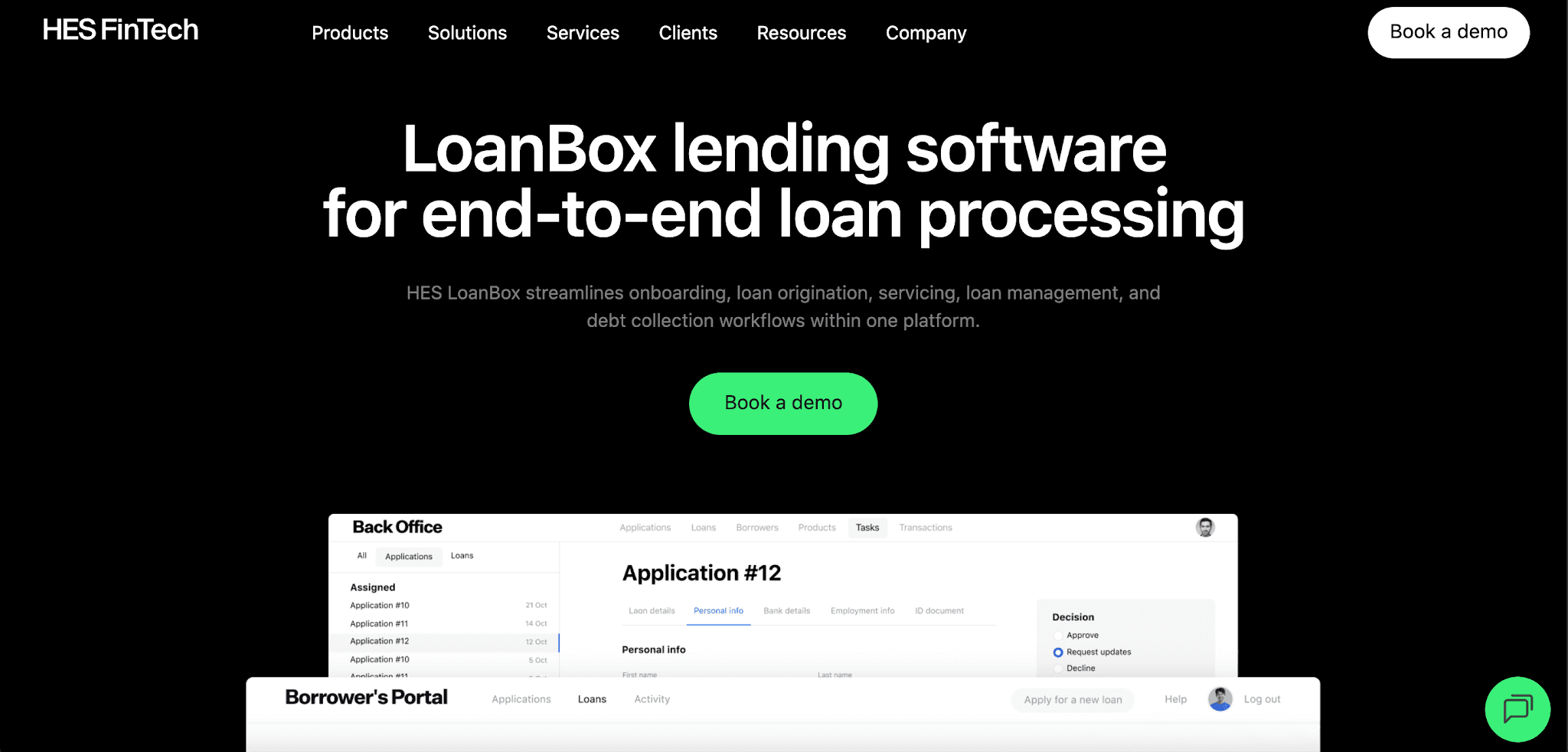
Image source: hesfintech.com
HES LoanBox covers origination, underwriting, servicing, loan management, and collections within one system. More complex commercial financing can use tailored implementations based on HES Core.
At a glance, HES LoanBox includes:
Configurable loan origination
Borrower portal
Manual, hybrid, and automated underwriting
GiniMachine AI scoring
Loan servicing
Collections automation
Open APIs and multiple deployment options
Intake and Document Handling
Custom application forms let lenders set required fields and document collection rules for each product. Borrowers can upload files and follow approval stages through the portal.
KYC and biometric authentication verify identity during the loan origination process. Open banking can also provide account information before the file reaches underwriting.
Contract templates populate borrower information, while e-signatures keep agreements digital. Audit logs and document tracking preserve activity records for compliance tools and internal reviews.
Underwriting and Decisioning
HES LoanBox supports manual, hybrid, and fully automated underwriting. Business rules, scorecards, stop factors, and credit bureau information help determine how each application proceeds.
Open banking adds transaction information for risk analysis and decision-making. GiniMachine adds AI-based scoring to the evaluation process.
Lenders can set different approval paths for borrower segments and credit products. Credit verifiers can request more information or preapprove a case before an underwriter reviews it.
Portfolio Management and Commercial Loan Coverage
After funding, HES LoanBox calculates payment schedules and accruals while recording disbursements, write-offs, and transaction history. These records give servicing teams the information required to manage active accounts.
When repayment terms change, lenders can extend maturity dates, adjust rates, or introduce payment holidays. Collections automation handles reminders, penalties, and follow-up activity to reduce manual effort during delinquency.
Dashboards and reports track repayment activity, collection results, and portfolio risk. HES LoanBox covers small and medium-sized enterprise (SME) lending, while HES Core handles more complex commercial financing.
Those HES Core implementations can cover bank loans, factoring, trade finance, working capital, and P2P lending.
How AI Reduces Manual Work Around Commercial Lending Software
Even an end-to-end commercial lending platform can leave preparation work outside its core workflows. Teams may still sort incoming files and pull borrower details before analysts can use them.
These manual tasks often happen around the LOS rather than inside its system-of-record functions. Missing information or unresolved conditions can also trigger repeated follow-ups that delay the loan process.
Specialized AI can handle preparation work around digital loan origination without taking over the LOS. It can read incoming files, extract relevant information, and flag missing items before underwriting.
With seamless integration, AI can pass extracted details and file updates back to the lender’s existing systems. It can also help review outstanding conditions and prompt borrowers for missing information.
The LOS remains the system of record for origination, credit decisions, and account information. This adds automation around existing software solutions without requiring lenders to replace their core system.
Automate Loan File Preparation Around Your LOS With Addy
Addy is designed specifically for mortgage workflows, so it is not another commercial LOS in this comparison. It works alongside a lender’s existing system of record as an AI acceleration layer for digital lending workflows.
Its mortgage-focused AI agents handle document-heavy work before formal underwriting, including:
Extract information from unstructured financial documents
Classify incoming files
Review borrower records
Identify missing information
Generate loan summaries
Build pre-underwriting checklists
Review outstanding loan conditions
Request missing documents through email, text, or phone
Sync information with LOS and CRM platforms
Addy can pull files from the LOS or a borrower’s email. Loan processors don’t have to scan inboxes and upload every attachment manually before working on the file.
When Addy finds missing information, it can send a targeted request by email, text, or phone. Earlier requests help lenders meet borrower expectations and improve the borrower experience during file preparation.
Addy also connects with LOS and CRM platforms, keeping extracted information linked to the lender’s existing workflow. The core system remains responsible for official application records and credit decisions.
Shorten Pre-Underwriting Preparation
Addy’s Processing Checklist compares file information with lending guidelines, automated underwriting system (AUS) findings, and product-specific conditions. It identifies unresolved requirements and returns results in under five minutes.
This helps streamline processes before formal credit analysis because processors know what requires attention before handing the file to an underwriter. They spend less time searching through records to find gaps late in the process.
For mortgage workflows, Addy also offers a ChatGPT app for pre-underwriting. It can analyze borrower files, identify missing items, and prepare findings in about five minutes.
FAQs About Commercial Lending Software
What features should commercial lending software include?
Commercial lending software should cover origination, document handling, underwriting, loan decisioning, servicing, reporting, and integrations. A unified platform connects these workflows and gives lenders one place to manage different business requirements.
What is the difference between commercial loan origination software and loan management software?
Origination software manages applications, credit review, approvals, and closing. Loan management software handles funded accounts, payments, servicing, collections, and portfolio activity.
Some lending solutions combine both functions in one system.
Can commercial lending software handle complex business loans?
Yes, depending on the platform. Many systems handle participations, syndications, revolving credit, commercial real estate, and asset-based lending.
Lenders can compare each platform with their lending practices, business needs, and the financial solutions they offer.
Does commercial lending software integrate with bank CRM systems?
Yes. Commercial lending software often connects with CRM platforms to share borrower, relationship, and application information.
These integrations help community banks and larger institutions avoid repeated data entry and improve the customer experience.
Start closing more loans – Book your demo today
Stay ahead of the competition and discover how AI can accelerate your loan origination process, reduce manual work, and help you close more deals in less time. Book a demo today and start experiencing the future of lending.