
Michael Vandi
If you’ve worked in lending, you know how frustrating manual underwriting can be. It’s slow, repetitive, and prone to human error.
Automated loan underwriting fixes that. It uses data and software to make faster, more consistent decisions, helping lenders reduce delays and borrowers get answers quickly.
Instead of relying on manual reviews and scattered paperwork, loan officers can reduce operational costs and spend less time on routine tasks.
In this guide, we’ll break down how automated underwriting works, why it matters, and what to look for in automated underwriting software.
TL;DR
Automated loan underwriting uses software to evaluate borrower information against lender criteria and support approval decisions.
Common inputs include income, credit, employment, debt, and financial documents submitted with the application.
Complex files, missing information, unusual income, or fraud concerns can still require human input.
Effective underwriting software combines reliable data access, configurable rules, system integrations, and detailed records.
Addy combines document extraction, guideline comparison, AI agents, and ChatGPT-based pre-underwriting for mortgage teams.
What Is Automated Loan Underwriting?
Automated loan underwriting is a digital process that helps lenders decide whether to approve a loan. Instead of relying on manual methods, the system pulls borrower data, applies predefined rules, and delivers a loan decision in seconds.
It’s designed to handle what human underwriters typically do. That includes reviewing income, credit history, bank statements, and other relevant data points to assess risk.
The biggest difference between automated and manual underwriting is consistency. Decisions made by individual reviewers can vary or miss key details. An automated underwriting system (AUS) applies the same logic every time, helping maintain accuracy throughout the process.
It also supports better record-keeping, which helps with audits, reporting, and regulatory compliance. Whether you’re working with consumer loans or small business loan applications, it cuts paperwork, so your team has more time for high-value work.
Curious how automated underwriting can improve your loan underwriting process? Book a demo with Addy to learn more!
How Automated Loan Underwriting Works: A Step-by-Step Guide
An AUS replaces manual checks with a digital process. Here’s what that looks like in action:
The borrower submits their application - The system collects the applicant's credit score, employment history, income details, and other financial data.
The system gathers and verifies key information - It pulls credit reports, bank statements, and other required documentation from connected sources. This step helps confirm the borrower’s identity and the applicant's financial history.
Risk is evaluated using predefined rules - The system evaluates the debt-to-income (DTI) ratio, credit history, and other risk factors. It compares these inputs against your underwriting criteria to generate a risk score.
A decision is made - Based on the results, the system recommends an approval, denial, or flag for manual review. This helps lenders determine which loan approvals can proceed and which applications need closer review.
The decision and data are recorded - The system creates a decision trail for compliance and future audits, helping lenders document outcomes and meet regulatory requirements.
This approach reduces manual effort and speeds up the loan origination process. It also supports better risk management by applying consistent logic to every application.
Benefits of Automated Loan Underwriting for Lenders
Manual underwriting takes time, and time costs money. Between data collection, data entry, checking numbers, and making judgment calls, your team can get stuck in a cycle that slows down the entire loan process.
Automated underwriting changes that. It gives lenders a faster, more reliable way to make decisions without losing control over risk. The result is fewer delays, more consistency, and better use of internal resources.
Here’s what that looks like in practice:
Faster approvals - Decisions happen in minutes, not days. That means less waiting, more closed loans, and better customer satisfaction.
Fewer mistakes - Automated systems can flag missing or conflicting information before a file moves forward.
Lower operational costs - With manual tasks off their plate, loan officers can focus on complex deals that truly need their attention. Lower processing costs can help lenders protect margins and improve business performance as loan volume grows.
Better compliance and recordkeeping - Every action is logged automatically, creating a clear audit trail when you need it.
Easier to scale - If application volume increases, automation helps lending operations keep up without adding staff or compromising review quality.
For lenders looking to improve the loan origination process, automated underwriting can reduce routine work while fitting into existing systems.
How Automated Loan Underwriting Improves the Borrower Experience
Automated loan underwriting doesn’t just help lenders. It improves the experience for borrowers, too. When decisions are faster and more consistent, applicants feel more informed and less stuck in the waiting process.
Here’s how automation can improve the process for mortgage loans:
Quicker responses - Applicants can receive an initial response sooner, so they know whether more information or documents are needed.
More objective evaluations - Automation uses established underwriting criteria and documented borrower data, reducing reliance on individual human judgment.
Fewer repeat document requests - Data extraction can capture information from submitted financial documents, including bank statements and employment records. This can reduce requests for information the borrower has already provided.
Clearer communication - Once a decision or status update is available, borrowers can receive it promptly. They have a better idea of where their application stands and what they need to provide next.
Overall, automated underwriting can create an enhanced customer experience with clearer requirements, fewer repeated document requests, and better visibility into what happens next.
Key Features of Automated Loan Underwriting Software
High-quality automated underwriting software should fit into your existing workflow without extra overhead. The right platform makes it easier to process loan applications, assess risk, and handle higher loan volume.
Start with integrations. Your system needs connections to your loan origination platform, customer relationship management (CRM) systems, credit bureaus, bank accounts, and payroll sources through flexible application programming interfaces (APIs).
This brings borrower information into underwriting without repeated data entry.
Custom rules matter too. Lending teams need control over underwriting criteria like credit score, DTI ratio, and income verification. Modern automated underwriting platforms use configurable rules engines that let teams adjust these settings without technical help.
Some platforms also use machine learning algorithms to compare application data with historical data and identify patterns that may need closer review.
Speed depends on reliable access to borrower data. Pulling credit reports, bank statements, and employment history directly into the system can shorten the time needed for risk evaluation.
You’ll also want reliable recordkeeping. Every action and score should be logged for audits or internal reviews. Detailed records can help with regulatory adherence and make underwriting decisions easier to review.
Finally, make sure the interface is easy to use. Loan officers should be able to review applications, see risk scores, and handle exceptions without navigating a complicated interface.
For lenders handling personal loans, small business financing, or mortgage pre-approvals, these features help improve accuracy and reduce delays as loan volume grows.
When Does Automated Underwriting Need Human Review?
Automation can support many parts of the underwriting process, but not every scenario fits predefined criteria. Some files still need a human underwriter.
Applications that involve complex financials, missing documents, or inconsistent borrower information often need manual review. For example, a self-employed applicant or someone with unusual income may need a human assessment before a decision is made.
Fraud detection is another area where human attention may be necessary. If the system flags conflicting information between bank statements or credit reports, a person can assess the discrepancy before the file moves forward.
People also add context for edge cases that don’t fit predefined rules, such as borrowers with strong assets but limited credit history. Applications that rely on alternative data sources may also need closer assessment if the system isn’t configured to evaluate them.
A practical approach uses automation to process application details, run risk assessments, and complete routine underwriting tasks. Human underwriters can then focus on exceptions.
In mortgage lending, that balance keeps straightforward files automated while exceptions stay with human underwriters.
How Addy Makes Automated Underwriting Even Easier
Mortgage underwriting involves document analysis, data verification, and borrower follow-up. Manual processing can add hours before a file is ready for underwriting.
Addy uses artificial intelligence to automate much of that work and connects with systems lenders already use. Its Document AI extracts borrower information from W-2s, pay stubs, bank statements, and other documents, then syncs it with your CRM or loan origination system (LOS).
It then runs real-time checks across credit history, financial statements, and income data, flagging anything that needs attention. No more switching between tools or chasing down missing documents.
The result is less time spent on document review, data verification, and borrower follow-ups without replacing your existing tech stack.
Faster Underwriting With AI Automation
These capabilities can reduce the time and labor required to prepare files for underwriting.
Close loans 90% faster - Addy's platform uses AI agents to automate mortgage underwriting tasks, shortening the loan process dramatically. Tasks that once took days now take minutes, freeing your team to handle more loans without extra staff.
Reduce labor costs significantly - Addy can handle document reviews, data verification, missing-document identification, and borrower follow-ups. That gives loan officers more time to focus on files that require their attention.
24/7 automated compliance - Trained on over 20,000 mortgage guidelines, Addy’s proprietary AI continuously guarantees compliance with federal, state, and lender standards. This automated compliance layer catches potential risks and reduces human errors.
Customers using Addy see tangible results. For example, Sphinx Capital’s CEO reports:
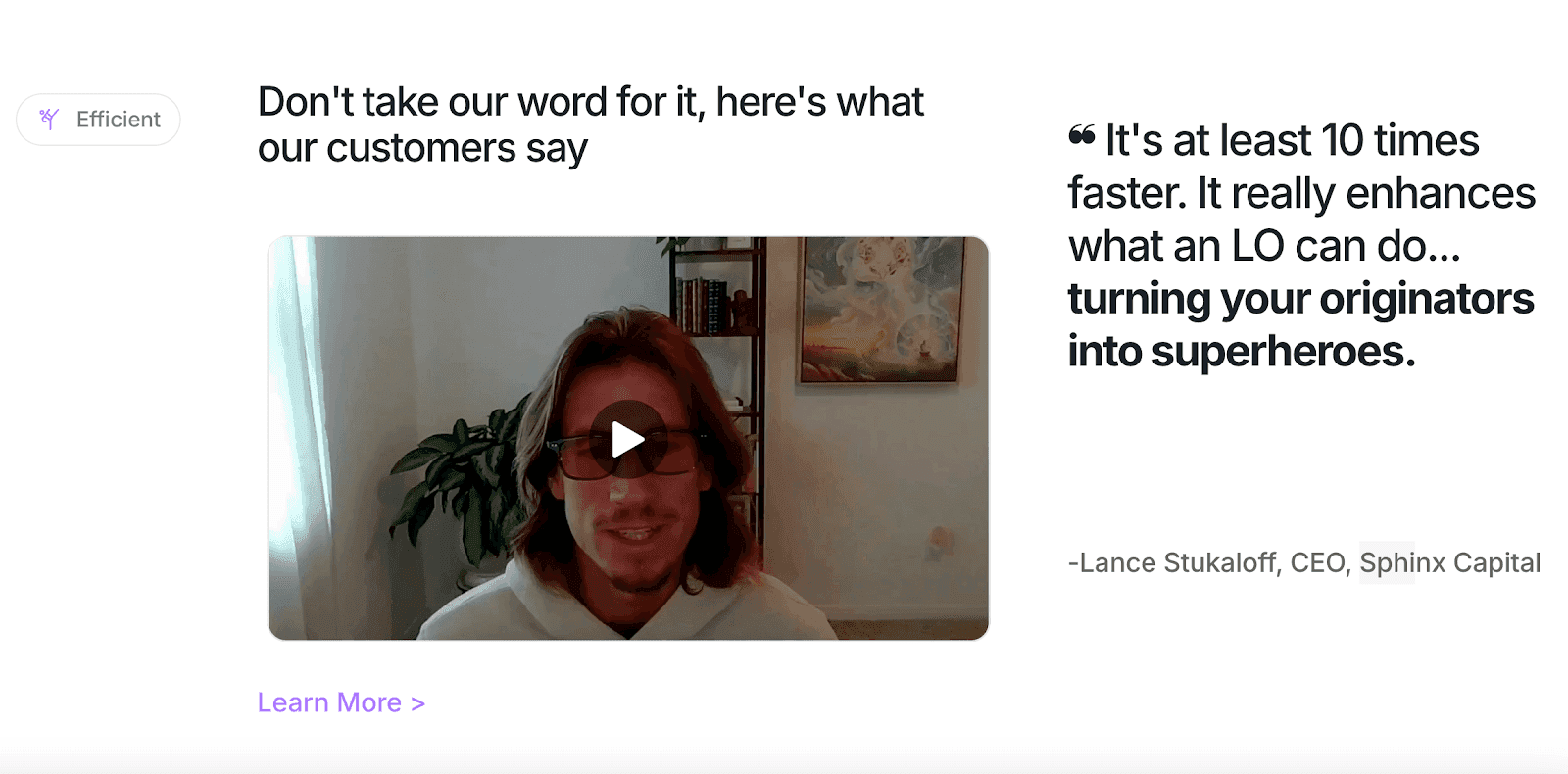
“It’s at least 10 times faster. It really enhances what a loan officer can do… turning your originators into superheroes.”
— Lance Stukaloff, CEO, Sphinx Capital
Addy integrates effortlessly into your existing lending systems, so there’s no complex setup. Just plug it into your CRM, LOS, or other existing tools, and you’re ready to automate.
Make Loan Underwriting Easier With Addy!
Manual underwriting is expensive and time-consuming, and it can hold up the loan process. Automation gives lenders faster decisions, fewer repetitive tasks, and a better experience for borrowers.
If you're dealing with high volumes, slow approval times, or too much back-and-forth on documents, it's time to rethink your lending process. Automated loan underwriting can reduce document review time, shorten approval timelines, and give loan officers more time for complex files.
If you're dealing with high volumes, slow approval times, or too much back-and-forth on documents, it's time to rethink your process. Automated loan underwriting helps you move faster, cut costs, and make smarter decisions at scale.
Addy makes that easier with AI agents that handle document checks, follow-ups, and underwriting analysis. Potential borrowers can use its ChatGPT app for mortgage pre-underwriting to explore loan scenarios and qualification questions before completing an application.
The app can also review borrower documents, identify missing conditions, and generate structured findings in about five minutes, bringing Addy’s automation earlier into the lending lifecycle.
FAQs About Automated Loan Underwriting
What is automated mortgage underwriting?
Automated mortgage underwriting uses software to evaluate whether a borrower meets lending requirements. It reviews income, credit history, financial statements, and the borrower’s ability to repay before returning an underwriting result or recommendation.
How long does automated underwriting take?
Timing varies based on system setup, file complexity, and available information. Some automated underwriting systems can return an initial result within minutes, while exceptions may take longer.
Machine learning models and predefined rules can support faster analysis, but timing still depends on the application.
How does auto loan underwriting work?
Auto loan underwriting starts with basic loan application information, such as income, employment, credit score, and requested loan amount. An automated system evaluates that information against the lender’s criteria and flags applications that need further review.
How accurate is automated underwriting?
Accuracy depends on data quality, underwriting rules, system configuration, and machine learning capabilities where applicable. Automated systems can apply lending criteria consistently, but unusual or incomplete applications may still need human review.
Who benefits from automated underwriting systems?
Lenders, borrowers, and financial institutions can benefit from underwriting automation. Within the financial industry, these systems can shorten review times, reduce routine processing, and give lending teams more time to focus on complex applications.
Start closing more loans – Book your demo today
Stay ahead of the competition and discover how AI can accelerate your loan origination process, reduce manual work, and help you close more deals in less time. Book a demo today and start experiencing the future of lending.