Michael Vandi
So, what is the best AI software to extract structured data from loan documents? The answer depends on the document types you handle and how much you want to automate.
Some products focus on mortgage operations and day-to-day lending tasks. Others give technical teams artificial intelligence tools for building custom extraction systems.
This guide compares seven leading options and explains where each one stands out.
TL;DR
These seven AI data extraction tools stand out for different loan document extraction needs.
Addy for mortgage extraction and pre-underwriting preparation
Ocrolus for income, asset, and financial document analysis
Docsumo Lending for intake, extraction, validation, and missing-item checks
Infrrd for mortgage quality control, disclosure comparisons, and audits
Google Lending DocAI for custom mortgage extraction in Google Cloud
Azure Document Intelligence for custom field extraction in Microsoft environments
Amazon Textract for API-based lending workflows in AWS
What Is Structured Data Extraction From Loan Documents?
Structured data extraction finds specific values in borrower records and places them into labeled fields. It turns unstructured data into usable data that lending software can read and organize.
With automated data extraction, lenders don’t have to copy information from PDFs, forms, and scanned images. That cuts down on manual data entry before the information reaches the next stage.
How Does AI Extract Structured Data From Loan Documents?
AI document processing reads a record, identifies the information inside it, and returns the values in a usable format. The extraction process usually follows five steps.
Identify the file. The system recognizes a bank statement, pay stub, tax return, or another record.
Read the page. Optical character recognition (OCR) captures text, while computer vision interprets tables, fields, and page layouts.
Interpret the content. Machine learning and natural language processing (NLP) connect labels with the values they describe.
Organize the fields. The software places each value in the correct category and flags unclear results for human confirmation.
Send the results. The extracted data can pass into a loan origination system (LOS) or other downstream systems.
Basic OCR recognizes the characters printed on a page. AI goes further by identifying what those characters mean within the record.
It can distinguish an account balance from a monthly deposit even when both appear as dollar amounts. That context helps produce accurate data extraction when layouts vary.
What Data Can AI Extract From Mortgage and Loan Documents?
A 1003 application contains:
The borrower’s identity
Employment
Assets
Liabilities
Property details
Requested terms
Extraction makes those details available for comparison with other records.
Pay stubs, W-2s, and tax returns provide earnings and employment information. Pulling this financial data into separate fields helps loan processors compare reported income with other records.
Bank statements show account ownership, balances, and how funds flow through an account. Structured transaction details can reveal reserves, recurring activity, and deposits that warrant closer attention.
Credit reports provide scores, tradelines, balances, and monthly obligations used during liability assessment. Appraisals add property values and other property information.
Loan Estimates and Closing Disclosures provide terms, fees, and final closing figures. Together, these records give lenders data points they can compare during underwriting.
Key Features to Look for in AI Loan Document Extraction Software
When comparing data extraction software, consider the records your business handles and what happens after extraction. The right extraction software does more than capture fields correctly.
These criteria can help you compare data extraction tools against your lending process.
Document Coverage and Classification
First, confirm that the product handles the records your operation receives regularly. That may include applications, income records, bank statements, tax documents, credit reports, disclosures, appraisals, and legal agreements.
Then test mixed uploads. Borrowers may send several attachments with vague filenames, so the system has to recognize each record type correctly.
Check which formats the product handles without complicated setup. Uncommon or lender-specific records may require additional configuration or training.
Extraction Accuracy and Document Complexity
Test the product with materials your team actually receives, not just polished samples. An extraction model may handle clean PDFs but struggle with complex documents, faint scans, tables, or handwriting.
Include several versions of the same record type. Document variability can reveal errors that won’t appear when every sample follows one layout.
Focus on the data points your operation relies on most. Accurate data for income, balances, dates, and account ownership often requires the closest attention.
Validation, Confidence Scoring, and Human Review
Confidence scores help identify values that deserve closer inspection. They can route uncertain fields into review workflows instead of passing them forward unchecked.
Validation rules can flag information that conflicts with expected formats, business rules, or other values in the record. A mortgage professional can investigate the discrepancy and correct it when necessary.
Technology assists with verification, but underwriters still make lending decisions.
File Completeness and Mortgage Workflow Capabilities
Document extraction tells your team what information appears in the material already received. Workflow capabilities help identify what’s still outstanding.
A product may flag an absent pay stub, missing statement period, or unresolved condition. Some products can assign the item or contact the borrower for additional evidence.
Connecting those steps can improve operational efficiency and replace manual processes such as repeated searches and follow-up messages.
LOS Integrations, APIs, and Data Outputs
Don’t take claims of seamless integration at face value. Check how a vendor maps document data into your LOS, customer relationship management (CRM) software, point-of-sale (POS) platform, or internal applications.
Lenders that retain or manage loans may also send extracted information into portfolio management systems. Those records can feed later portfolio management and servicing activities.
Native connections often require fewer technical steps. APIs and webhooks give developers more flexibility when systems use different field structures.
Custom field mappings, JSON output, and exports may also help. Confirm that updates reach the correct record without producing duplicates.
Security and Auditability
Borrower records contain Social Security numbers (SSNs), income details, account information, and other sensitive data. Examine encryption, permissions, storage practices, and access controls.
Useful audit logs show what the software processed, when activity occurred, and who accessed or changed information.
That history helps lenders investigate activity, address compliance risk, and meet regulatory compliance requirements.
7 Best AI Data Extraction Tools for Loan Documents in 2026
These seven products take different routes to AI data extraction. Some add mortgage-specific capabilities, while others provide technical components for custom systems.
1. Addy for Structured Mortgage Document Data Extraction
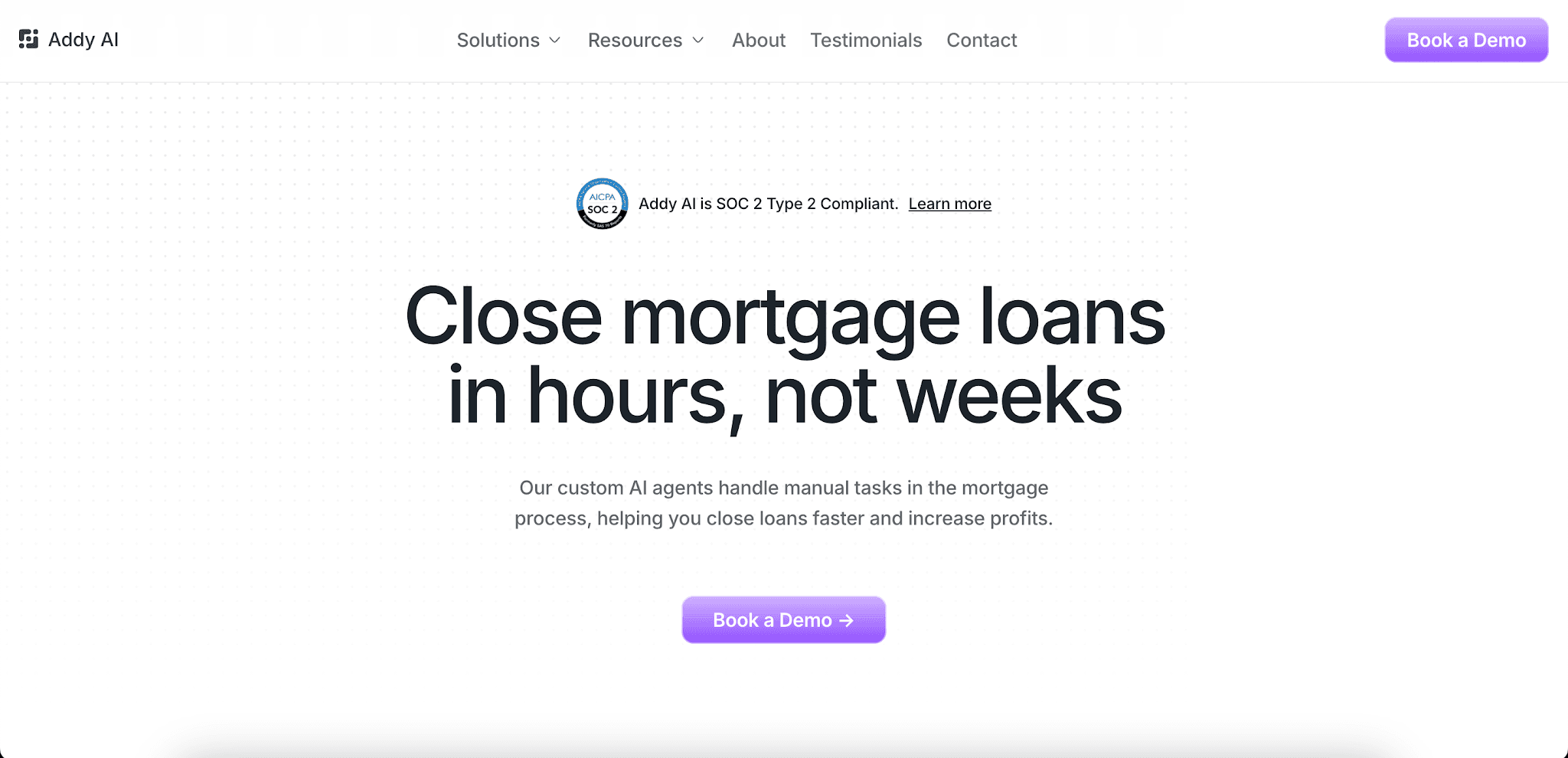
Addy is AI data extraction software for mortgage teams. Its Document AI handles 1003s, 1040s, 1099s, W-2s, W-9s, bank statements, pay stubs, and tax returns.
The system extracts borrower and loan information from unstructured documents and sends it into connected mortgage systems. This cuts down on manual extraction during pre-underwriting preparation.
Loan officers can also ask questions about uploaded records and generate summaries. They can locate relevant data points such as authorized signers, interest rates, or notable deposits.
Key Features
Automatic intake and classification: Addy can pull attachments from an LOS or borrower email and connect each record with the corresponding loan.
Processing Checklist: Addy compares available information with automated underwriting system (AUS) findings and lender guidelines to identify outstanding conditions.
Borrower follow-up: AI agents can request missing records through email, text, or phone when the application requires more information.
Mortgage integrations: Addy connects with LOS, CRM, POS, Gmail, Outlook, Slack, and Microsoft Teams. Its browser extension operates within existing mortgage systems.
Addy combines AI-powered data extraction with mortgage-specific pre-underwriting preparation rather than offering field capture alone.
Mortgage professionals still examine the results and make formal underwriting decisions.
2. Ocrolus for Financial Document Extraction and Income Analysis

Image source: ocrolus.com
Ocrolus processes complex financial documents for mortgage, consumer lending, and fintech companies. It turns bank statements, pay stubs, tax forms, and other records into standardized information for credit analysis.
The platform goes beyond field capture by calculating income and analyzing assets and cash flow. Credit teams get comparable figures without reading every page manually.
Ocrolus also combines machine learning models with human verification. Its Data Professionals can examine edge cases that automation can’t resolve.
Key Features
Broad record coverage: Ocrolus handles more than 2,000 record types spanning mortgage forms, disclosures, credit, taxes, assets, and legal materials.
Fraud detection: The system looks for tampering, invalid dates or amounts, unusual fonts, incomplete datasets, and suspicious patterns.
Conditions and discrepancy handling: Inspect compares borrower-provided information with Encompass 1003 fields and identifies inconsistencies.
Access and integration options: Teams can access Ocrolus through its web application, API, or ICE Encompass integration.
Ocrolus is useful for lenders spending substantial manual effort on income and asset analysis. Its automated extraction provides cleaner inputs while adding verification for difficult cases.
3. Docsumo Lending for Loan Document Intake and Extraction
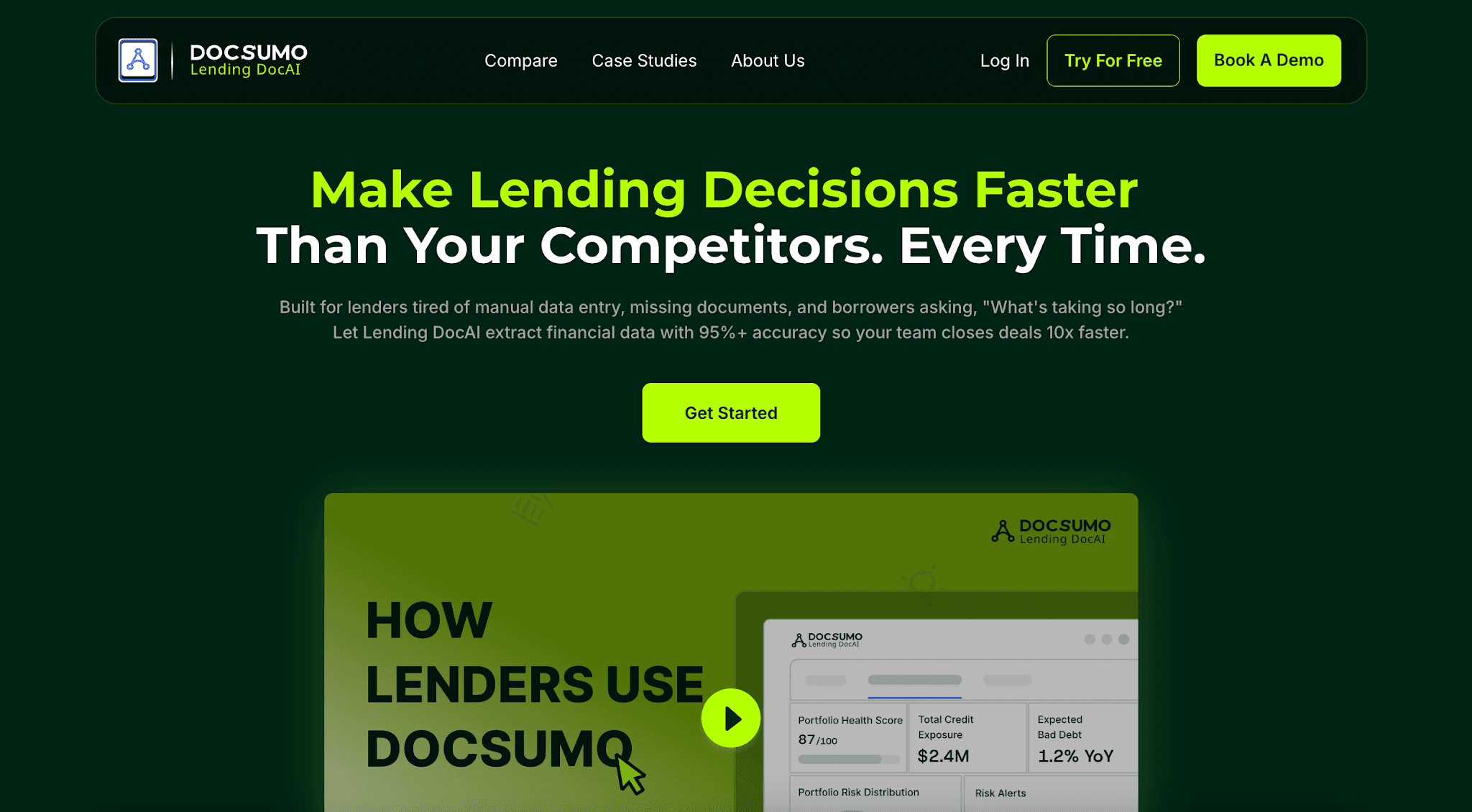
Image source: lending.docsumo.com
Docsumo Lending combines intake with AI extraction for credit workflows. Records can arrive through email, uploads, APIs, an LOS, or a CRM.
The system sorts incoming material by type and can rename it using lender naming conventions. It also identifies missing records before an incomplete submission reaches underwriting.
For lengthy records, the data extraction platform pulls transactions and key fields into spreadsheet-like tables. Credit teams can inspect figures without searching hundreds of pages manually.
Key Features
Validation and fraud detection: Docsumo looks for tampering, duplicate transactions, missing information, and other anomalies that warrant inspection.
Case management: Teams can follow application status, outstanding items, and audit history as a case progresses.
System connectivity: Processed information can sync with LOS, CRM, and ERP systems in the lender’s preferred format.
Docsumo is relevant to lenders receiving borrower materials through several channels before credit analysis. Its lending setup combines intake, organization, and extraction.
4. Infrrd for Mortgage Document Extraction and Quality Control

Image source: infrrd.ai
Infrrd uses AI-based extraction to pull mortgage information from 1003s, credit reports, and wire instructions. It also classifies incoming records by type.
For mixed loan documents, the platform organizes pages and adds bookmarks for navigation. Auditors don’t have to sort a disordered PDF before examining it.
Infrrd also reconciles borrower names when records contain aliases or different name formats. It identifies missing items and expired Closing Disclosures that may require attention.
Key Features
Disclosure comparisons: Infrrd compares Loan Estimates, Closing Disclosures, and title records side by side to identify tolerance differences.
Rule-based checks: Lenders can define checklist rules through partner integrations and test the relevant information against those requirements.
Audit trails: Reports connect identified issues with the underlying evidence, helping auditors trace each result to the relevant record.
Infrrd is useful for mortgage organizations handling high document volume and frequent pre-funding or post-close audits.
Automating repetitive comparisons can lower the chance of costly errors and human error.
5. Google Lending DocAI for Mortgage Extraction on Google Cloud
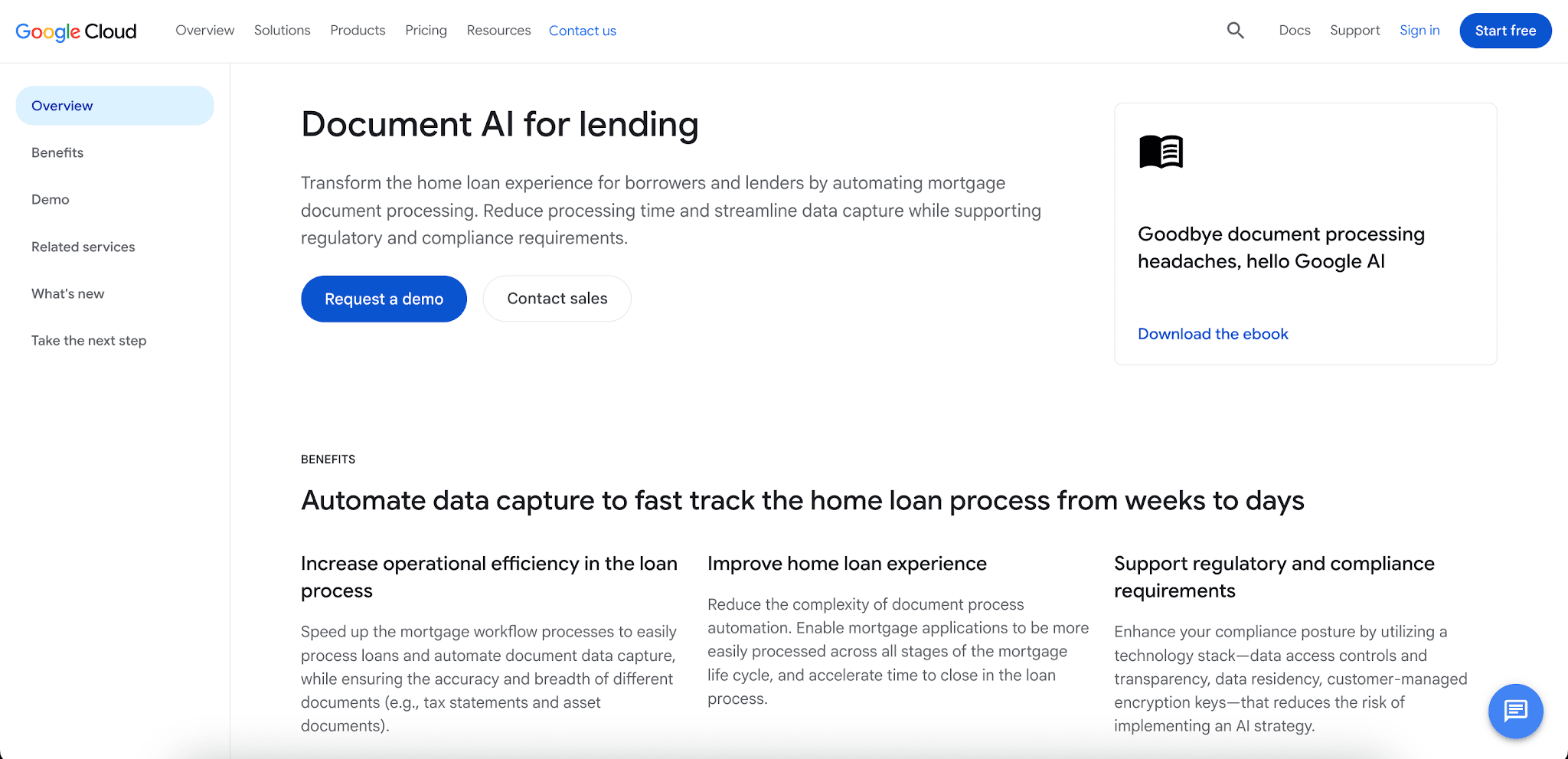
Image source: cloud.google.com
Google Lending DocAI uses pretrained models built for mortgage records. It processes income and asset materials and extracts fields such as names, wages, and Social Security numbers.
The technology combines OCR, computer vision, and natural language processing to interpret content and page layout. It can read scanned pages without relying on traditional OCR alone.
Key Features
Custom Extractor: Teams can configure which fields they want to capture from specific record types.
Custom Classifier: Organizations train classifiers with their own examples and categories. This custom model training helps sort incoming material before extraction.
Form Parser: The parser identifies key-value pairs and other fields within structured forms.
Google Cloud integration: Developers can connect Document AI with applications and other data sources through Google Cloud APIs.
Organizations can add human verification when they want someone to inspect uncertain predictions before using the results.
Lending DocAI provides mortgage extraction technology rather than a complete operations platform. It targets institutions with technical resources to build their own rules and exception handling.
6. Azure Document Intelligence for Custom Loan Data Extraction
Image source: azure.microsoft.com
Azure Document Intelligence extracts text, key-value pairs, tables, and page structure from PDFs, images, and forms. It also preserves layout information developers may use when interpreting lending records.
The service returns typed values such as dates, numbers, currency amounts, addresses, and strings. Developers don’t have to convert raw text separately before another system uses it.
Key Features
Prebuilt models: Microsoft offers ready-made models for common business records when an existing field schema matches the material.
Custom extraction: Developers can train models when traditional data extraction tools or fixed templates aren’t flexible enough.
Changing layouts: Custom models can handle semi-structured documents that contain familiar fields in different positions.
Custom classification: Teams can train classifiers that recognize incoming record types and route each one to the right extraction model.
REST API and Microsoft Foundry: Developers can call the service through REST APIs and connect results with applications in Microsoft’s ecosystem.
Azure Document Intelligence provides document-processing infrastructure rather than an out-of-the-box mortgage operations platform.
Technical organizations can use it to build custom extraction workflows within Microsoft’s cloud environment.
7. Amazon Textract for AWS-Based Loan Document Processing
Image source: aws.amazon.com
Amazon Textract reads printed text and handwriting from PDFs and images, including handwritten notes within scanned material. It also recognizes form fields and relationships between labels and values.
For lending documents, Analyze Lending classifies individual pages before applying the appropriate analysis. Developers can handle mixed mortgage records without separating every page beforehand.
Key Features
Queries and Custom Queries: Developers can request critical data such as applicant names or mortgage rates. Trained adapters can tailor the extraction process to business-specific records.
Confidence scores: Textract assigns confidence values to recognized text and extracted fields. Teams can flag uncertain results for closer inspection.
Signatures and layout: The service identifies signatures, tables, titles, lists, headers, sections, and other page elements.
API-based implementation: Teams can access Textract through AWS APIs and pass results into applications that handle later lending tasks.
Textract provides a technical foundation rather than a finished mortgage operations platform.
Financial organizations already using AWS can build validation, exception handling, and downstream workflows around it.
Why Mortgage Lenders May Need More Than Structured Data Extraction
The seven products fall into two broad groups. Addy, Ocrolus, Docsumo, and Infrrd combine extraction with lending-specific analysis or workflow capabilities.
Google Lending DocAI, Azure Document Intelligence, and Amazon Textract provide technical components for custom systems. Their users build the surrounding rules, interfaces, and connections themselves.
The better option depends on how much mortgage functionality you want out of the box. Teams with developers may prefer configurable cloud extraction tools.
Mortgage operations teams may favor software that connects extracted information with tasks required before underwriting.
Get Mortgage Files Ready for Underwriting With Addy
Addy connects information gathered during intake with the tasks that follow. Records can come from an LOS, borrower inbox, or another connected source.
After Addy links each record to the relevant loan, Document AI captures the information needed for processing. Those results can feed mortgage-specific checks, including details from financial statements when they appear in the file.
The Processing Checklist identifies open conditions and other requirements that need attention. Loan officers can examine the relevant records and decide what to address next.
If the borrower owes another item, Addy can request it by email, text, or phone. Addy can also pull attachments from the borrower's email and sync loan data through seamless integration with connected mortgage systems.
Addy’s ChatGPT app provides another route for pre-underwriting preparation. It can review borrower records, identify missing items, and produce findings for human review.
The AI helps prepare the file, while licensed underwriters remain responsible for formal lending decisions.
FAQs About What Is the Best AI Software to Extract Structured Data From Loan Documents
What is the best AI model for data extraction?
There isn’t one best model for every task. Lenders should consider accuracy, document coverage, and how well it understands mortgage financial language.
It should also handle transforming data from financial statements and other borrower records into fields lending systems can process.
What is the best AI model for extracting data from PDFs?
The best option depends on the PDFs you receive. Mortgage teams often handle forms, scanned records, and transactional documents such as bank statements.
For scanned PDFs, OCR converts printed content into machine-readable characters. Document AI then identifies the relevant fields and interprets their meaning.
Do loan document AI tools require custom model training?
Not always. Pretrained models can handle many common mortgage records, while custom training helps with lender-specific forms, fields, or unusual layouts.
Even well-trained models can’t eliminate errors completely. Lenders can route uncertain results to a person for verification.
Start closing more loans – Book your demo today
Stay ahead of the competition and discover how AI can accelerate your loan origination process, reduce manual work, and help you close more deals in less time. Book a demo today and start experiencing the future of lending.