Michael Vandi
A mortgage loan can appear on schedule even when an updated bank statement hasn't arrived. The request remains in an email thread, while the application record still shows everything as on track.
AI analytics for lenders connects these details to identify missing documents, delayed reviews, and recurring problems. Processors and underwriters can use the findings to determine which applications deserve attention first.
This article explains how AI for lenders helps mortgage teams address issues sooner while professionals retain responsibility for lending decisions.
TL;DR
AI analytics for lenders identifies processing delays, incomplete applications, and recurring issues that can hold up mortgage underwriting.
Disconnected LOS, POS, and CRM records can produce misleading results when submissions and condition statuses don't match.
Processors use these findings to prioritize urgent cases, request corrections, and address outstanding conditions before closing.
Compare turnaround times and repeat paperwork requests before and after adoption. Qualified professionals retain responsibility for lending decisions.
Addy identifies missing requirements, while its AI agents help coordinate borrower follow-ups.
What Is AI Analytics for Lenders?
AI analytics for lenders uses artificial intelligence to interpret mortgage records and identify processing patterns. It can analyze document contents and reviewer notes alongside application statuses to flag issues that need attention.
A pipeline report might show 30 files awaiting underwriting. Data analytics can reveal that applications from one origination channel have waited longer than similar cases. Mortgage operations leaders can investigate what's causing the difference.
Analytics highlights potential problems, while automation handles repetitive tasks, such as sending reminders for overdue documents. Loan officers still decide when personal follow-up is appropriate.
Mortgage analytics can cover the entire customer lifecycle, although this article concentrates on origination.
After funding, loan servicing involves monitoring whether installments follow the agreed payment frequency. Payment processing records can reveal posting errors, while debt collection histories show how overdue accounts were handled.
Regardless of the lending stage, analytical results depend on the accuracy of the source information.
How Disconnected Mortgage Records Delay Loan Processing
When borrowers submit loan applications through a point-of-sale (POS) platform, processors still have to determine whether each file is ready. A loan origination system (LOS) tracks outstanding conditions, while customer relationship management (CRM) software records document requests and responses.
Processors compare financial records with results from an automated underwriting system (AUS) to verify the lender's specific requirements. An income document might be available but won't satisfy a condition if it covers the wrong pay period.
Consider a borrower who uploads a corrected pay stub through the POS. The CRM confirms that the loan officer received it, but the LOS still lists the condition as pending. Another employee could request the same paperwork again or postpone underwriting preparation.
Without integration linking submissions to their corresponding conditions, AI systems could misinterpret the delay. An analytics report might attribute the holdup to a slow borrower response when the actual problem is an outdated status.
What AI-Powered Analytics Reveals About Originations
AI analytics helps lenders identify patterns in processing delays, incomplete applications, and pipeline performance. Comparing similar cases reveals recurring problems, enabling lenders to investigate where delays begin.
Pipeline Delays and Processing Backlogs
Tracking milestone timestamps helps distinguish active processing time from days spent waiting for assignment. An application submitted on Monday but assigned on Thursday has already spent three days in the queue.
Comparing those waiting periods with typical turnaround times can reveal backlogs at particular stages. Dashboards that refresh with status updates provide real-time visibility into applications still awaiting attention.
Recurring Document Gaps and Unresolved Conditions
AI document analytics can flag missing paperwork by comparing submissions with the lender's requirements. A sole proprietor might submit a tax return without Schedule C, leaving important business income details unavailable.
When internal policies require that attachment, the income condition remains unresolved. Tracking its frequency helps distinguish isolated errors from recurring problems affecting certain mortgage products.
Origination Trends and Pipeline Performance
More applications don't necessarily mean a healthier mortgage pipeline, especially when interest-rate changes and market volatility affect demand. A lender might receive 120 submissions this month, up from 100, yet see fewer reach underwriting without additional paperwork requests.
The percentage reaching that milestone on the first attempt provides one measure of operational efficiency. Comparing these trends by origination channel helps identify where file readiness has declined.
This analysis concerns processing performance rather than borrower credit risk, broader portfolio risks, or default predictions, which require different models.
How Lenders Use AI Analytics to Improve Loan Processing
Once analytics identifies an issue, mortgage teams can assign the appropriate follow-up and decide how urgently it requires attention. The next step depends on what's holding up the application.
Prioritize Files by Deadline and Readiness
A mortgage closing this Friday with an unresolved income condition deserves attention before one scheduled for next month. Loan processors can review the approaching deadline and determine whether the missing information could postpone underwriting.
Team leaders assign urgent cases based on employee availability and experience. When income calculations conflict, qualified underwriters apply human judgment before making a lending decision.
Coordinate Document Requests and Condition Resolution
A missing signature on a gift letter doesn't require another complete document package. The processor identifies the omission so the loan officer can request a signed copy.
Once it arrives, the processor verifies the signature before updating the condition status. This helps avoid human error, such as marking the requirement complete while the signature remains missing.
Automated reminders can follow up on unanswered requests, while loan officers address questions about acceptable documentation.
Improve Recurring Document Collection Procedures
Repeatedly contacting borrowers about missing pay periods is time-consuming. Lenders can revise their upload instructions to specify the required dates before applicants submit their paperwork.
During intake, employees can confirm that each submission covers the requested period rather than discovering omissions during underwriting preparation.
Operations leaders can compare re-request rates and correction times before and after these changes. The results indicate whether revised instructions have lowered rework and associated operational costs.
Key Features of Mortgage AI Analytics Tools
Before adopting an AI analytics tool, lenders can evaluate five areas to determine whether it meets their requirements:
Accuracy and traceability: Test the software with sample mortgage applications containing known outcomes. Confirm that each result identifies its source so reviewers can investigate discrepancies with greater precision.
System compatibility: Verify that loan identifiers and condition codes transfer correctly from legacy systems. If the software offers real-time monitoring, confirm its refresh frequency and response to failed transfers.
Forecast reliability: Evaluate predictive analytics using historical cases excluded from model training. Compare forecasts with actual outcomes to identify missed delays and false alarms.
Security and privacy: Confirm that employee permissions restrict access to sensitive information and that audit logs record changes. Examine data retention policies and unauthorized access procedures to identify potential compliance risks.
Human oversight: Reviewers should verify flagged delays and document gaps before acting. If AI also informs lending decision-making, assess how borrower risk factors influence recommendations. Test for bias and record reasons for overrides.
How Addy Brings AI Analytics Into Mortgage Workflows
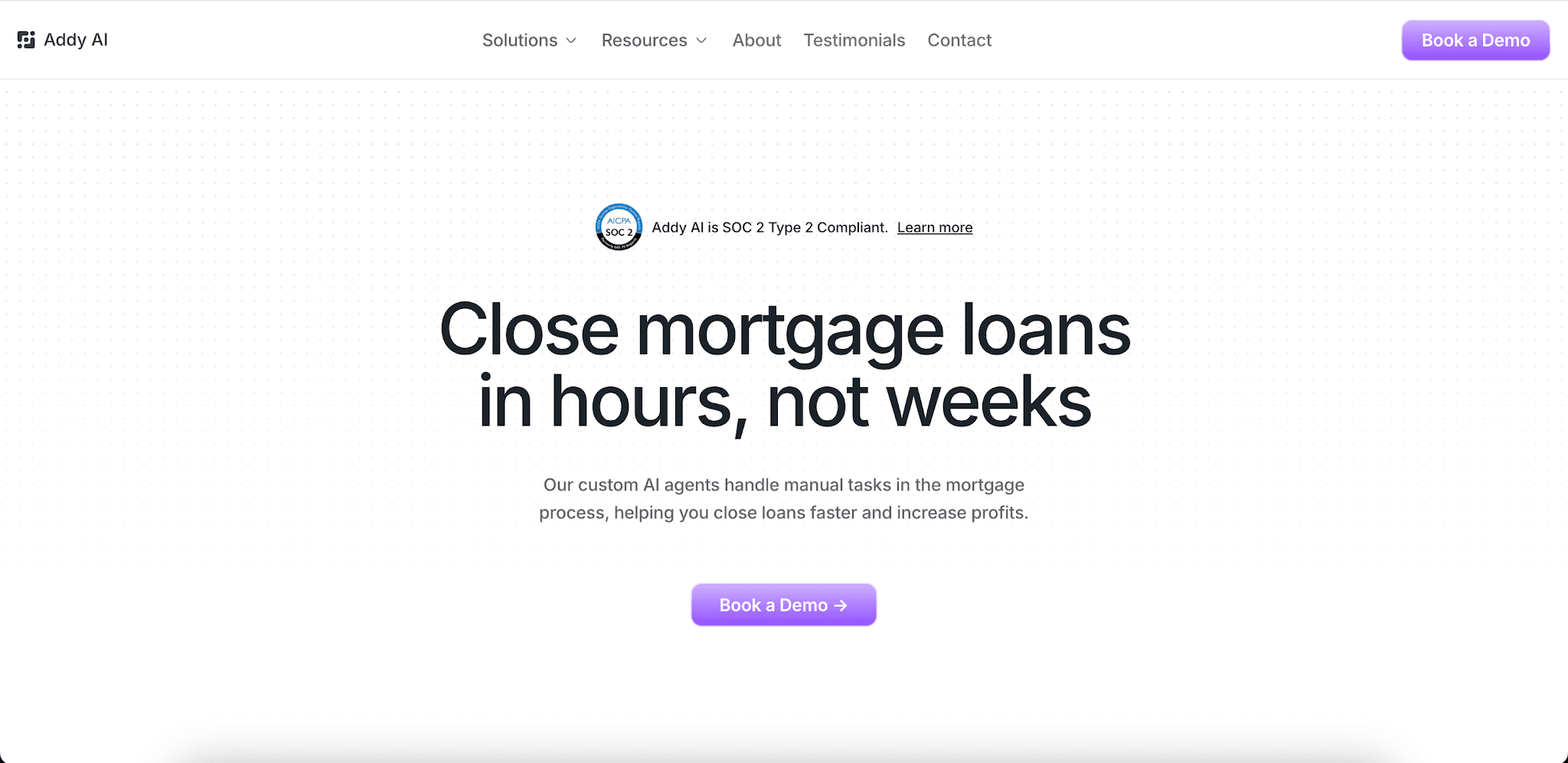
Addy connects borrower information with AI-powered document analysis to help prepare applications for underwriting. Its tools identify outstanding requirements without replacing a lender's LOS or taking over credit decisions.
Connect Loan Information During File Review
Addy reviews loan documents and AUS findings to identify outstanding requirements. Users can review flagged items and request missing paperwork before underwriting.
Document AI extracts information from financial statements and other supporting records. A processor reviewing cash flow data can ask Addy to locate specific deposits or transactions in a bank statement.
Addy offers two-way synchronization with Arive and connects with other lending platforms. Its browser extension provides access to guideline answers and file analysis while professionals use their LOS or CRM.
Identify Pre-Underwriting Gaps and Coordinate Follow-Ups
Addy's Processing Checklist compares submitted information with automated underwriting results and lender guidelines. It flags outstanding requirements and tracks condition statuses, helping users see what remains incomplete before submission.
Addy's ChatGPT app also generates preliminary pre-underwriting findings in about five minutes, according to Addy. Underwriters can consider those results during risk assessment, but they remain responsible for final lending decisions.
When the checklist identifies missing paperwork, Addy's AI agents can request it through email, text, or phone. Processing personnel can inspect incoming submissions to determine whether they satisfy the original condition.
How Lenders Can Measure AI Analytics Performance
Banks, credit unions, and mortgage companies can test AI analytics with one processing team. First, record baseline results using traditional methods, then compare them with similar applications handled after adoption.
Track five indicators:
Time in each processing stage: Count the days between an application entering and leaving a milestone. Compare typical turnaround times before and after implementation.
Document re-request rate: Calculate the percentage of applications requiring borrowers to resend paperwork. Exclude first-time requests arising from new conditions.
Unresolved-condition aging: Record how long each requirement stays open. Check whether fewer remain unresolved beyond seven days.
Manual touches per loan: Count duplicate entries and routine administrative updates. Keep mandatory verification separate so skipped reviews don't appear as improvements.
Late-stage issue discovery: Count applications with missing requirements first identified near closing. A decrease suggests earlier detection.
Compare cases of similar complexity using the same criteria. Continue tracking results after implementation to inform strategic decisions about expanding the software.
To assess profitability, compare cost per funded loan before and after adoption. Include software fees and training expenses to determine whether the investment delivers actual savings.
Spot Outstanding Conditions Before the Next Handoff
A mortgage application can appear ready even when a critical requirement remains unresolved. An unanswered appraisal condition can create delays by leaving collateral status uncertain.
Real-time insights can help lenders identify outstanding items before another professional receives the application. Addy's Document AI and Processing Checklist assist with identifying incomplete information, while its AI agents coordinate requests for missing paperwork.
Experienced professionals determine whether each condition has been satisfied. That gives the next reviewer greater confidence in the information received rather than relying solely on the application's status.
FAQs About AI Analytics for Lenders
Is there an AI tool for mortgage financial analysis?
Yes. AI tools can extract income and asset figures from borrower documents to help lenders verify application details. Some also analyze general ledger reports exported from accounting software when assessing self-employed income.
Does AI analytics require historical mortgage data?
No. Lenders don't need vast amounts of historical information to analyze current applications. Past records become more useful when forecasting processing delays or evaluating portfolio performance over time.
How are lenders using AI to mitigate risks in mortgage processing?
Lenders focus on mitigating risk by using AI to flag conflicting income figures and incomplete paperwork before underwriting. These findings complement credit scoring and professional verification, helping inform more accurate credit decisions.
Can smaller financial institutions benefit from AI analytics?
Yes. Smaller lenders can use ready-made analytics tools without hiring dedicated data scientists. Their finance teams can compare software costs with processing hours saved before expanding to more loan products.
Start closing more loans – Book your demo today
Stay ahead of the competition and discover how AI can accelerate your loan origination process, reduce manual work, and help you close more deals in less time. Book a demo today and start experiencing the future of lending.