Michael Vandi
Mortgage teams spend hours reviewing documents, checking guidelines, requesting missing items, and updating loan systems.
According to SS&C, some lending operations receive up to 300,000 agent notices each quarter. Operations teams often sort these notices and enter key details manually.
AI for lenders can handle much of this work by reading mortgage files, flagging missing information, and managing follow-ups. Loan officers and underwriters still make the final decisions.
This article explains how lending AI works, where lenders use it, the challenges involved, and how to measure results and implement it.
TL;DR
AI for lenders reviews applications, assesses risk, and routes files to the right reviewer.
It can process vast amounts of borrower information and flag missing or conflicting details sooner.
Lenders can streamline operations by standardizing document review, exception routing, and borrower follow-ups.
Automating complex processes still requires licensed professionals to review exceptions and make final lending decisions.
Addy applies mortgage-focused AI to guideline review, condition analysis, and pre-underwriting preparation within existing origination systems.
How AI Processes Mortgage Information
Machine learning studies records to find patterns and flag activity that falls outside normal ranges. Lenders use those findings to spot issues that may need review.
Large language models (LLMs) and natural language processing (NLP) read questions, emails, guidelines, and long agreements. This form of generative AI can find a specific clause without making a reviewer search every page.
For example, a lender can ask whether a 100-page agreement permits a maturity extension. The system can return the relevant clause, its conditions, and the page where it appears.
Optical character recognition (OCR) reads printed or handwritten text from submitted files. Document AI then populates those fields with that information during loan processing.
Computer vision checks how information appears on the page. It can determine whether a form includes a signature, a table, or a marked checkbox that affects the review.
Workflow orchestration connects these functions within lending operations. Like a traffic controller, it starts each task, passes along the needed information, and sends the result to the right system.
For real estate tax processing, it can check tax sites, read payment emails, confirm the status, and update the servicing platform.
How Lenders Use AI During the Mortgage Lifecycle
AI for lenders can assist from the first inquiry through account servicing. The software performs a specific job at each stage and sends its findings to the right person.
Borrower Acquisition and Application Review
AI compares an applicant’s financial profile with product requirements. A loan officer can use the results to recommend relevant options to new customers and choose an appropriate contact method.
During loan origination, document automation sorts submitted files and adds verified details to the correct application. It also identifies missing fields before the file reaches underwriting.
Automated checks strengthen fraud detection by comparing identity details with account records. They can flag altered documents, unusual deposits, or conflicting personal information for further review.
Underwriting, Approval, and Pricing
A risk assessment examines whether the applicant has enough income to manage the proposed payment. It also considers debt obligations and credit history under the lender’s rules.
During the loan approval process, AI checks the file against established eligibility criteria. It sends policy exceptions and incomplete applications to qualified reviewers for human oversight.
Pricing models assess expected risk against current interest rates and return targets. Loan officers review the suggested range before they discuss terms with the applicant.
Communication, Portfolio Review, and Collections
Virtual assistants answer common questions and send updates based on the application’s status. They also request missing documents, which improves customer engagement during review.
After funding, predictive analytics examines borrower behavior through payment activity and delinquency patterns. Managers use real-time data from servicing records to track portfolio performance and identify accounts that need attention.
Early payment problems may trigger borrower outreach or an account review. Servicers can then discuss repayment options or escalate the case under internal policy.
Core Features and Security Essentials in AI Lending Software
AI lending software needs to accept scanned files, email attachments, images, and digital forms in their original format. Configurable rules then apply product criteria and internal policies to each submission.
Each finding needs a direct link to the source page or field. Reviewers can check the evidence and send exceptions to an authorized employee when human judgment is required.
Mortgage teams also need to track how AI models perform after launch. Accuracy alerts can reveal unusual outputs before they affect more applications.
Role-based permissions control who can view or edit sensitive borrower data. Data encryption protects the information during storage and transfer between connected systems.
Audit logs record automated actions, reviewer decisions, and system updates. Retention settings keep records for the period required by compliance obligations and data privacy rules.
These controls help lenders protect borrower information, document system actions, and assign review responsibility.
Challenges When Adopting AI for Lending
Before lenders expand AI use, they need to address risks that can distort outcomes, weaken documentation, or leave review responsibilities unclear.
Bias and fairness: Historical records may reflect unequal lending outcomes. Test findings by borrower group and review any results that could affect eligibility or pricing.
Regulatory explainability: AI systems need to show how they reached a result. Save the source information, model version, reason code, and reviewer action for regulatory compliance.
Inconsistent information: Missing fields and conflicting definitions weaken decision-making accuracy. Use standard field names, validate incoming records, and assign someone to correct errors before the system processes them.
Legacy systems: Older platforms may store information in formats that newer software can’t read. Connect one priority workflow through an application programming interface or middleware, then confirm that records reach the correct fields.
Model drift: Economic conditions, fraud tactics, and lending policies change. Compare current outcomes with the original benchmark and retrain the model when performance drops.
Dependence on automated findings: Licensed professionals need to verify the source and policy behind exceptions, compliance concerns, and final decisions.
User adoption: Train mortgage teams with representative files, explain updated internal processes, and document who handles questions or escalations.
Key Metrics for AI in Mortgage Lending
Mortgage lenders need a baseline before introducing AI technology. Use the same file types, reporting periods, and calculation methods so every comparison remains accurate.
AI-powered dashboards can display these measurements together, using the same definitions and reporting periods for every review.
AI-Powered Processing Time
Measure processing time at several points to see whether automation is minimizing wait times throughout origination.
Document receipt to completed review: Tracks how long reviewers wait for findings they can use.
Application to approval: Measures the period between receiving all required information and reaching a decision.
Application to closing: Shows whether earlier time gains continue through underwriting, conditions, and funding.
Clear-to-close preparation: Records how long processors need to prepare a file for final approval.
Review these stages separately. A faster initial review won’t shorten closing when unresolved conditions continue to hold up the file.
File Quality and Decision-Making
Quality metrics show whether the system produces reliable information from loan applications. Poor results may come from low-quality scans, incorrect settings, or human error during review.
Classification accuracy: Tracks how often the software assigns a document to the correct category.
Extraction accuracy: Compares captured values with the source.
Missing-item detection rate: Measures how often the system finds required information that wasn’t submitted.
Correction rate: Records how many findings reviewers revise before the file advances.
Review errors by source so administrators know whether to adjust the model, submission requirements, or review process.
Team Capacity
Capacity metrics show whether automation reduces the manual effort required for each completed file.
Files completed per employee: Compares staff output before and after adoption.
Manual touches per file: Counts how often employees enter, correct, or transfer information.
Automated entry rate: Tracks the percentage of records added without staff input.
Labor hours per application: Measures the labor required from intake through completion.
Compare output with file complexity and overtime. A higher file count may hide added correction work or longer employee hours.
Customer Experience Metrics
Customer experience metrics show whether applicants receive enough information to respond during origination.
Response time: Measures how long borrowers wait for answers.
Document submission rate: Tracks how often applicants respond after outreach.
Application completion rate: Shows how many started applications reach submission.
Customer satisfaction: Records feedback after key stages.
These results indicate whether communication meets borrower expectations and helps applicants complete requests without repeated follow-ups.
Fraud Detection and Data Analytics
A mortgage fraud detection tool needs to identify suspicious activity without overwhelming reviewers. Compare confirmed fraud cases with false positives to see whether alerts lead to useful investigations.
Use data analytics to connect system performance with cost per origination, approval-to-funding conversion, delinquency, default, and portfolio profitability.
Review the results on a fixed schedule before extending automation to more workflows.
How to Implement AI Solutions for Lenders
Start with one frequent task that has a clear owner and enough file volume for testing. Choose work where automating routine tasks could lower the manual workload.
Next, map how customer information enters the workflow, who reviews it, and where the result goes. This shows the handoffs that AI-powered solutions need to follow.
Then, configure product rules, access permissions, and escalation paths. Mortgage teams need to know which findings they can accept and which require further review.
After configuration, run representative files through the platform. Review disagreements, adjust the setup, and repeat the test until results meet the selected standards.
Finally, launch with a limited user group before adding related lending processes. Use approved key performance indicators (KPIs) to confirm that results remain stable as usage grows.
Why Addy Stands Out From General Lending AI Tools
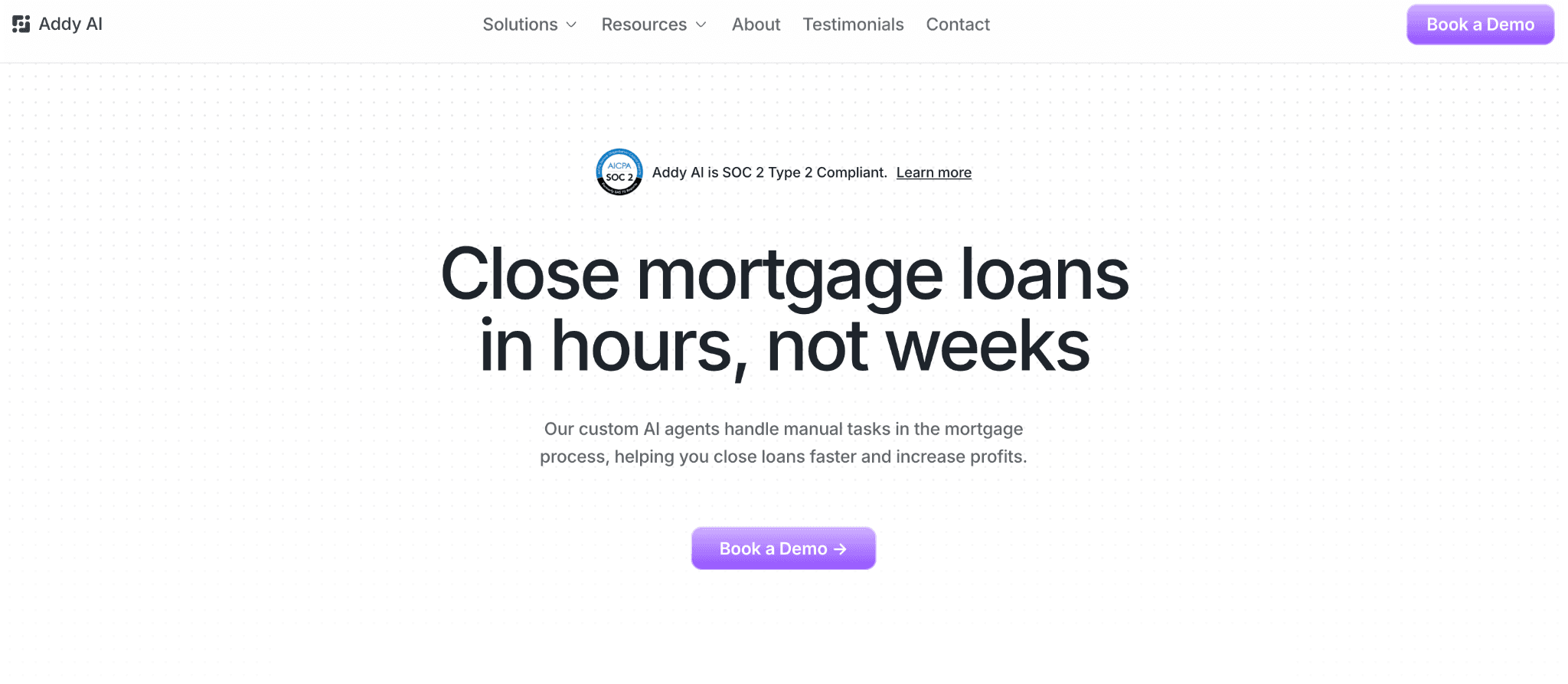
Addy applies artificial intelligence to the rules and systems used in the mortgage industry. Lenders can use prebuilt agents or train custom ones on guidelines, rate sheets, products, internal information, and operating procedures.
That mortgage-specific training lets Addy answer lending questions and process files under the lender’s requirements.
Guideline and Condition Intelligence
Addy compares Fannie Mae, Freddie Mac, and non-qualified mortgage (non-QM) criteria during pre-underwriting. It also reviews automated underwriting system (AUS) findings and product conditions to identify missing requirements.
Loan officers can ask program and underwriting questions in plain language. Addy returns relevant guideline information to inform data-driven lending decisions.
AI Access Inside Existing Workspaces
The browser extension works inside loan origination and customer relationship management (CRM) platforms.
Mortgage professionals can review files, search guidelines, run the Processing Checklist, and price scenarios without leaving their current workspace.
Addy’s ChatGPT app reviews borrower documents, analyzes scenarios, and identifies missing items. It can produce pre-underwriting findings in minutes. This gives users real-time insights through a conversational interface.
Mortgage System and Communication Connections
Addy integrates with loan origination, CRM, and point-of-sale (POS) platforms to sync loan information.
It also connects with Gmail, Outlook, Slack, Microsoft Teams, Google Drive, Salesforce, and HubSpot.
Addy can contact borrowers by email, text, or phone based on file status. It can also send updates to real estate partners, title agents, and other transaction participants.
Addy supports customer interactions through email, text, or phone, based on file status. It can also send updates to real estate partners, title agents, and other transaction participants.
Evaluate Document Review and Pre-Underwriting With Addy

Mortgage teams can evaluate AI for lenders through one defined workflow, such as document review before underwriting. They can compare review time, correction rates, and missing-item findings before and after deployment.
They should also record when licensed professionals review policy exceptions, confirm guideline findings, or approve the file. This shows whether AI-driven automation handles repetitive tasks without skipping required review, which helps maintain customer trust.
Addy brings mortgage-focused AI agents into existing origination systems. The platform can review documents, assess AUS findings, and follow lender-specific review rules.
Book a demo with Addy to see how it can improve document review and pre-underwriting preparation.
FAQs About AI for Lenders
How are AI tools used in lending?
Financial institutions use AI to review documents, assess risk, answer borrower questions, and flag missing information. AI algorithms also help route applications and identify unusual activity.
Will AI replace lenders?
AI doesn’t replace licensed professionals. The lending industry still relies on them to review policy exceptions, interpret guidelines, and make final approval decisions.
How can lenders use AI to process loans?
Lenders can leverage AI to classify documents, extract borrower details, and request missing items. The technology can also detect fraud by flagging mismatched records or suspicious transactions.
Start closing more loans – Book your demo today
Stay ahead of the competition and discover how AI can accelerate your loan origination process, reduce manual work, and help you close more deals in less time. Book a demo today and start experiencing the future of lending.