Michael Vandi
Loan officers now have more AI options than ever, but choosing the right one isn’t always simple. The best AI tool depends on the mortgage task you need it to handle.
AI tools for loan officers solve specific problems, from first contact to reviewing loan applications and supporting underwriting. Some mortgage AI tools help with borrower intake and follow-up. Others focus on lead nurture, client recapture, document processing, or file preparation.
AI can assist with analysis and communication, while mortgage professionals remain responsible for regulated lending decisions. This guide groups the category around common mortgage workflows so you can compare your options more easily.
TL;DR
These eight AI tools for loan officers cover key workflows from borrower intake to underwriting:
Document processing and file preparation: Addy organizes mortgage files, identifies open conditions, and coordinates document collection, while Ocrolus extracts and verifies financial information.
Borrower intake and first contact: Perspective AI supports adaptive conversational intake, while Structurely handles lead response, appointment scheduling, and live transfers.
Lead nurturing and client recapture: BNTouch supports CRM campaigns and follow-up, while Homebot uses homeowner activity and predictive analytics to identify possible transaction intent.
Underwriting research and automation: Zeitro supports guideline and scenario research, while Tavant automates repeatable credit, income, collateral, and underwriting analysis.
What Do AI Tools Actually Do in Mortgage Loan Origination?
In loan origination, artificial intelligence helps turn incoming information into findings a loan officer can assess faster. It can extract relevant details, compare information, flag inconsistencies, and organize the results so professionals know what requires attention.
That operational help doesn’t transfer decision-making authority. Licensed and authorized professionals remain responsible for advice, underwriting, property valuation, credit decisions, and approvals in mortgage lending.
AI output should provide useful evidence and context for informed decisions, not act as the final authority.
With that boundary in mind, the workflow starts with the period before a prospect reaches an active mortgage file.
AI Tools for Mortgage Document Processing and File Preparation
Once a borrower has an active mortgage file, attention turns to preparing it for underwriting. Teams need to organize incoming records, identify gaps, and resolve outstanding items before the file advances.
Addy focuses on bringing the full mortgage file together. Ocrolus focuses on extracting, calculating, and verifying the financial information within borrower records.
1. Addy for Mortgage File Preparation
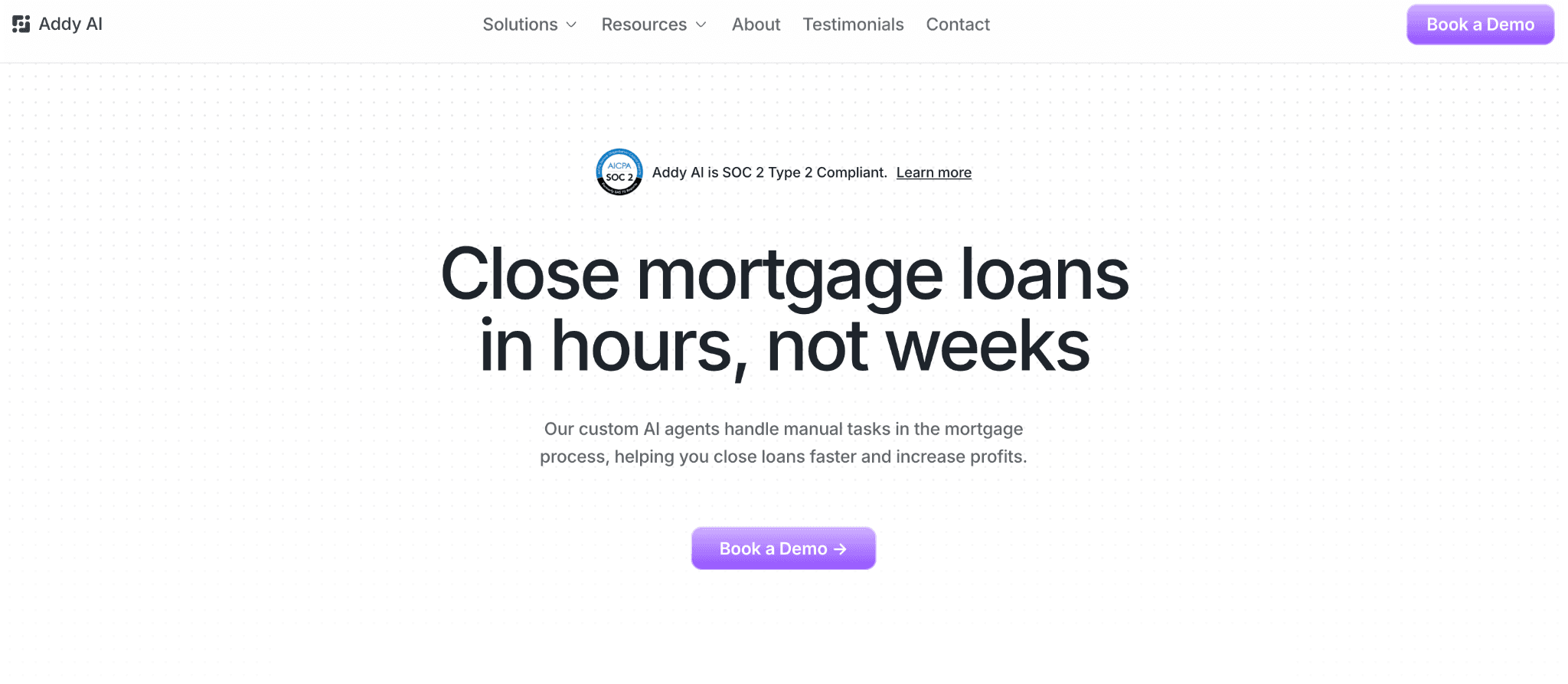
Addy works at the whole-file level rather than treating each submission as a separate task. It organizes incoming records into a loan-level view so processors can see what they have and what still requires attention.
The platform classifies incoming materials and extracts borrower data instead of requiring loan processors to re-enter the same details manually. Its Processing Checklist also uses automated underwriting system (AUS) findings, lender guidelines, and file contents to identify open conditions and missing items.
Addy can handle document collection when the file remains incomplete. Its agents can contact borrowers by email, text, or phone and bring outstanding items back into the preparation workflow.
Key features:
Extraction from 1003s, W-2s, 1040s, bank statements, pay stubs, and other mortgage records
Loan-file summaries and large-deposit flags
Connections with loan origination systems (LOS), point-of-sale (POS) systems, CRMs, Gmail, Outlook, Slack, and Microsoft Teams
Two-way synchronization with LOS platforms such as Arive
Addy also brings its mortgage-focused agents into ChatGPT. Loan officers can use the app for pre-underwriting and file analysis, with findings produced in under five minutes.
Book a demo with Addy to see how its AI agents prepare mortgage files before underwriting.
2. Ocrolus for Financial Document Analysis and Verification
Image source: ocrolus.com
Ocrolus specializes in document analysis for complex financial records. It turns information buried in borrower submissions into standardized calculations and fields that lenders can evaluate.
The platform calculates income and assets and analyzes cash flow. It also compares supporting records with Encompass 1003 information to spot differences between the application and its underlying evidence.
Ocrolus checks submitted files for suspicious changes as part of its fraud detection process. It can flag tampering, inconsistencies, and anomalies while showing the reasons and evidence behind each finding.
When a result has low confidence, more than one AI agent can check the task before it goes further. Ocrolus Data Professionals handle difficult cases that still require human examination.
Key features:
Indexing for more than 2,000 document types
Coverage for bank statements, pay stubs, tax records, and other financial materials
Processing logs that preserve activity for audits
API delivery to existing systems
For lenders, Ocrolus provides calculated and verified financial information they can use when evaluating the borrower’s supporting records.
AI Tools for Borrower Intake and First Contact
This category covers the short window after someone expresses interest but before an active mortgage file exists. At this point, mortgage lenders need enough context to understand the inquiry and decide who should handle it next.
The goal is to prepare a useful handoff before mortgage loan officers spend time on a full conversation. These tools help collect early information or respond to an inquiry before the process reaches a full loan-file review.
3. Perspective AI for Conversational Borrower Intake
Image source: getperspective.ai
Perspective replaces static forms with conversations that adapt to each response. If someone gives a vague answer, it asks a relevant follow-up instead of forcing them through fixed questions.
That makes lead capture more useful than collecting contact details alone. Perspective gathers goals, timing, financial complexity, and intent, then turns those answers into structured fields that other systems can use.
The platform also validates responses against the business rules a company sets for intake. This gives teams a way to sort inquiries based on the information gathered rather than relying only on fixed form fields.
Key features:
Adaptive conversations with follow-up questions based on earlier answers
Structured field extraction from natural-language responses
Validation against configured business rules
Routing to a customer relationship management (CRM) system, calendar, inbox, or Slack
Website widget, popup, email link, and standalone page options
Custom questions, routing rules, and white-label branding
Perspective’s qualification logic applies the intake and routing criteria the business sets before an inquiry advances.
4. Structurely for AI Lead Response and Appointment Setting
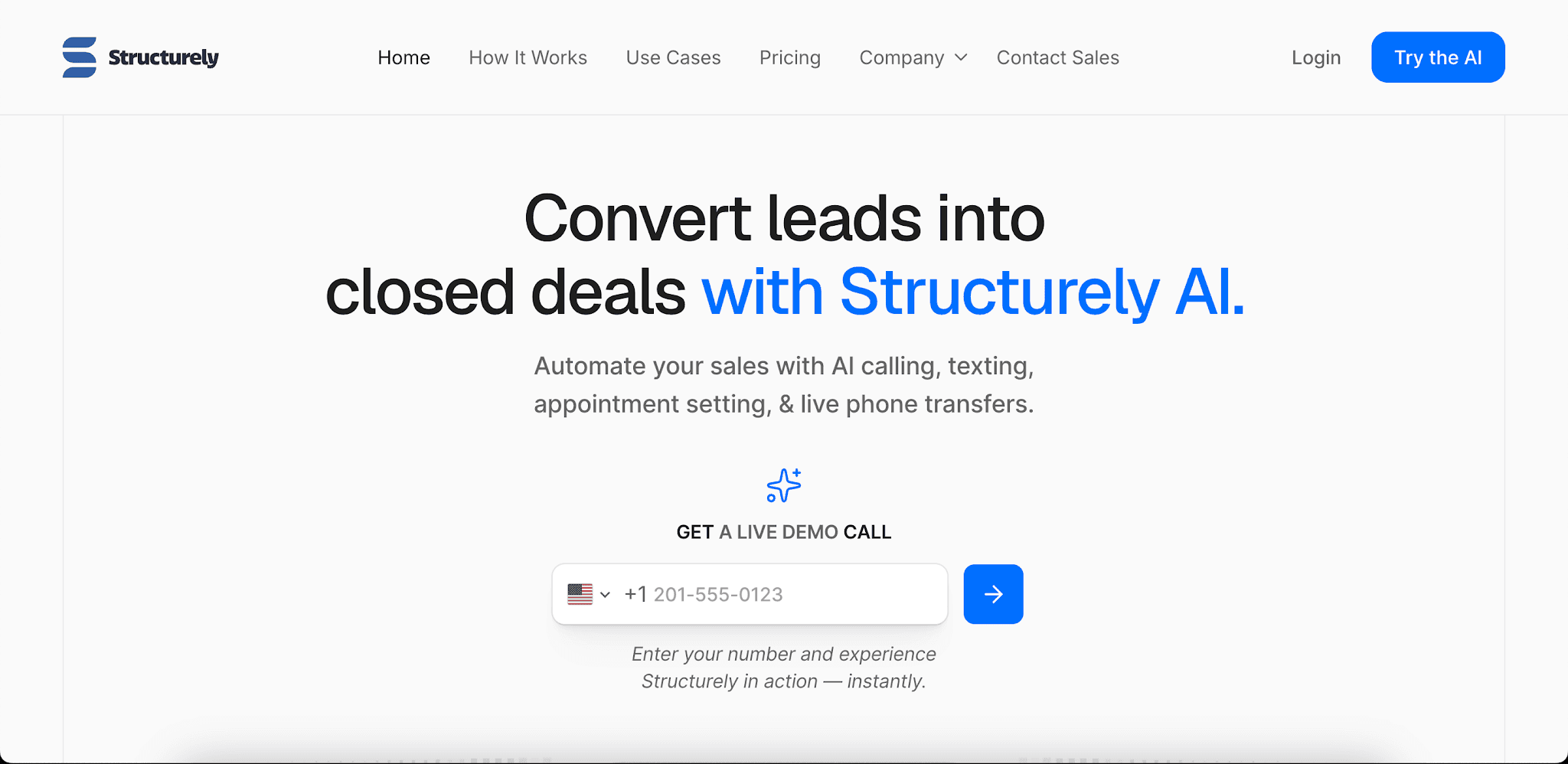
Image source: structurely.com
Structurely focuses on reaching a new lead after an inquiry arrives. Its AI engages new leads through voice, two-way SMS, or email, automating early client communication.
Its conversation engine adjusts based on how the person responds and keeps context from earlier interactions. This helps Structurely identify intent, handle common objections, and gather information for the next sales step.
Key features:
Inbound and outbound AI voice calls
Two-way SMS and email conversations
Structured conversation trees with dynamic branching
Intent, urgency, readiness, and objection detection
Appointment scheduling with calendar and CRM integrations
Live transfers and routing to specific representatives
Context retained between interactions
These capabilities can improve speed to lead because outreach can begin as soon as an inquiry enters the system. Faster response can matter when converting leads, especially when a prospect is ready to speak with someone.
Structurely can then book an appointment, make a live transfer, or route the prospect based on configured rules.
AI Tools for Mortgage Lead Nurture and Recapture
Once a prospect or borrower is already in the database, the priority changes. Instead of making first contact, lenders need a way to stay relevant until another conversation makes sense.
This stage covers ongoing lead management and client recapture. Better-timed follow-up can reopen conversations with existing contacts and create opportunities for more deals.
Behavioral activity can also show when someone in the database may be ready to transact again.
5. BNTouch for Mortgage CRM and Campaign Automation

Image source: bntouch.com
BNTouch connects marketing activity with the records inside its mortgage CRM. Teams can follow up based on each contact’s place in the sales pipeline rather than managing every touchpoint separately.
For instance, the CRM can apply established workflows to borrowers, prospects, and referral partners as their status changes. This gives teams a repeatable way to assign follow-ups, distribute leads, and keep communication connected to the sales process.
That keeps lead nurturing active while loan officers spend more time on borrower conversations and closing deals.
Key features:
Mortgage-specific CRM workflows and sales pipelines
Email and text campaign sequences
Borrower and partner communication
Automatic lead distribution
Follow-up tasks and workflow automation
Campaign and touchpoint templates
Loan-officer and team reporting
Configurable feature controls for compliance teams
Lenders don’t need to automate every campaign at once. Starting with a few high-value workflows gives them room to test messaging, ownership, source tracking, and results before expanding.
6. Homebot for Borrower Intent and Client Recapture
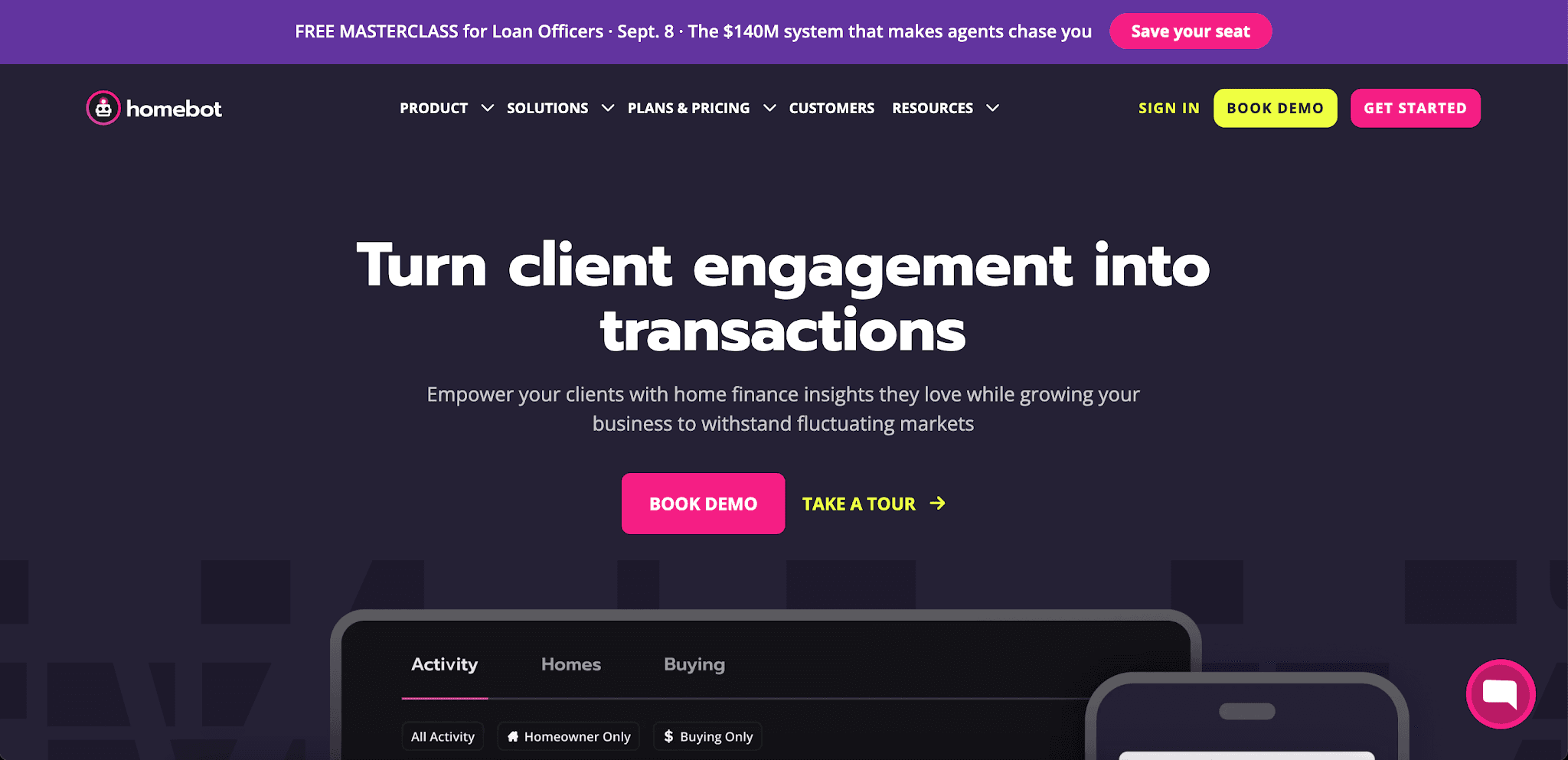
Image source: homebot.ai
Homebot focuses on homeowners already in the lender’s database. It sends personalized home-finance content based on home value, equity, financing, and local market data.
That ongoing content gives clients relevant market trends while helping loan officers maintain stronger relationships between transactions.
Homebot also tracks each client’s activity. Checking equity, exploring refinance scenarios, or searching for homes provides data-driven insights into possible transaction intent.
Key features:
Automated home-value and equity updates
Personalized refinance and buy-up scenarios
Homeowner activity tracking
Behavioral indicators based on client actions
Likelihood to Sell Score
Alerts for potential purchase, refinance, and sale opportunities
Activity reporting for existing clients
Educational home-finance content
Homebot combines those behaviors with equity and rate-related factors through predictive analytics. This type of propensity modeling helps identify when a past client may warrant outreach for a purchase, refinance, or sale.
AI Tools for Mortgage Underwriting Research and Automation
After file preparation, this part of the lending process focuses on program research, scenario structuring, and underwriting analysis. These tasks help mortgage professionals interpret borrower information before a lending decision.
Within the mortgage industry, Zeitro focuses on research before submission. Tavant handles multiple underwriting functions within larger lending operations.
7. Zeitro for Mortgage Guideline and Scenario Research
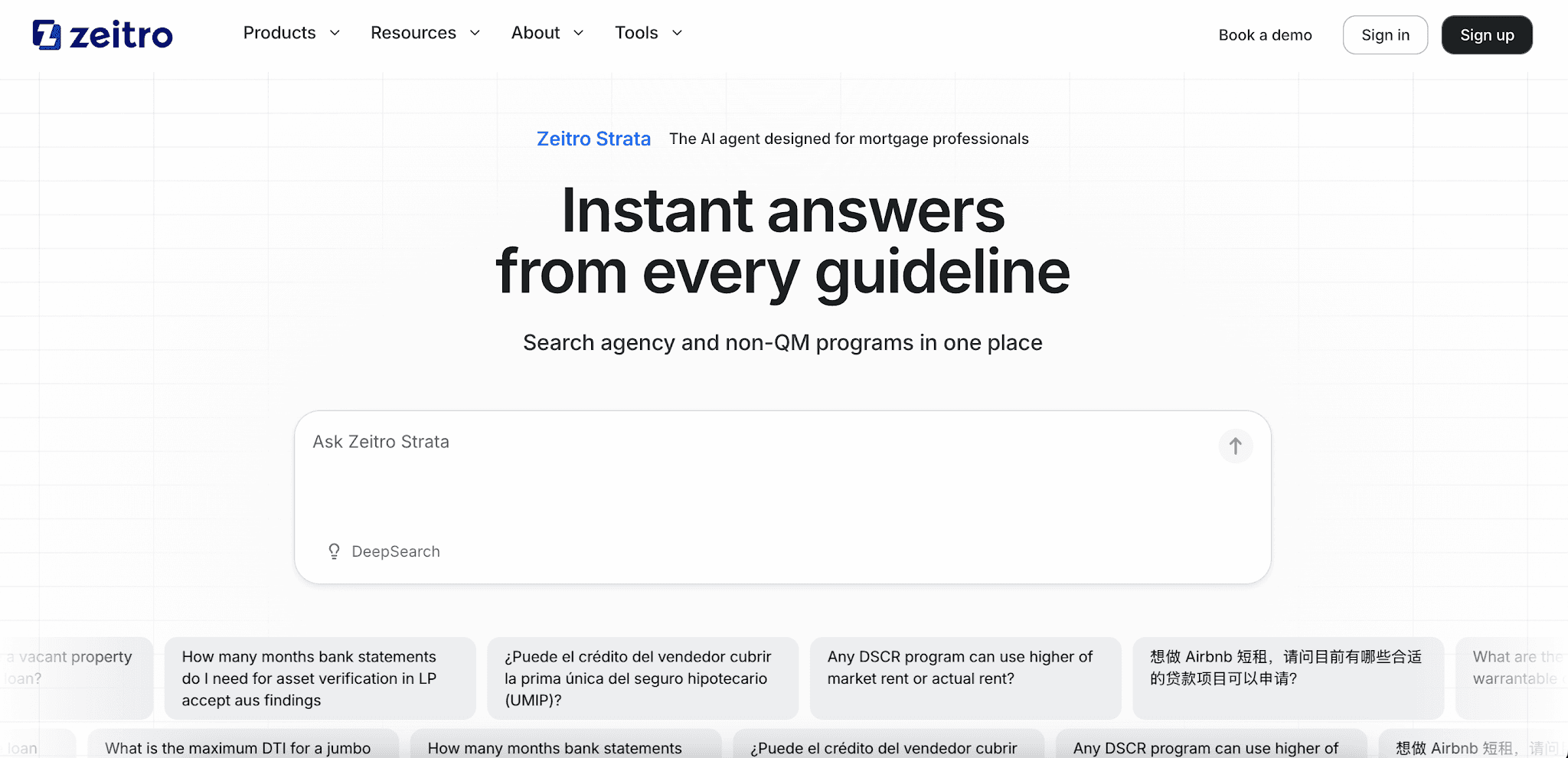
Image source: zeitro.com
Zeitro’s Strata AI gives loan officers one place to research program requirements and complex scenarios. Its answers include citations, so users can trace the information back to the underlying source.
That helps when a borrower doesn’t fall neatly into a standard scenario. Loan officers can use the research alongside calculations and investor matching to compare possible ways to structure the file.
Key features:
Search across Fannie Mae and Freddie Mac guidelines
Non-QM investor guideline coverage
Comparison of lender and investor rules
Automated qualifying income and debt-to-income calculations
Investor matching for complex scenarios
The main value is context before submission. Instead of relying on a single rule in isolation, loan officers can compare requirements against the borrower’s scenario before choosing a path forward.
8. Tavant for Enterprise Underwriting Automation
Image source: tavant.com
Tavant’s AI-powered platform connects several underwriting functions with existing LOS and POS infrastructure. Its Touchless products automate repeatable analysis while keeping the information connected within the same enterprise workflow.
The platform uses borrower and loan information to support risk assessment under applicable investor rules.. That analysis covers borrower risk and can generate or clear conditions as required information becomes available.
MAYA gives loan officers and underwriters contextual help within that process. Users can ask questions about the file without leaving the underwriting workflow to search another system.
Key features:
Touchless Credit for automated credit analysis
Touchless Income for employment calculations and verified income inputs
Touchless Decisioning for multi-AUS and investor-rule comparison
Touchless Collateral for appraisal analysis
Automated condition generation and clearing
More than 150 third-party integrations
Tavant keeps the human element in exception handling instead of treating automation as the final decision-maker. Underwriters still step in when a file needs closer review, while the platform handles repeatable analysis around them.
How to Build an AI Stack Around Your Mortgage Workflow
Most lenders don’t need a product from every AI category. A focused stack should address the few workflow problems causing the most manual effort, delays, or follow-up.
The key points to compare are the task each tool handles, how it connects with existing systems, and the controls around its use. AI also doesn’t need to replace traditional methods that already work.
Add it where a specific task slows production, affects the borrower journey, or holds back business growth.
Start With the Mortgage Workflow Problem
Start with the tasks where time spent on repetitive steps is highest. Then match each problem to the type of technology built for that job.
These practical examples show how common workflow problems map to different AI categories:
Incomplete or rigid intake: Conversational intake AI asks follow-up questions and organizes responses before a detailed borrower conversation.
Slow new-lead contact: Lead-response AI begins outreach quickly and routes interested prospects to the appropriate person.
Inconsistent ongoing marketing: Mortgage CRM automation manages recurring campaigns, follow-up tasks, and partner communication.
Low database recapture: Borrower-intent technology tracks client activity that may point to another transaction.
Time-consuming file preparation: Mortgage processing AI organizes active files, finds missing items, and prepares them for underwriting.
Complex financial-record analysis: Document intelligence extracts, calculates, and verifies information from borrower submissions.
Slow guideline research: Mortgage knowledge AI searches program rules and helps loan officers structure difficult scenarios.
High underwriting workload: Enterprise automation handles repeatable analysis, conditions, and exception routing in the back office.
A lender may only need two or three of these categories. Prioritize the problems that affect production or the borrower experience most instead of filling every category.
Check How Each AI Tool Connects With Your Existing Systems
Once you know what the tool needs to do, map how information will enter and leave it. Identify the source system, the information the AI receives, and where its output needs to go.
The required connections depend on the job. An intake platform may send contact info to a CRM, while processing software may update a specific loan record.
Check the connections your workflow actually uses, including LOS, POS, CRM, email, document storage, SMS, phone, and communication platforms. A vendor’s integration list only helps if those connections pass the information required for the task.
APIs may handle transfers between systems automatically. Confirm whether the integration updates the correct record and fields or still requires someone to copy results manually.
This gives teams a concrete basis for data-driven decisions about interoperability rather than comparing products by integration count alone.
Review Governance, Security, and Auditability
Governance focuses on what the vendor records, who can access the system, and how it handles sensitive information. The level of compliance risk will vary based on the tool’s role and the information it processes.
Look for activity records that show what the system did and when. Source citations, decision-support histories, and exception logs may also help teams trace how a result was produced.
Next, check permission settings and data policies. Teams should know who can access records, who can change automation rules, and how the vendor handles retention and deletion.
Verify relevant security certifications during vendor review. Compliance settings and human-review workflows should also show how the platform handles exceptions that need further attention.
A focused AI stack gives each tool a distinct job, connects it to the right systems, and applies controls suited to that job.
Bring Addy Into Your Mortgage Processing Workflow
The right AI tools for loan officers depend on the job you need them to handle. Intake, lead follow-up, document analysis, and underwriting each call for different capabilities.
For teams spending too much time preparing active files, Addy focuses on the processing stage before underwriting. Its advanced algorithms help handle repeatable preparation tasks while processors concentrate on exceptions and borrower questions.
That boosts productivity and gives loan officers more time to offer personalized services that improve the client experience. They also get more useful context around active files and borrower profiles when they need to step in.
FAQs About AI Tools for Loan Officers
Will AI replace loan officers?
AI can automate repetitive tasks, but it doesn’t replace the licensed professional responsible for borrower guidance and lending decisions. It helps loan officers work smarter while they explain options, answer questions, and provide personalized services.
What is the difference between mortgage AI and an AUS?
Mortgage AI assists with tasks such as extracting employment history, reviewing property details, and organizing loan information. An AUS applies underwriting rules to borrower and loan information, including property type, and returns an underwriting finding.
A borrower may be pre-approved after lender review, but that still isn’t final loan approval.
Do mortgage AI tools need to integrate with a LOS?
Integration isn’t always required, but it becomes important when AI outputs need to update an active loan record. A tool doesn’t need to connect with most LOS platforms; it needs a reliable connection with the one your lender uses.
What CRM software do loan officers use?
Loan officers use mortgage-focused CRMs such as BNTouch and broader CRM platforms configured for lending workflows. These systems help manage prospects, real estate partners, and follow-up. Depending on the platform, they may also automate market updates and social posts.
Start closing more loans – Book your demo today
Stay ahead of the competition and discover how AI can accelerate your loan origination process, reduce manual work, and help you close more deals in less time. Book a demo today and start experiencing the future of lending.