Michael Vandi
If Ocrolus still leaves your team with too much manual work, it may be time to explore other options.
Ocrolus does a solid job extracting data from documents, but it doesn’t check loan guidelines, follow up with borrowers, or help files reach closing faster.
For lenders, brokers, and mortgage operations teams that need more than optical character recognition (OCR), other platforms can manage broader lending workflows and cut hours of back-office work each week.
This guide covers reliable Ocrolus competitors, including one that manages the lending process from intake through closing.
TL;DR
Here are the nine best Ocrolus alternatives to consider in 2026.
Docsumo
Casca
Capacity
LoanLogics
Blend
DocuClipper
Hyperscience
Veryfi
What Is Ocrolus Used For?
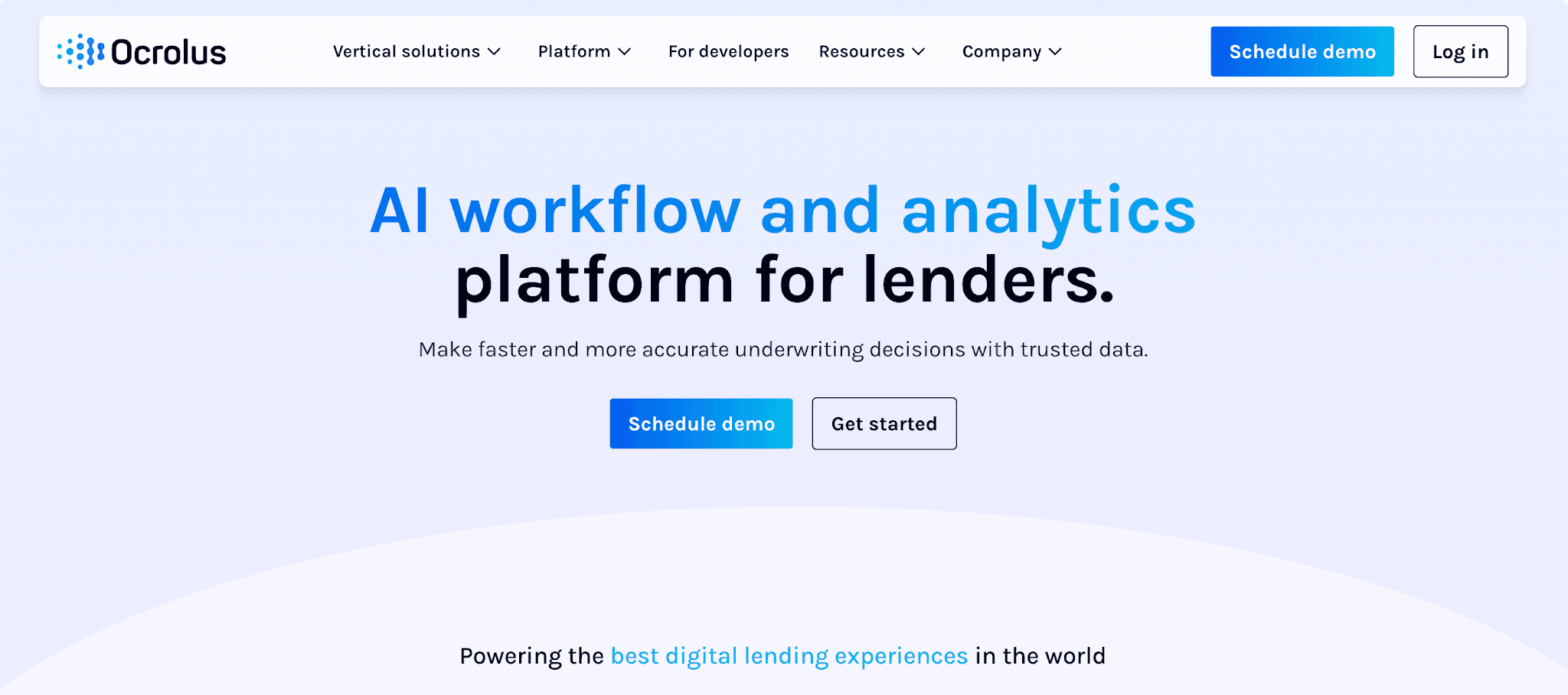
Image source: ocrolus.com
Ocrolus helps lenders process complex financial documents by extracting data from bank statements, pay stubs, tax returns, and other records. It reduces manual data entry and gives credit teams standardized information for faster review.
Many teams use Ocrolus to support document processing during the early stages of the loan cycle.
Some of its core features include:
Document capture for both structured and unstructured file types and layouts
Data validation using built-in business rules and automated checks
Bank statement analysis and automated underwriting support for financial decision-making
Audit trails that keep records of every step in the loan workflow
Ocrolus is often used in mortgage, consumer lending, and fintech, where teams deal with high volumes of financial data and need to improve accuracy across document types.
While Ocrolus can handle unstructured documents, more complex or custom use cases may require configuration or human-in-the-loop review.
It offers strong intelligent document processing (IDP) capabilities, but doesn't provide end-to-end automation or borrower engagement tools, which some lenders may need for a complete workflow.
Why So Many Teams Are Looking for an Ocrolus Alternative
You’ve uploaded the documents, and the data has been extracted. But now your team is stuck waiting for borrower follow-ups, manual checks, and for the next system to take over. That gap between document processing and decision-ready loans is exactly where many lenders hit a wall with Ocrolus.
For some teams, the platform may require added configuration for custom documents or specialized lending use cases. Others report difficulty connecting it with existing systems without additional support.
These issues can slow down financial workflows and create more back-and-forth than expected.
Cost is another common concern. Ocrolus uses custom pricing, which may not suit SMB lenders that want predictable costs or a simpler setup.
Lenders that want decision-ready data to flow into borrower communication, document requests, condition management, and underwriting preparation may prefer broader workflow automation.
Top 9 Ocrolus Competitors to Try in 2026
If you need fewer manual handoffs, automated document review, or faster onboarding, you’re not alone. Many lenders compare the top Ocrolus alternatives that better match their daily operations and cut repetitive tasks.
Below is a list of tools that solve different parts of the loan process:
1. Addy
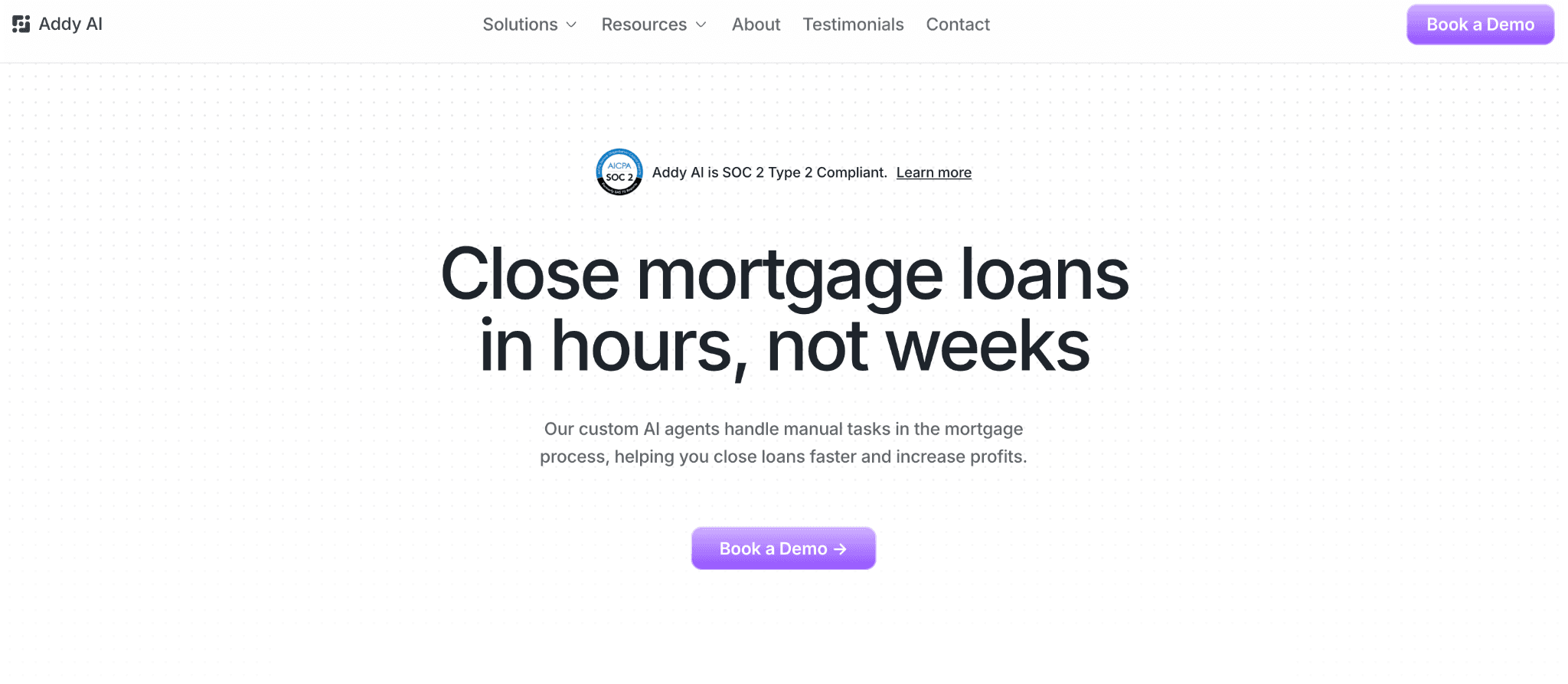
Addy is a mortgage automation platform built for teams that want to close loans faster without adding manual steps.
One of its core solutions, Document AI for Lending, automates document intake, review, and validation, freeing up loan officers to focus on decisions, not data entry.
Addy uses AI agents to check loan files, follow up with borrowers, and compare documents with lending guidelines. It connects with loan origination systems (LOS), customer relationship management (CRM) platforms, and email, so teams can keep their existing systems and get started quickly.
Unlike tools that only extract data, Addy carries the work into borrower follow-ups, eligibility checks, condition management, and underwriting preparation. Teams can use its preconfigured agents or apply their own lending rules.
Addy’s ChatGPT app for mortgage pre-underwriting can assess borrower documents, analyze loan scenarios, identify missing conditions, and generate pre-underwriting findings in under five minutes.
Key Features
AI agents that take action - Review applications, trigger tasks, and request missing items
Instant loan eligibility checks - Evaluate files using lender-specific credit score policies
Bank statement and income analysis - Extract key metrics for underwriting in seconds
Automated follow-ups - Keep brokers and borrowers on track
Broader document coverage - Process 1003s, 1040s, W-2s, pay stubs, bank statements, and other financial records
Built-in fraud detection and document validation - Flag mismatched information or unusual activity for investigation
Custom mortgage chatbot - Train your own bot to answer guideline questions in Slack or Teams
Secure and audit-ready - Maintain traceable records with SOC 2 Type 2 compliance
2. Docsumo
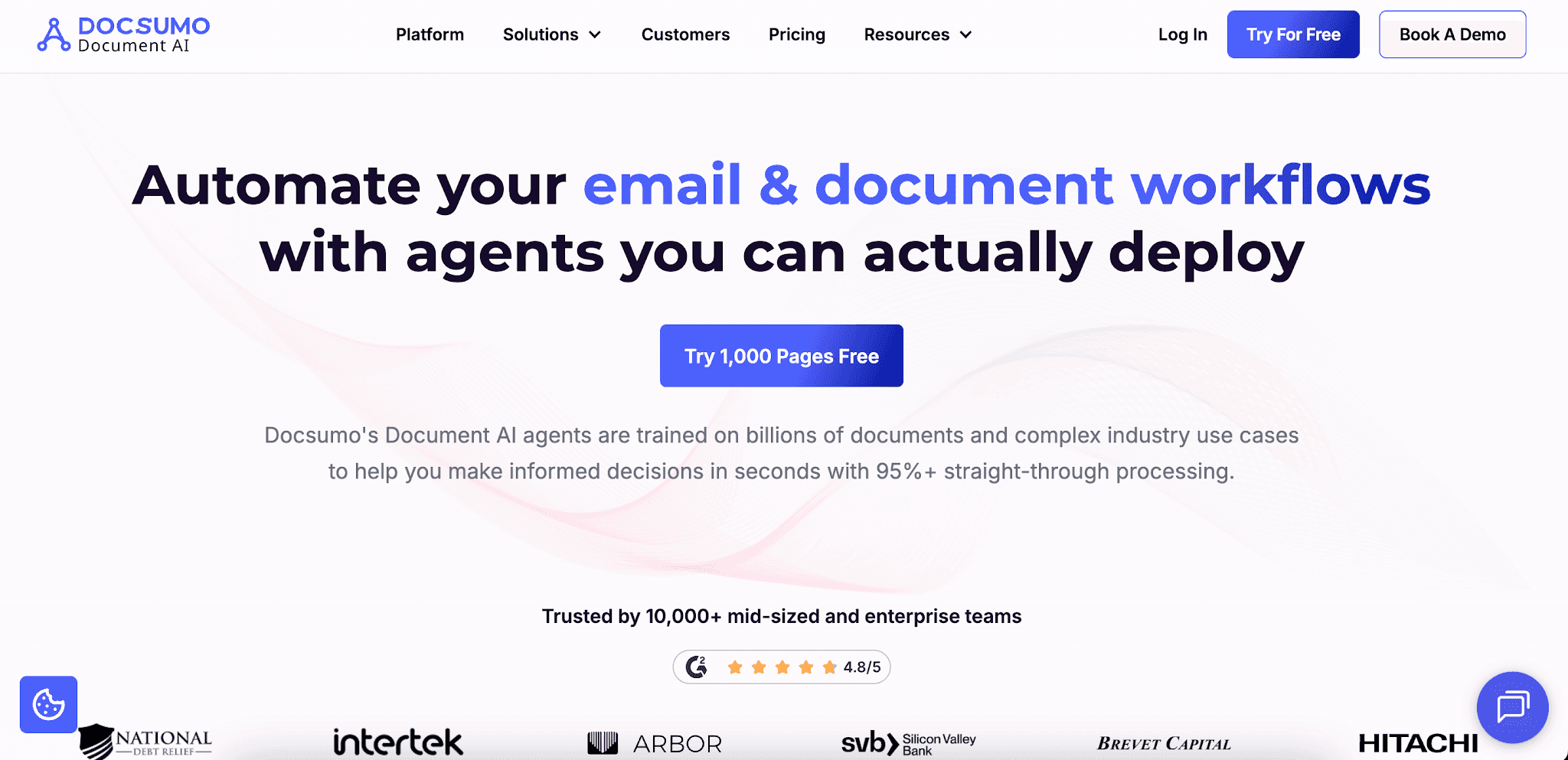
Image source: docsumo.com
Docsumo is a document processing platform built to help businesses extract data from structured files like bank statements, invoices, and utility bills.
It’s designed for finance teams that want to move away from manual data entry by setting up automated document review and conversion processes.
The platform handles repeatable formats and sends extracted information to reporting tools, accounting software, or loan analysis systems.
Docsumo doesn’t require technical setup, which makes it useful for teams without engineering support.
Key Features
No-code configuration - Upload files and define field mappings without a developer
Auto-classification - Identify and sort document types automatically
Data validation - Flag missing or incorrectly formatted fields
Supports financial documents - Handle statements, invoices, tax forms, checks, and similar records
Analytics dashboard - Track usage, accuracy, and field performance over time
Pros and Cons
Users value Docsumo’s ability to process large batches and recognize variations of the same document. They report that it can extract key fields from high volumes of checks and export the results to a CSV, which cuts manual entry.
However, implementation may require more time than expected. Accuracy can also drop when formats vary widely, so lenders may need to review results and adjust field rules as new layouts appear.
Docsumo focuses mainly on data extraction. Lending teams that need borrower follow-ups, credit checks, or custom decision rules may need another platform.
3. Casca
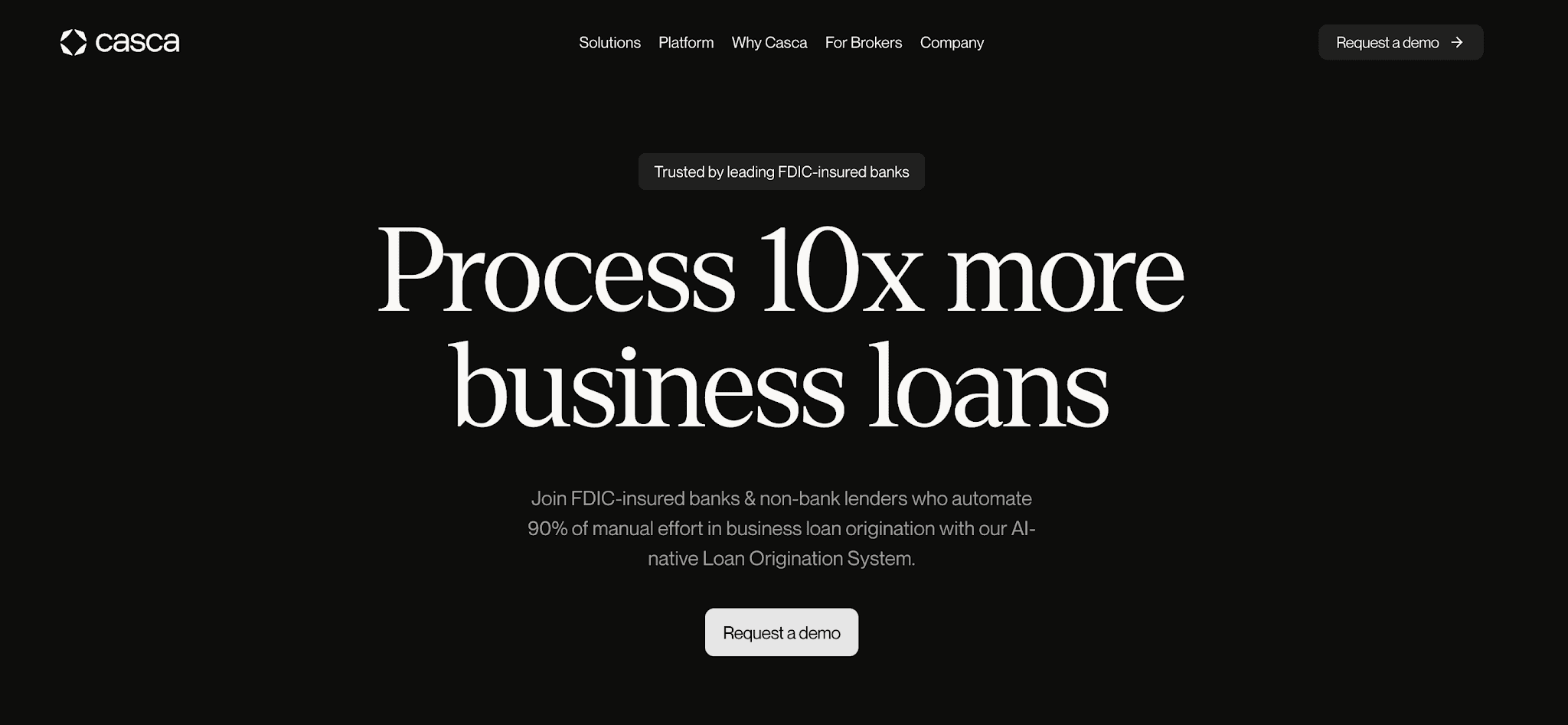
Image source: cascading.ai
Casca is a decision automation platform built specifically for lenders. It helps teams run credit and risk checks using AI-powered rules and models that align with their underwriting policies.
The system assesses applicant information, reviews financial records, and calculates ratios for cash flow analysis.
Lenders often use Casca to speed up approvals and reduce time spent on manual verification. It works alongside LOS and supports custom rules for credit eligibility, document checks, and exception handling.
Key Features
Lending-specific automation - Manage business loan origination and credit decisions
Custom rule builder - Set decision logic without technical support
Human-in-the-loop support - Review flagged cases manually when needed
Real-time eligibility checks - Compare borrower data against lending criteria
Audit visibility - Track how decisions were made at each stage of the loan pipeline
Pros and Cons
Casca combines application intake, document collection, credit analysis, applicant communication, and underwriting tasks in one system.
The platform focuses more on business lending. Companies that need automated underwriting system (AUS) findings, mortgage guideline checks, or loan-specific condition management may require more specialized software.
4. Capacity
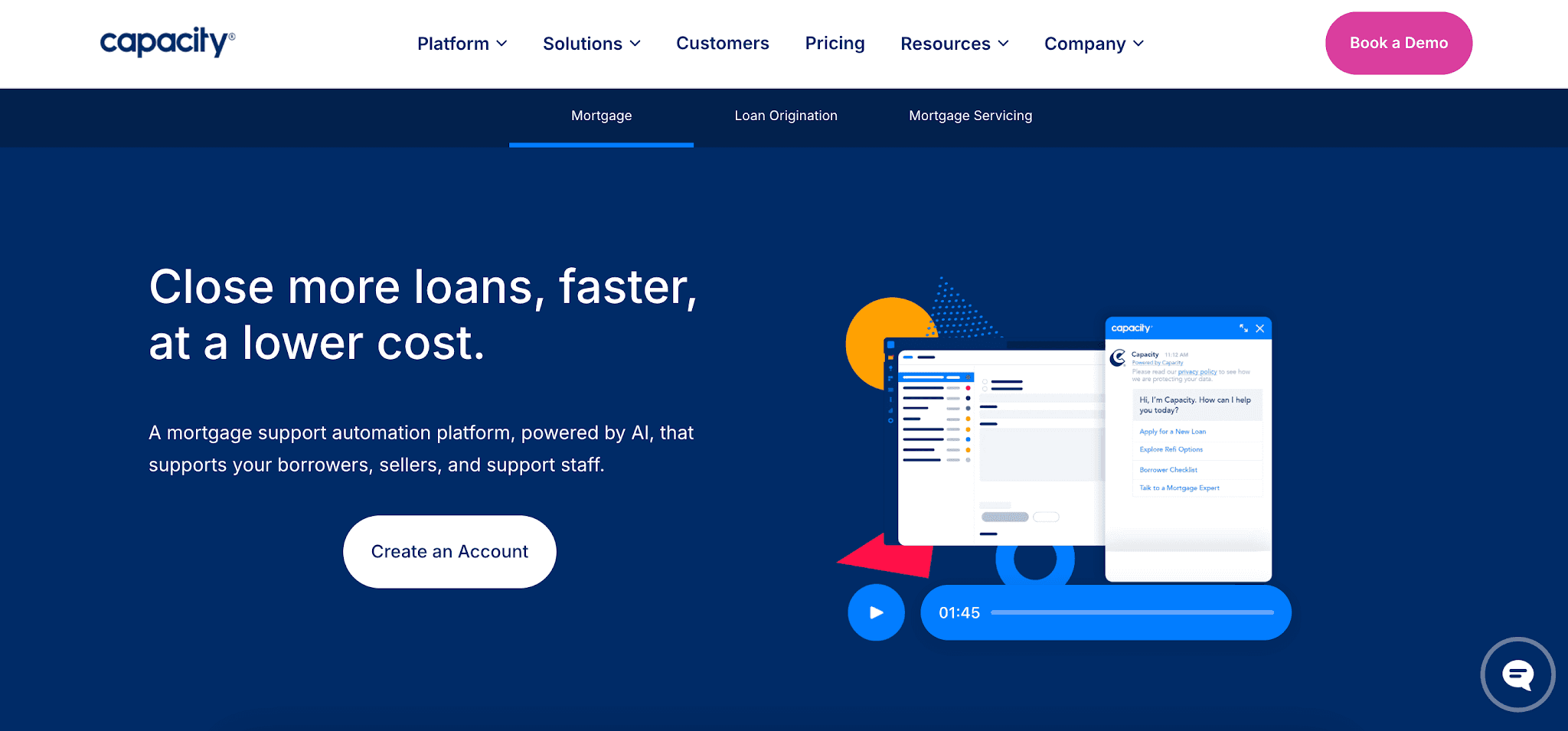
Image source: capacity.com/mortgage
Capacity is a support automation platform that helps mortgage teams handle borrower questions, file uploads, and general loan communication.
It combines a knowledge base, chatbot, and workflow tools to guide borrowers through the loan process and route routine back-office tasks. Users can submit natural language queries (NLQs), while staff manages cases through connected systems.
Capacity integrates with LOS and CRMs, which keeps communication and document handling in one place.
Key Features
AI-powered chatbot - Answers borrower questions using preset and learned responses
File collection assistant - Helps borrowers upload required documents
Knowledge management - Stores internal and external FAQs for fast support
Integrations - Connects with LOS and CRM platforms
Workflow tools - Automates form completion, ticket updates, and task routing
Pros and Cons
Users highlight the interface, general performance, product integrations, technical assistance, and the ability to see colleagues edit cases in real time.
Searching through older tickets can be difficult. The chatbot may also struggle to answer company-specific questions or use recently updated documentation accurately.
Capacity focuses more on borrower communication than deep document processing. Teams that need full control over data extraction may need to pair it with additional software.
5. LoanLogics
Image source: loanlogics.com
LoanLogics is a loan quality management platform that helps mortgage teams validate, audit, and process files throughout the loan lifecycle.
It’s often used during post-close reviews, where accuracy and compliance are critical. The system extracts information, recognizes file types, and organizes records, including scans and digital PDFs.
Lenders use LoanLogics to automate checks on income, assets, and property documents. It also compares extracted details with LOS data, tracks defects, and prepares completed loans for investor delivery.
Key Features
Automated document recognition - Identifies, classifies, and sorts incoming files
Post-close audit tools - Checks loans for accuracy, compliance, and completeness
Mortgage integrations - Connects with loan origination platforms and document repositories
Data verification - Confirms borrower information matches uploaded files
Audit readiness - Tracks defects, corrective actions, and document history
Pros and Cons
Users note that entering loan details and receiving case recommendations can simplify loan management. The format can take time to learn and may seem confusing at first.
LoanLogics centers on document processing and formal quality-control operations. Smaller lenders or companies that also need application intake and borrower communication may require another platform.
6. Blend
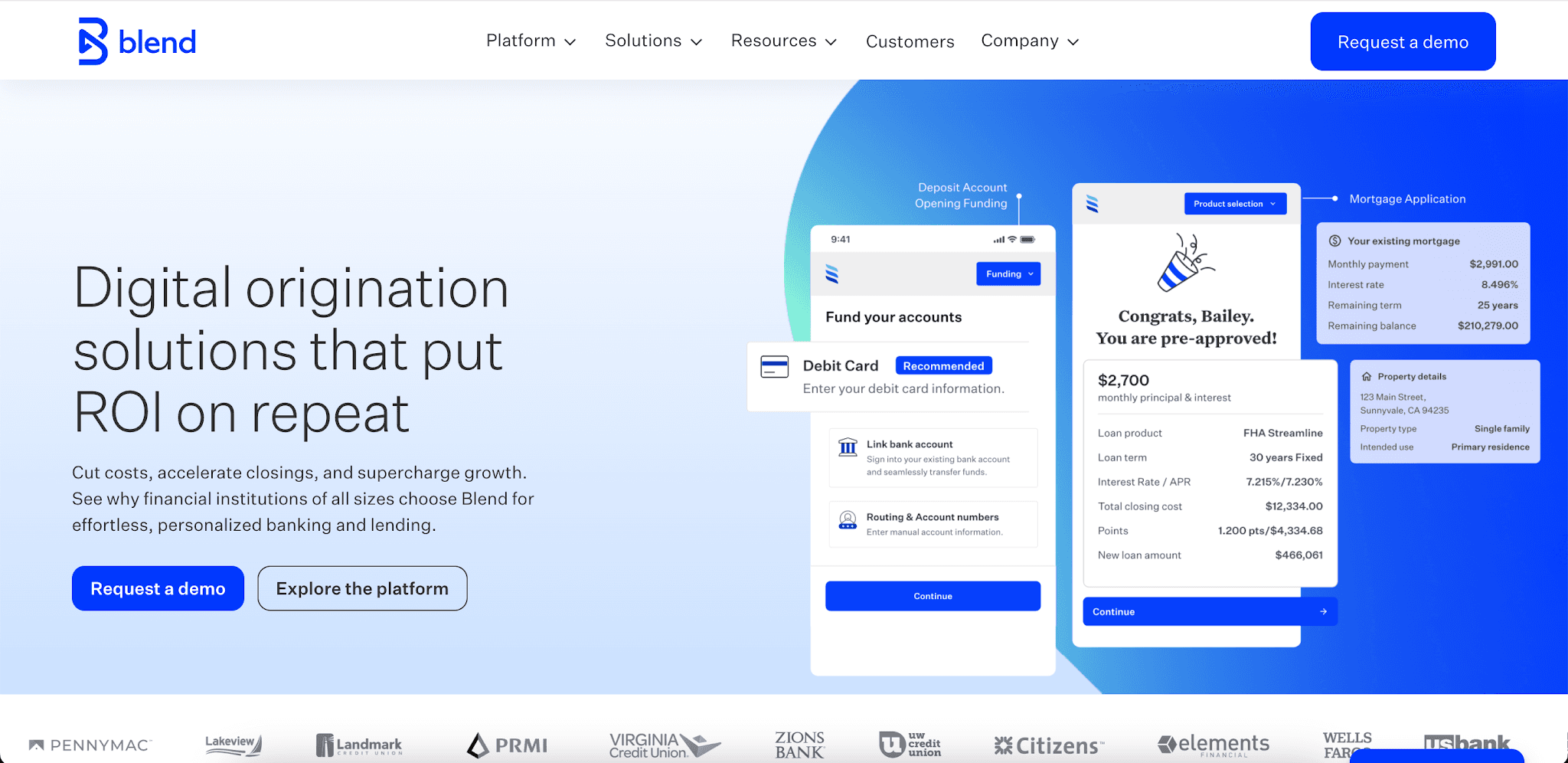
Image source: blend.com
Blend is a digital lending platform that helps mortgage lenders manage borrower-facing processes like loan applications, file uploads, and pre-approvals.
It focuses on making the frontend experience easier by offering a clean interface for borrowers to complete and track their applications.
Lenders use Blend to improve communication during intake and reduce delays in collecting documents and disclosures.
The platform connects with LOS and third-party services that verify employment, assets, income, and credit during early processing.
Key Features
Borrower portal - Let applicants track their progress and upload required files
Pre-filled forms - Uses existing client data to reduce repeated input
Digital verifications - Confirms employment, assets, and income
Task tracking - Keeps borrowers on schedule with to-do lists
Integration options - Connects with LOS platforms and third-party tools
Pros and Cons
Blend can remove several complications from application intake and document collection. Reliance on a third party for updates and technical help may create problems when issues arise.
Blend centers on digital origination and the applicant experience. Mortgage teams that need detailed data extraction, guideline checks, or automated condition management may require additional software to fill those gaps.
7. DocuClipper
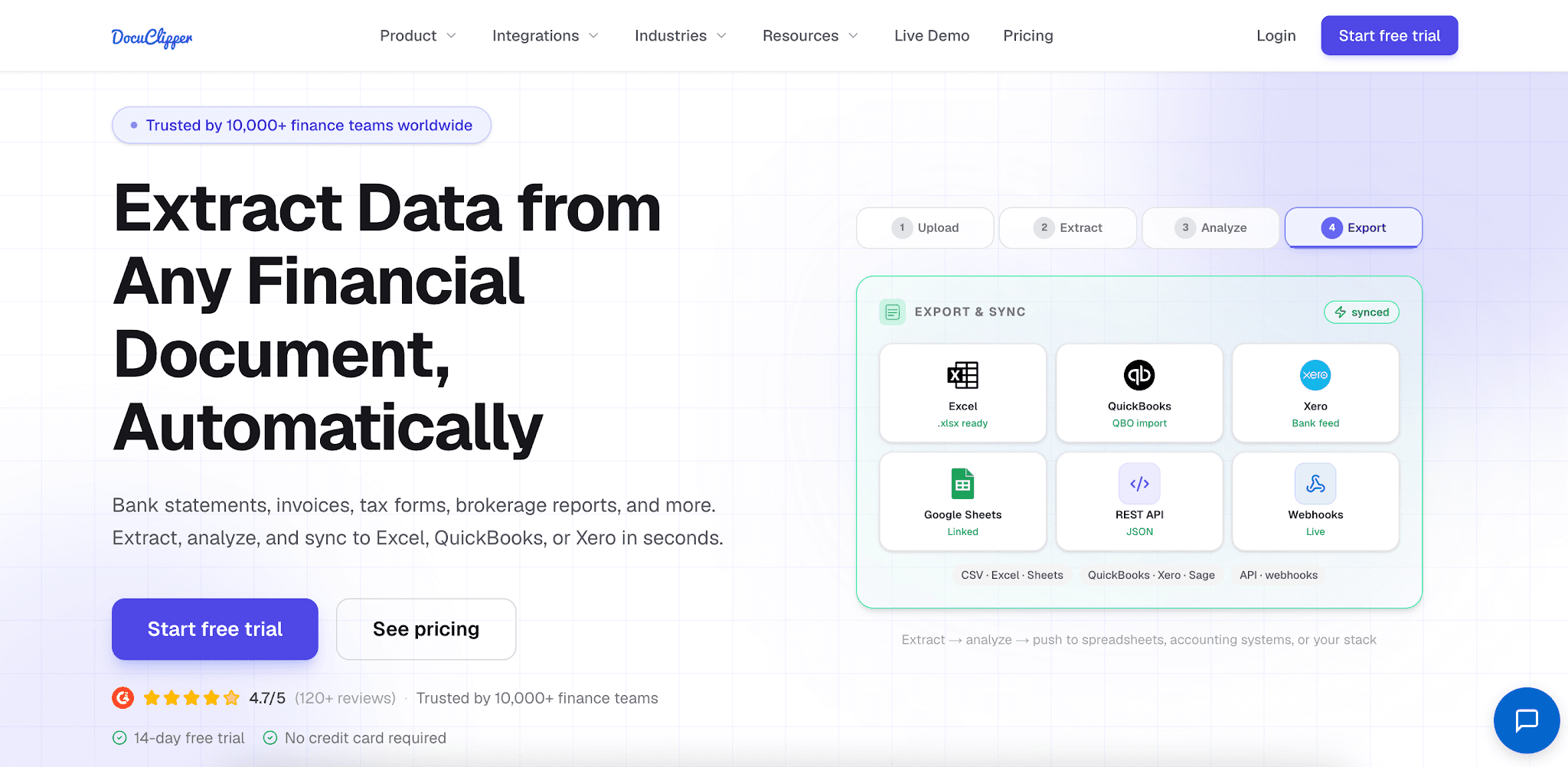
Image source: docuclipper.com
DocuClipper is a lightweight document conversion tool built to turn PDFs into usable spreadsheet data.
Financial teams use it to extract transactions, balances, summaries, and cash flow data from bank statements and convert them into CSV files or Excel formats.
Small businesses and accountants can process multiple statements through its drag-and-drop interface without advanced setup. Files can also be grouped by client for easier reference.
Key Features
Bank statement parser - Converts financial PDFs into spreadsheet-ready information
Multi-language support - Processes records from different regions
No setup required - Designed for quick uploads and fast results
Supports CSV and Excel exports - Sends extracted details to CSV, Excel, and accounting platforms
Simple user interface - Built for non-technical users
Pros and Cons
The drag-and-drop uploads save time when converting records for several clients. Organizing files by account also makes previous exports easier to locate.
Certain statement layouts can cause errors. The system may miss sub-accounts, transaction lines, or text, which requires manual correction.
DocuClipper focuses on financial record conversion. Users who need borrower communication, eligibility checks, condition management, or full loan automation can benefit from another software.
8. Hyperscience
Image source: hyperscience.ai
Hyperscience is a document automation platform used by large organizations to process complex forms and handwritten documents.
It uses machine learning and custom model training to extract and validate data from scanned forms, applications, and customer records.
Enterprises often choose Hyperscience to improve efficiency in operations that rely on high volumes of unstructured documents.
Financial services, insurance, and government organizations use Hyperscience for high-volume operations that rely on unstructured content. The platform includes classification, accuracy checks, and human verification steps.
Key Features
Handwriting recognition - Extracts data from handwritten forms
Content classification - Sorts and labels incoming files by type
Human-in-the-loop verification - Supports manual review and corrections
Unstructured format processing - Handles non-standard layouts and complex forms
Audit tracking - Records activity throughout each processing stage
Pros and Cons
The AI engine automates data extraction and repetitive entry. Processing large data volumes can cause lag, particularly in older versions.
Hyperscience is built for large organizations with technical resources. Finance providers seeking a quick setup may find the platform complex for daily loan processing.
9. Veryfi

Image source: veryfi.com
Veryfi is a data extraction platform focused on receipts, invoices, bank statements, and other financial records. It helps accounting departments and businesses capture and organize financial data in real time.
The platform works through mobile apps, APIs, and web uploads, making it easy to process documents from different locations.
Teams use Veryfi to automate expense tracking, prepare financial records, and send structured data into bookkeeping systems. It’s built for fast processing and includes features like mobile scanning and instant field recognition.
Key Features
Real-time OCR - Extracts data instantly from receipts and invoices
Mobile capture - Scan and process documents directly from mobile devices
APIs for developers - Integrate data capture into existing workflows
Hybrid extraction - Combines specialized models with large language models (LLMs) for varied layouts
Financial record processing - Handles receipts, bills, and statements
Audit trails - Tracks how and when data was extracted
Pros and Cons
Traceable activity can simplify the preparation of tax office archives. Mobile capture also lets clients photograph records on-site and send them to a shared workspace.
Default export formats may require manual reformatting to meet specific archive requirements. Veryfi also lacks automated file locking, which can extend audit preparations.
Veryfi is designed more for expense management than mortgage or loan workflows. Teams focused on underwriting or document review may need additional tools to manage those processes.
How to Choose an Ocrolus Alternative That Fits Your Needs
Before switching platforms, take a moment to assess what your team needs across the loan process. Some platforms handle one task. Others support everything from intake to closing.
Here are the key factors to consider when choosing the right Ocrolus alternative.
Start With Your Loan Workflow
Map your current workflow and identify where manual work remains. Some organizations only need financial record processing or cash flow analytics. Others need borrower follow-ups, decision checks, and complete file preparation.
Addy handles document intake and later loan tasks without forcing you to replace your existing systems.
Check for System Compatibility
Choose a tool that fits into your existing tech stack. Addy connects with CRMs, LOS platforms, email inboxes, and shared drives. It supports product teams that want to keep their business operations intact while improving loan processing speed and visibility.
Look for a User-Friendly Interface
Give your team tools they can use without training. Addy's easy-to-use UI helps non-technical users complete tasks without relying on developers. Teams move faster and make fewer errors when they don’t have to figure out the interface.
Understand Your Automation Goals
List the tasks you want the system to complete, not just the information you want it to extract. Addy uses natural language processing (NLP) and AI agents to complete tasks like follow-ups and eligibility checks. If your team needs more than OCR, automation should be a top priority.
Match the Tool to Your Team Size
Compare setup fees, usage charges, contract terms, and costs at higher volumes. Ask each provider to explain how pricing changes as your pipeline expands.
This gives you a more accurate picture of the total cost before implementation. Addy offers custom pricing, so you can scale without paying for features you don’t need.
Keep Security and Compliance Top of Mind
Protect your borrower data and reduce risk. Addy includes mortgage fraud detection, audit trails, and built-in document validation. It uses a security service to protect your environment from online attacks and technical errors that might trigger the security solution.
Evaluate Performance and Reliability
Choose a platform that supports growth without slowing you down. Avoid tools that send commands or malformed data, break when users phrase a SQL command incorrectly, or crash when submitting a certain word or phrase.
Addy runs in a secure sandbox environment, so your team stays productive under pressure.
Why More Lending Operations Choose Addy Today
Lenders are choosing Addy because it handles more than just financial document processing. Its AI agents read loan records, apply rules from more than 20,000 lending guidelines, and complete tasks throughout the file.
Rather than stopping at data extraction, Addy checks eligibility, analyzes income, identifies missing items, and compares information with lender-specific policies. It can also contact borrowers and brokers when additional records are needed.
Addy connects with LOS, CRM platforms, email, Slack, and Microsoft Teams. Financial institutions can keep their existing systems while adding automation for manual tasks.
Built-in validation and traceable activity help loan processors catch discrepancies before they cause delays. Custom rules automate routine checks while reserving human review for exceptions that require professional judgment.
Addy: The Ocrolus Alternative That Handles the Work for You!
Finding the right Ocrolus alternative depends on what still slows your loan workflow down. Each competitor listed here brings something useful to the table. Still, few offer the flexibility, automation, and operational speed that mortgage teams need to close more loans.
Addy helps lenders move away from manual work, reduce delays, and stay focused on closing loans.
If you're looking for a faster way to process 1003s, W-2s, tax returns, bank statements, and more, Addy’s Document AI for Mortgage Lending can help. It extracts key information, flags discrepancies, and identifies missing items before they hold up the file.
FAQs About Ocrolus Competitors
Is Ocrolus a mortgage document processing platform?
Yes. Ocrolus is a mortgage document processing platform that classifies records, extracts data, calculates income, and supports loan analysis.
Can Ocrolus process complex financial documents?
Yes. Ocrolus supports more than 2,100 financial document types, including bank statements, pay stubs, W-2s, and tax returns. Available processing features depend on the file type and selected service.
How much does Ocrolus cost?
Ocrolus doesn’t publicly publish a fixed price list. Pricing depends on file types, extraction requirements, processing volume, and contract terms.
Start closing more loans – Book your demo today
Stay ahead of the competition and discover how AI can accelerate your loan origination process, reduce manual work, and help you close more deals in less time. Book a demo today and start experiencing the future of lending.