Michael Vandi
Small and medium-sized business (SMB) lenders often spend hours checking borrower information and replying to emails manually.
At the same time, borrowers expect quick updates and a smoother lending experience.
That’s why more lenders are exploring AI agents for SMB lending workflows. These systems help lenders organize borrower files and process loan applications faster while underwriters continue making final lending decisions.
This guide explains how AI agents work, where they help, common mistakes to avoid, and practical use cases for SMB lending.
Need a faster way to prepare loan files and track missing conditions? Book an Addy demo today!
TL;DR
AI agents for SMB lending workflows help lenders organize files, check loan documents, and automate borrower communications.
Lenders use AI agents to process bank statements, tax returns, and uploaded borrower paperwork before files reach underwriters.
AI agents can identify missing details, income issues, document conflicts, and policy concerns before the file moves toward approval.
Underwriters still review fraud-detection alerts, compliance concerns, and credit decisions that require human oversight.
Addy helps lenders analyze loan files, request documents, track conditions, and manage lending workflow tasks inside existing systems.
What Are AI Agents in SMB Lending?
AI agents for SMB lending workflows are software programs that complete lending tasks with limited employee input.
During loan origination, AI agents can organize borrower files automatically after upload. They can also compare borrower information against credit policies and notify borrowers when paperwork is incomplete.
They’re different from basic chatbots. A chatbot answers questions with mainly preset answers, whereas autonomous AI agents can review borrower documents, update loan files, and notify employees when information is missing.
This is useful for small business lenders and credit unions that rely on manual reviews and data entry.
For example, AI agents can help verify uploaded documents, monitor open conditions, and organize files earlier in the lending process.
Human analysts still make credit decisions that require judgment and human oversight. AI agents take over repetitive administrative work, so lending staff spend more time speaking with borrowers.
How Do AI Agents Handle SMB Lending Workflows?
AI agents handle loan tasks that usually take lenders hours to finish manually. Here’s how lenders use them throughout SMB lending workflows.
Gather Borrower Information Automatically
Borrowers often submit paperwork through online applications or email attachments. AI agents can collect and organize that information automatically.
If documents are missing, the system can request updated bank statements or tax returns from the borrower. Employees spend less time sorting paperwork and re-entering borrower information manually.
Extract Data From Lending Documents
AI agents use optical character recognition (OCR), document parsing, and natural language processing (NLP) to read borrower documents.
The software can pull relevant lending information from uploaded paperwork. It may identify recurring expenses from bank statements or verify employer details from pay stubs and tax returns.
The system can then transfer that borrower data into loan origination systems (LOS) and core banking platforms.
Check Applications Against Lending Requirements
AI agents compare borrower information against lending policies and risk assessment rules.
The software might detect missing paperwork or flag income figures that don’t match between documents. It can also identify debt-to-income (DTI) concerns or unusual transaction activity before the file moves forward.
Many agent platforms also keep audit trails for compliance and regulatory requirements.
Send Follow-Ups and Route Files for Review
AI agents can notify borrowers when documents are incomplete or when additional paperwork is needed.
The system can also update application statuses and assign review tasks to employees. During loan servicing or collections, it may send borrower communications through email or trigger outbound calls automatically.
Loan officers and underwriters still review mortgage fraud red flags and final loan decisions that require human judgment.
What Are the Key Features of AI Agents for SMB Lending?
When lenders evaluate AI agents for SMB lending workflows, they should focus on the following capabilities.
Read Different Types of Borrower Documents
Borrowers submit paperwork in many formats. Lenders often receive scanned PDFs, screenshots, mobile uploads, and handwritten forms.
AI agents should recognize document types automatically and organize uploaded files correctly. That prevents employees from spending hours renaming documents or sorting paperwork manually.
Catch Inconsistent Borrower Information
AI agents should compare borrower information between documents and flag missing or conflicting details before approval decisions.
For instance, the software might detect discrepancies in income between tax returns and bank statements. It can also identify unsigned forms or missing pages before the application moves deeper into the lending process.
Lenders can catch human error earlier rather than finding problems late in the application process.
Reference Lending Policies During Review
Lending requirements change frequently, especially for financial institutions offering multiple loan products.
AI agents should compare applications against underwriting conditions, credit policies, and eligibility requirements during processing.
Platforms that use retrieval-augmented generation (RAG) can also pull updated lending guidelines during underwriting preparation.
That prevents employees from searching through policy documents manually.
Send Borrower Updates Automatically
Borrowers often stop responding when communication becomes inconsistent.
AI agents can notify borrowers when documents are missing or when application statuses change. A borrower who forgets to sign a required form may receive a reminder automatically before the file stalls.
During servicing or collections, the software can also send payment reminders without employees following up manually every time.
That gives loan officers more time for borrower conversations and relationship-building.
Connect With Existing Lending Software
AI agents should work inside the systems lenders already use daily.
That includes LOS, customer relationship management (CRM) software, and borrower portals. When platforms connect properly, employees no longer waste time copying borrower information between multiple systems.
Borrower updates remain consistent because information syncs directly between lending platforms.
Track Compliance and User Activity
Financial institutions need detailed audit trails showing who reviewed documents or approved loan conditions.
AI agents should also include user permissions and monitoring controls connected to compliance requirements.
Compliance teams can inspect employee activity later if questions come up during audits or internal reviews.
Benefits of Using AI Agents for SMB Lending Workflows
Lenders often lose hours reviewing uploaded documents, correcting data entry mistakes, and checking whether borrower files are complete.
AI agents can process loan applications earlier and identify missing paperwork before underwriters open the file.
The software may also compare income data between tax returns and bank statements to catch conflicting information sooner.
Borrowers receive quicker status updates and more consistent borrower communications. Applicants are less likely to disappear during document collection when communication remains consistent.
Artificial intelligence can also improve document understanding during underwriting preparation.
In many cases, the system can identify identity verification issues or unusual transaction data before human intervention becomes necessary.
This becomes useful during busy lending periods when application volume increases suddenly. Lenders can process more loan approvals without overwhelming operations staff.
Research on artificial intelligence in financial services workflows found that lenders automated an average of 62.40% of underwriting decisions. That’s why many financial institutions now use AI agents to review applications before files reach underwriting staff.
Real-World Examples of AI Agents in SMB Lending
AI agents already help lenders manage everyday lending tasks that usually consume hours of employee time. Here are a few common examples:
Application intake: A borrower uploads part of the required paperwork. The AI agent requests missing bank statements and organizes uploaded files inside the correct loan application. That prevents employees from checking email attachments and renaming files by hand.
Financial review: An agent reads business financials and bank statements to identify revenue patterns, recurring expenses, overdrafts, and large withdrawals before underwriters assign a risk score.
Eligibility review: Specialized agents compare borrower information against lending policies and flag DTI issues, missing tax returns, or cash flow concerns before manual intervention starts.
Condition management: In multi-step workflows, an AI agent can check open conditions and confirm whether the borrower has already sent the requested file.
Post-funding communication: Agentic AI can send servicing notices, payment reminders, and borrower updates through email, chat, or borrower portals. Borrowers receive updates sooner, even outside normal business hours.
These examples show where AI agents can help, but lenders still need to deploy them carefully to avoid workflow and compliance issues.
Common Mistakes to Avoid When Deploying AI Agents in SMB Lending
A common mistake is assuming AI can approve loans without human review.
AI can organize borrower information and flag unusual activity, but underwriters still make final lending decisions that require judgment.
Lenders also create risk when AI agents receive unrestricted access to internal systems. Borrower data and underwriting platforms should remain protected through user permissions and access controls.
Poor data quality causes problems, too. Outdated lending policies or inconsistent workflow rules can lead to incorrect application checks during processing.
Software selection creates another issue. Many lenders rely on polished demos without testing how the platform performs during daily loan operations or busy lending periods.
Continuous monitoring also matters after launch. Lenders should regularly inspect escalated loan files to confirm the AI follows updated lending policies correctly.
Platforms like Addy help lenders connect AI agents more closely to daily lending workflows. The software can assist with underwriting preparation, borrower communication, and document processing throughout the loan process.
Simplify Document-Heavy Lending Workflows With Addy
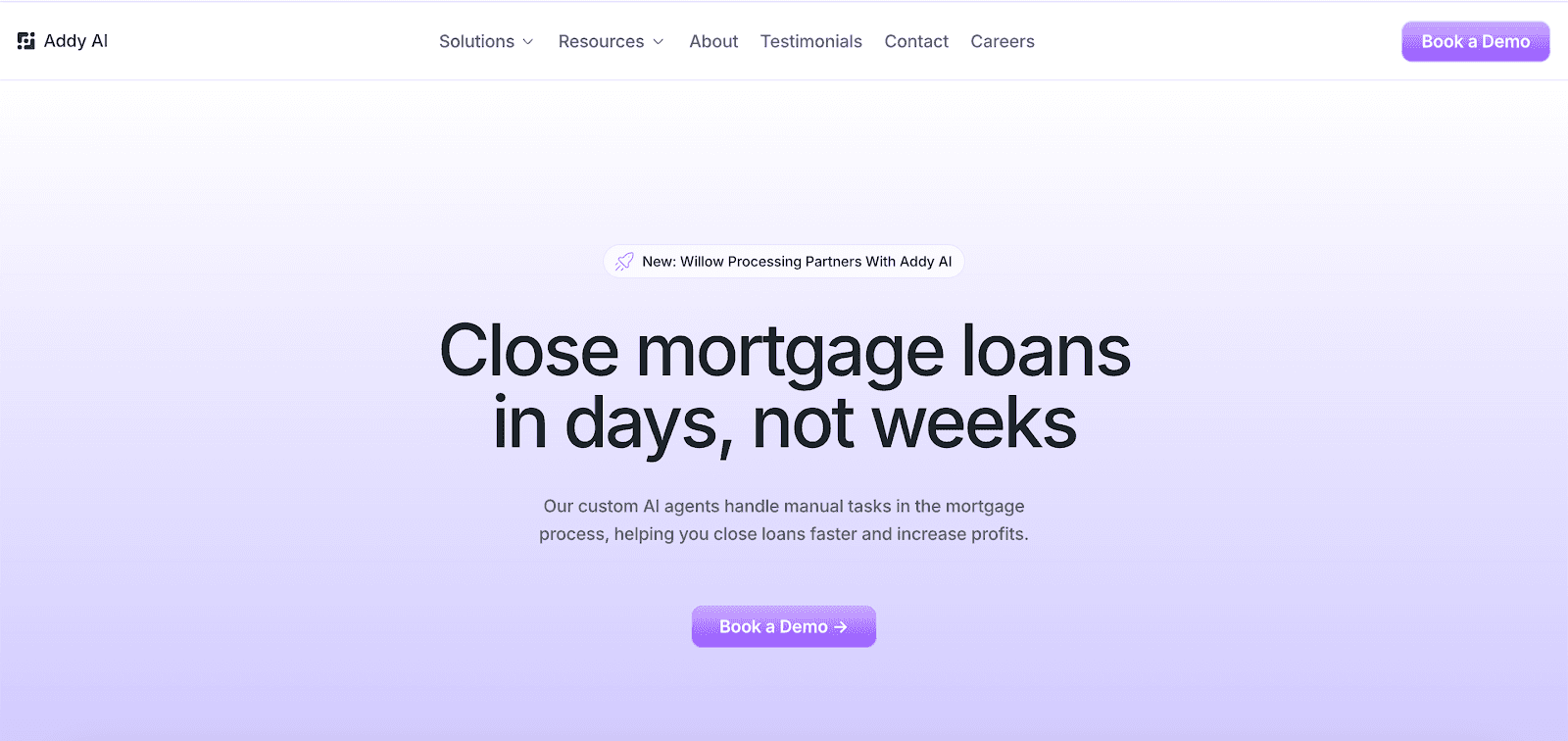
Addy facilitates lenders’ use of an agentic workflow during loan origination and underwriting preparation.
Unlike traditional automation, Addy can review documents, check lending guidelines, request missing items, and help prepare files before underwriters review the application.
You can use Addy for specific tasks such as:
Extract borrower data from tax returns, bank statements, pay stubs, W-2s, and business financials
Review loan files against lending guidelines and AUS findings
Identify missing documents and open conditions
Request outstanding items from borrowers automatically
Sync loan data with your LOS
Addy also connects with CRM software, point-of-sale (POS) systems, Gmail, Outlook, Slack, Microsoft Teams, Salesforce, HubSpot, and Google Drive.
The platform includes pre-built AI agents for document processing and borrower communication. Specialized agents can review uploaded files or request missing borrower documents automatically.
You can also train custom AI agents using internal lending guidelines and rate sheets.
Addy works alongside human review rather than replacing it. You still review fraud concerns, underwriting exceptions, and final approval decisions.
Spending too many hours reviewing files and requesting documents manually? Book an Addy demo today!
FAQs About AI Agents for SMB Lending Workflows
What are the five types of AI agents?
The five common AI agent types are:
Simple reflex agents
Model-based agents
Goal-based agents
Utility-based agents
Learning agents
In lending, they help automate document review, borrower communication, and underwriting tasks through intelligent automation.
What is the AI in the lending process?
AI in lending helps lenders review applications, organize borrower files, check loan conditions, and monitor risk. It can also read unstructured data from bank statements, tax returns, and uploaded documents before underwriters review the file.
Is ChatGPT an AI agent for lending?
No. ChatGPT is mainly a conversational AI tool that answers questions and generates responses.
AI agents for lending go further by reviewing documents, updating systems, and completing lending tasks automatically. That gives lenders a stronger business case for using AI during loan operations.
Start closing more loans – Book your demo today
Stay ahead of the competition and discover how AI can accelerate your loan origination process, reduce manual work, and help you close more deals in less time. Book a demo today and start experiencing the future of lending.