Michael Vandi
Loan officers can get leads from referrals, websites, paid campaigns, and past customers. Keeping track of every source, owner, and follow-up gets harder as the pipeline expands.
Mortgage lead tracking software helps organize that activity and gives teams a better mortgage lead management process. Other mortgage platforms may handle applications, loan records, or processing tasks.
This guide compares the five best options and explains what to look for when choosing the right setup.
TL;DR
Here are the five best mortgage lead tracking software platforms to consider in 2026:
Jungo: Best for Salesforce-based CRM and referral tracking
Lendware: Best for configurable mortgage CRM workflows
Shape: Best for mortgage lead routing and prioritization
ICE Surefire: Best for mortgage lead nurture and marketing
Total Expert: Best for enterprise mortgage lead management
What Is Mortgage Lead Tracking Software?
Mortgage lead tracking software helps lenders, brokers, and loan officers capture prospects, record lead sources, assign ownership, track pipeline stages, manage follow-ups, and measure conversions.
For mortgage professionals, it records how a prospect entered the pipeline and who owns the relationship. That makes mortgage lead management easier as inquiry volume grows.
To understand how it works in practice, let's look at the main parts of lead tracking, from source attribution to conversion measurement.
Mortgage Lead Source Tracking
Lead source tracking connects each prospect with the channel that brought them in. Sources can include realtor referrals, website forms, paid search, social ads, landing pages, and past clients.
The next question is which channels produce applications and closings.
Paid search might deliver more leads, while referral partners generate a higher share of funded files. Marketing leaders can use that comparison when deciding where to spend.
Mortgage Pipeline Tracking
Mortgage pipeline tracking shows how far a lead has progressed through the sales cycle. An originator can tell whether someone is newly contacted, completing an application, or nearing closing.
Common stages include:
New lead
Contacted
Pre-qualified
Application started
Application submitted
Processing
Underwriting
Conditional approval
Clear to close
Funded
Mortgage pipeline management also helps managers spot where leads tend to drop out. If several files stop after application submission, that stage deserves attention.
Pipeline stages can correspond with milestones in a loan origination system (LOS). Lead tracking follows the sales opportunity, while the LOS stores official application details and loan milestones.
Mortgage Lead Routing and Assignments
Lead routing decides who receives a new prospect. The assignment can depend on state licensing, branch location, workload, borrower history, or how the person entered the pipeline.
Round-robin distribution spreads new contacts among eligible originators. Capacity rules can prevent one person from receiving too many, while state filters route borrowers to properly licensed loan officers.
Returning borrowers can go back to the originator they already know. Lead scoring can also rank new leads by intent, giving the sales team a practical order for outreach.
Lead Follow-Up and Borrower Nurture
Follow-up features help originators manage contact after the first conversation. Mortgage customer relationship management (CRM) software can log calls, texts, and emails while scheduling the next task.
Timing matters here. A missed call can trigger another attempt, while an unfinished application can prompt a reminder at a set time.
After closing, continued contact can bring former borrowers back for refinances, future purchases, or referrals.
Mortgage Lead Conversion Tracking
Conversion tracking shows how effectively leads progress from first contact to funded loan. It also helps lenders compare channel performance and originator results.
Useful metrics include:
Lead-to-contact rate
Lead-to-application rate
Application-to-close rate
Funded-loan conversion rate
Conversion by lead source
Referral performance
Campaign results
Loan officer performance
Comparing conversion rates adds context to lead volume. A channel with fewer leads can deliver more closings if a higher percentage completes the process.
Sales managers can also compare assigned leads with applications and funded files. That shows where performance is strongest and where prospects leave the pipeline.
Top 5 Mortgage Lead Tracking Software Options for 2026
Mortgage tracking platforms vary in lead ownership, referral activity, communication, and origination-system connections. Compare those functions against the sales model and technology stack already in use.
1. Jungo: Best for Salesforce-Based CRM and Referral Tracking
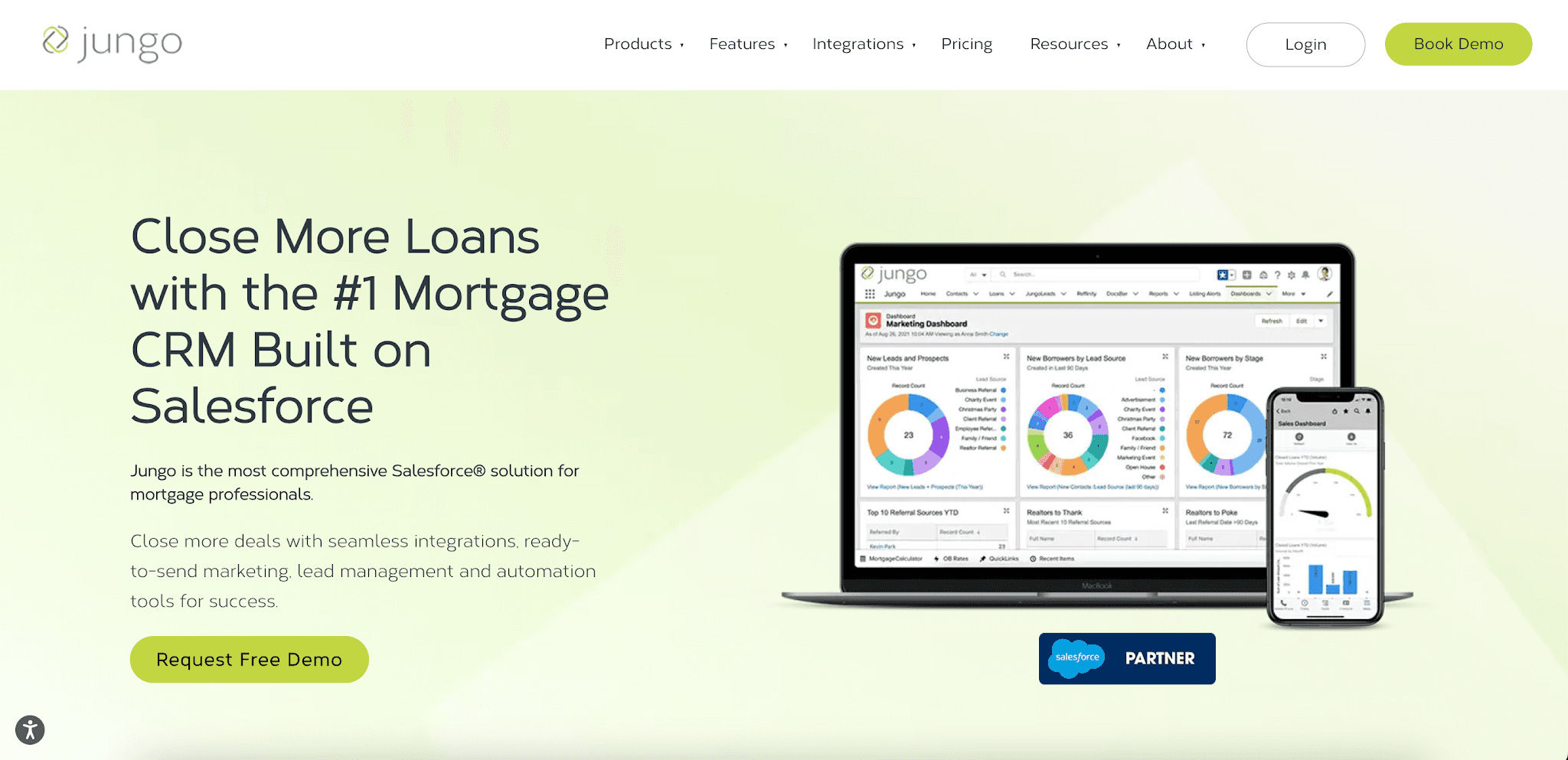
Image source: ijungo.com
Jungo is a Salesforce-based mortgage-specific CRM for loan officers and brokers. It brings prospect records, sales activity, and borrower relationships into a Salesforce environment designed for loan origination.
The platform also gives referral activity its own place in the CRM. Reffinity records who sent a borrower and follows the resulting transaction through the pipeline.
Key Features
Lead capture and assignment: Jungo receives leads from Zillow, LendingTree, Trulia, and Informa Research Services. Distribution rules send new contacts to selected originators based on lender criteria.
Referral reporting: Reffinity records referral volume and results by partner. Automated pipeline reports update partners as referred borrowers progress.
Pipeline visibility: Jungo's Pipeline View displays active transactions and contact activity, giving users a view of progress from prospect to active file.
Follow-up tools: Task alerts, email notifications, and drip campaigns help mortgage loan officers stay on schedule after initial contact.
Marketing automation: Automated email campaigns, trigger-based messages, video marketing, and co-branded materials cover borrower and partner outreach.
LOS connections: Encompass, Calyx Point, Byte, LendingPad, and Velocity integrations transfer information between Jungo and the origination system.
DocsBar: Correspondence and file records remain attached to the contact profile. As items arrive, the document checklist can update outstanding borrower requests.
When to Consider Jungo
Explore Jungo if Salesforce already forms part of the technology stack. Its Salesforce foundation also means buyers need to account for the administration that comes with that environment.
Jungo also addresses a specific use case for mortgage brokers who rely on realtor and partner referrals. Reffinity gives them a way to trace those relationships from referral through transaction activity.
If you mainly need basic lead capture and follow-up, compare that scope with the amount of Salesforce administration Jungo requires.
2. Lendware: Best for Configurable Mortgage CRM Workflows
Image source: lendware.ai
Lendware is mortgage lead management software for lenders that want centralized CRM controls alongside branch-level configuration. Administrators set permissions, while individual groups can adjust fields, statuses, and mortgage workflows.
Lendware Predict adds contact scoring for purchase and refinance leads. It uses CRM and consumer information to calculate a Readiness to Transact Score.
Key Features
Custom pipelines: Users can configure contact and transaction stages, fields, statuses, and tags around their internal sales process.
Workflow automation: Lendware includes more than 80 prebuilt playbooks and a no-code builder for custom rules.
Communication: Two-way text messaging, email, and an in-app dialer keep borrower conversations attached to contact records.
Task management: Users can assign tasks, receive alerts, and trigger new work from automated rules.
Lead capture: Embedded forms and single-property sites send new contacts into the CRM.
Lendware Predict: The tool ranks purchase and refinance leads using CRM information and more than 5,000 consumer signals. It refreshes Readiness to Transact Scores daily as new activity appears.
Reporting: In-app reports cover branch activity, campaigns, referral performance, and producer results.
Integrations: Lendware offers native integrations and more than 100 prebuilt connectors for LOS, point-of-sale (POS), lead-source, and related platforms.
When to Consider Lendware
Review Lendware when different branches or producer groups use different CRM configurations under centralized oversight. Administrators can control permissions without forcing every group into the same pipeline.
Lendware Predict addresses lenders with older purchase and refinance contacts. Its scoring gives originators a way to rank those contacts before starting outreach.
Before choosing Lendware as a lead management system, compare its connectors with the LOS, POS, and lead sources already in use. That shows which systems can exchange information without manual data entry.
3. Shape: Best for Mortgage Lead Routing and Prioritization
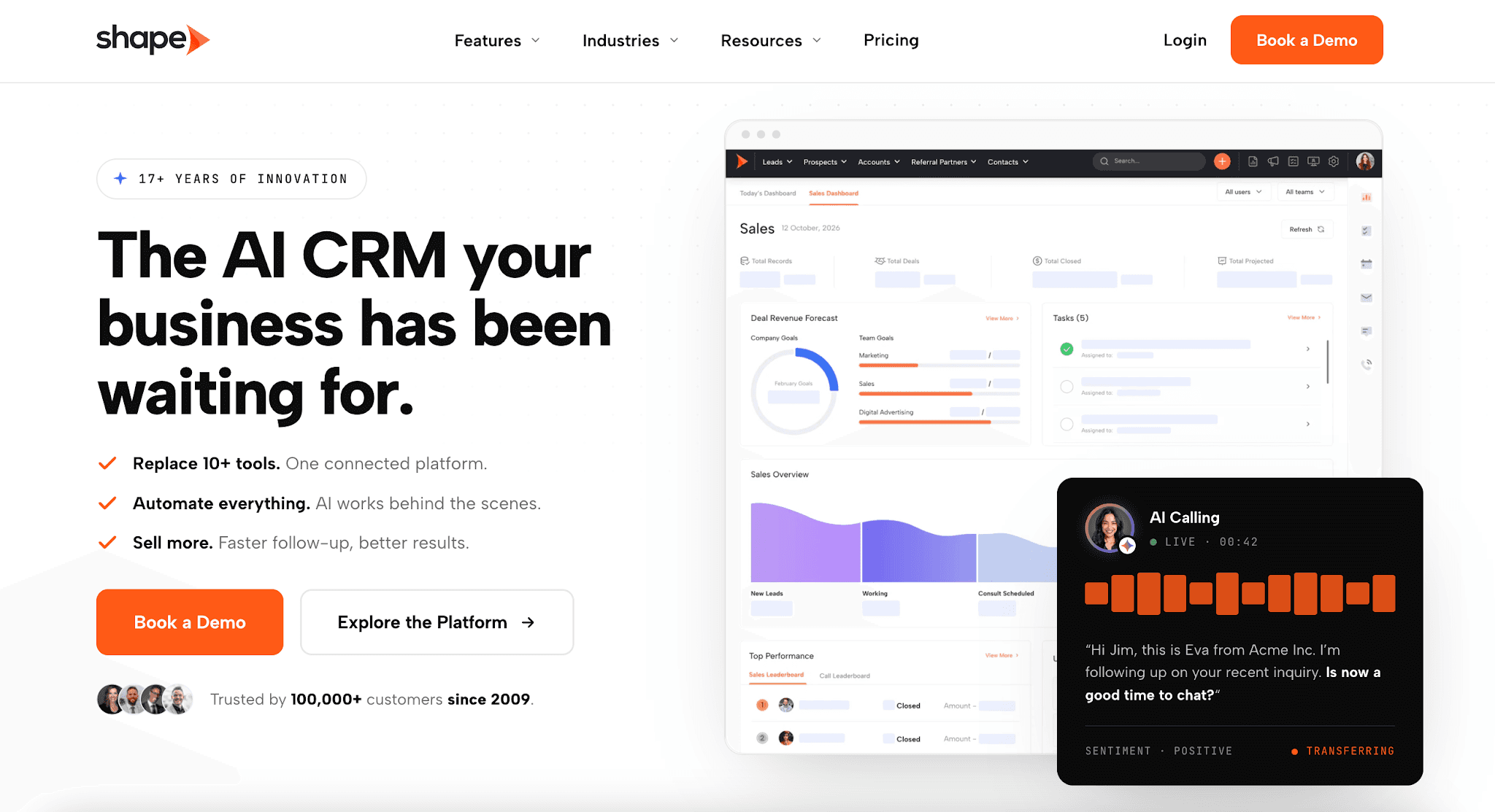
Image source: setshape.com
Shape is a CRM for mortgage teams that manage high volumes of mortgage leads. It covers prospect capture, assignment, communication, scoring, follow-up, and conversion reporting.
Its main value in this comparison is how it controls lead distribution and helps originators prioritize who to contact first.
Key Features
Lead capture: Shape accepts leads through application programming interfaces (APIs), web forms, providers, and bulk imports. Source tracking records where each contact originated.
Duplicate management: The system matches records using email, phone number, and other criteria. It merges history, notes, and activity into one profile.
Lead routing: Round-robin, QuickFire, Shark Tank, and rule-based assignment control distribution. State filters direct leads to originators licensed in that location.
Lead redistribution: Shape can reassign missed prospects when the first owner doesn't respond, giving another originator a chance to make contact.
ShapeIQ scoring: Machine learning uses source, behavior, profile details, calls, and engagement to estimate conversion intent. Scores update as prospects respond to outreach.
Priority queues: Higher-scoring leads rise in the queue. Score changes can also trigger assignment rules or follow-up.
Built-in communication: Calling, text messaging, and email remain inside each contact record, so originators can track outreach without leaving the CRM.
Lead nurture: Drip campaigns and templates help users continue outreach after first contact.
Reporting: Shape tracks lead conversion rates, cost per acquisition (CPA), customer acquisition cost (CAC), and marketing return on investment (ROI).
LOS connections: Shape connects with Encompass, LendingPad, Arive, and other origination systems that can sync assignments and milestones.
When to Consider Shape
Shape is one option for consumer-direct lenders that receive a high flow of leads and distribute them among several originators. Multi-state operations can also use licensing rules when assigning contacts.
Its scoring and routing features are more useful when response time and contact priority play a major role in the mortgage sales process.
4. ICE Surefire: Best for Mortgage Lead Nurture and Marketing
Image source: topofmind.com
Surefire is part of ICE Mortgage Technology and combines CRM functions with marketing automation for the mortgage industry. It covers lead nurture, milestone communication, referral outreach, and post-close engagement.
That approach places more weight on ongoing communication than lead scoring.
Key Features
Lead distribution: Surefire includes round-robin and Shark Tank assignment for consumer-direct operations. Assigned contacts can enter nurture sequences after distribution.
Lead nurture: Automated workflows send educational and sales messages as prospects progress from initial interest through application and funding.
Milestone communication: Lenders can trigger borrower messages when an origination file reaches selected events, such as underwriting submission or approval.
Marketing automation: Surefire uses email, text, video, social media, and other channels for lead and borrower outreach.
Post-close outreach: Client for Life campaigns continue communication after closing to encourage referrals and repeat business.
Referral tools: Co-branded campaigns, partner workflows, and Pulse Reports help track relationships with real estate agents and other referral sources.
Reporting: Dashboards track pipeline activity, campaign engagement, referral activity, and sales results.
Mortgage integrations: Surefire connects with Encompass, Calyx, LendingPad, LendingQB, Blend, Floify, and other mortgage software.
When to Consider ICE Surefire
Explore Surefire if mortgage lenders prioritize borrower nurture, referral outreach, and post-close communication. It also covers retail, consumer-direct, and wholesale operations with different messaging rules.
Surefire can handle marketing alongside an existing CRM that manages primary contact records. Its connectors and APIs let lenders add these functions without replacing their main CRM.
5. Total Expert: Best for Enterprise Mortgage Lead Management
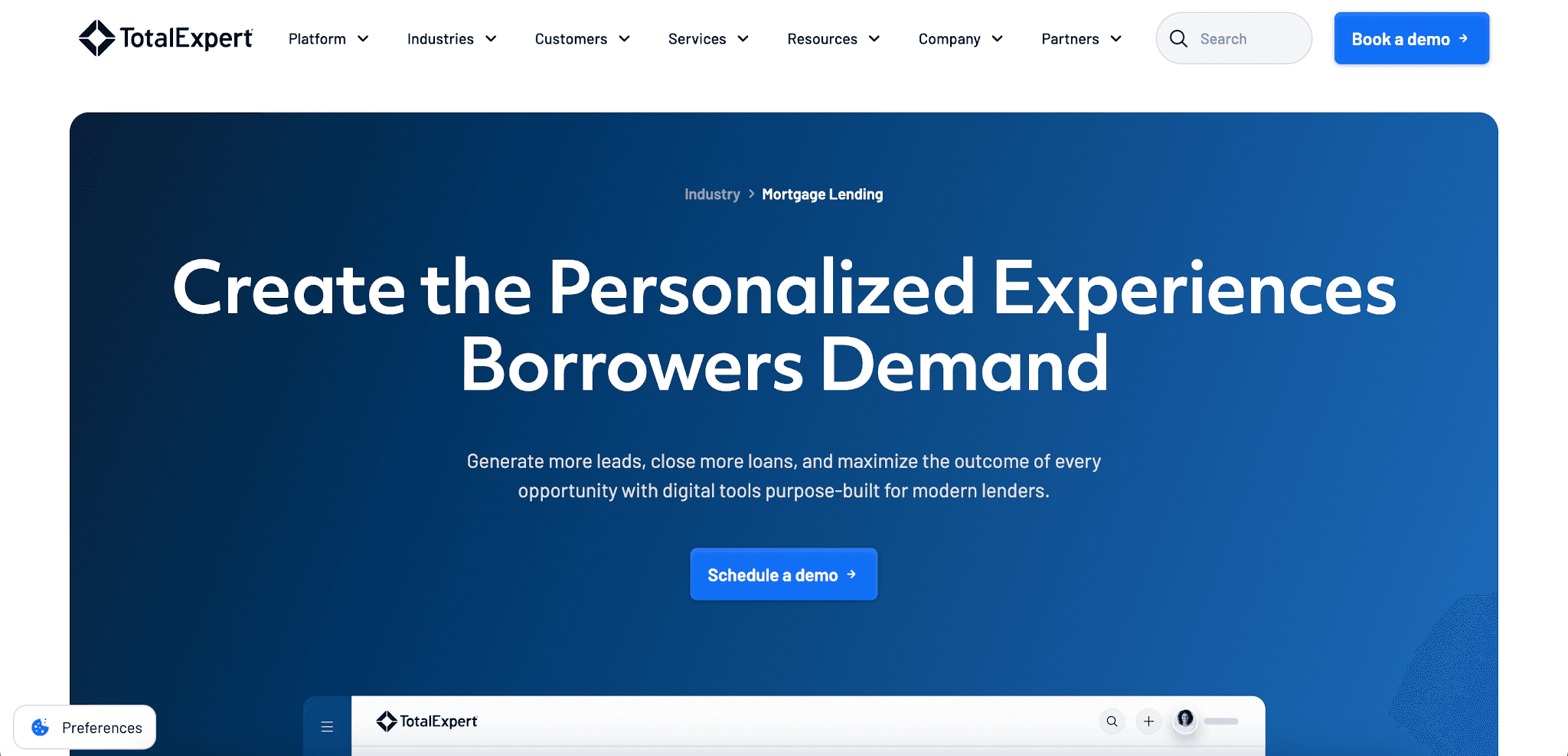
Image source: totalexpert.com
Total Expert is a financial-services CRM platform with dedicated lead-management tools for lenders. It covers the sales activity that happens before and during application, including lead ownership, outreach, and conversion tracking.
For mortgage operations, the platform connects early sales activity with later origination progress. That gives originators context as leads move through the mortgage process.
Key Features
Lead capture and source tracking: Total Expert creates records from campaigns, referrals, servicing portfolios, Customer IQ insights, and bulk imports. Source and assignee fields show lead origin and ownership.
Intelligent routing: Assignment rules can use state licenses, ZIP codes, active volume, and existing borrower relationships. Round-robin and fallback rules control distribution when several originators share incoming leads.
Pipeline visibility: Users can filter contacts by source, stage, amount, and owner. Sales leaders can use those filters to find stalled leads and compare activity by stage.
Automated Journeys: Email and text-message sequences can start from contact details or engagement. Opens, replies, and other actions can update the recorded stage.
Contact history: Each profile keeps prior interactions together, so originators can avoid disconnected outreach when contacting a borrower again.
LOS synchronization: A status change in the connected LOS can update the matching Total Expert stage. Originators don't have to record the same milestone in both systems.
Mobile access: The mobile app lets users view leads, send messages, record notes, and log outcomes away from a desktop.
Performance reporting: Reports compare source activity, pipeline movement, engagement, and conversions. These views help lenders identify channels that produce qualified leads and funded outcomes.
When to Consider Total Expert
Consider Total Expert if the lending operation manages high lead volume and several originators, branches, or assignment rules. It also applies when sales leaders need loan pipeline management alongside lead ownership and nurture activity.
Organizations with an established LOS should also compare how Total Expert fits into their existing technology stack. That review can help avoid adding another system that duplicates work already handled elsewhere.
What to Look for in Mortgage Lead Tracking Software
Choose software that matches how your lending operation manages leads, assignments, reporting, communication, and technology.
Mortgage Technology Integrations
Start with the systems your operation already uses. Confirm whether the platform connects with your LOS, POS, lead generation sources, and communication tools.
Look beyond the number of integrations shown on a product page. Find out which fields sync, how often updates occur, and whether information moves both ways.
An LOS connection should send useful milestones back to the CRM after origination starts. Without that exchange, originators might still enter the same status in two systems.
API access also matters when a vendor doesn't offer a direct connection. Ask what the API exposes and who will maintain any custom integration.
Lead Routing Flexibility
Match assignment rules to how the operation distributes new business. Branch structure, state licenses, originator capacity, existing relationships, and priority can affect ownership.
Ask what happens after a missed response. Reassignment rules should send an untouched prospect to another eligible originator within a set timeframe.
For high-volume operations, instant lead routing can shorten the time between inquiry and first contact. Confirm that managers can adjust routing rules without calling a developer.
Reporting and Attribution
Look for reporting that connects acquisition sources with applications, funded files, referrals, and closing deals. Sales and marketing leaders need more than inquiry totals.
For paid campaigns, look for cost-per-lead and marketing ROI reporting. Referral-heavy operations should also be able to trace results back to individual partners.
Larger lenders often need performance views by branch and originator. Those metrics should be available without rebuilding the analysis through manual exports.
If several channels influence one lead, ask how the system assigns credit. The attribution method needs to show why a channel received credit for the conversion.
Pipeline Customization
Default stages won't match every sales process. Confirm that administrators can adjust fields, tags, stages, views, and permissions without custom development.
A visual sales pipeline can also make stage changes easier to track. Check whether users can filter it by branch, originator, status, or other fields they use each day.
Branch-level controls matter when groups follow different procedures. Look for settings that apply shared rules while allowing limited local changes.
Test which actions a stage change can trigger, such as tasks, alerts, or approved outreach sequences.
Communication Capabilities
Find out whether email, text messaging, and calling come with the platform or require separate sales tools. Native communication keeps contact history attached to the lead record.
Then check how outreach rules work. The system might trigger reminders, nurture sequences, milestone messages, or referral communication after specific activity.
Consent and communication controls also deserve attention in the lending industry. Confirm that administrators can manage permissions for texting, email, and automated outreach.
A complete conversation history helps originators avoid asking borrowers to repeat information. Fewer repeated questions can improve customer satisfaction during a longer sales cycle.
Mobile Access, Onboarding, and Training
For mortgage businesses with mobile originators, the app needs to make record updates practical away from a desk. Test whether users can manage contacts, tasks, messages, and pipeline activity from a phone.
Implementation should cover the setup that affects daily use. Ask who configures integrations, permissions, routing rules, and workflows before launch.
Training should reflect different user roles. Originators, managers, and administrators won't use the same parts of the platform.
Finally, ask what assistance is available after implementation. Confirm whether the vendor offers live assistance, account contacts, or self-service resources for later setup questions.
How Addy Automates Mortgage Processing
Once a borrower enters origination, Addy handles file preparation, pre-underwriting, and follow-up.
Keep Sales Records in the CRM and Loan Records in the LOS
Use the CRM to keep lead source, ownership, referral history, marketing activity, and conversion results. That history helps originators manage client relationships from first contact through application.
The LOS holds the official record once origination starts. It stores application details, milestones, conditions, underwriting findings, and closing information throughout the loan process.
Keeping those records in their intended systems gives originators and processors the information they need without creating another source of record.
Use Addy for Document Review and Pre-Underwriting
Addy's Document AI classifies mortgage documents and extracts borrower data from 1003s, 1040s, W-2s, bank statements, and pay stubs. It also verifies information and locates details inside longer files.
When borrowers upload documents through connected systems or email, Addy can process the files without requiring loan processors to search every page themselves.
Addy also checks automated underwriting system (AUS) findings, lender guidelines, product conditions, and missing items. Its Processing Checklist organizes those findings and can return results in under five minutes, according to Addy.
Addy's AI agents can automate follow-ups for missing files and contact borrowers or brokers by email, text, or phone. They can also address open conditions using information already available in the file.
Licensed mortgage professionals remain responsible for formal underwriting and final lending decisions.
Access Addy Through Existing Mortgage Systems
Lenders can access Addy through LOS, CRM, and POS integrations, as well as Gmail, Outlook, Slack, and Microsoft Teams.
The browser extension makes Addy available inside web-based origination systems. Its AI-powered ChatGPT app provides another access point for mortgage pre-underwriting workflows.
Pair Lead Tracking Software With Addy
Jungo, Lendware, Shape, Surefire, and Total Expert address different CRM requirements. Compare their routing, attribution, communication, and integrations against the way the sales team operates.
After application, Addy can take on processing work outside the CRM while existing origination systems continue recording the file.
Book a demo with Addy to learn how mortgage AI can help with post-application processing.
FAQs About Mortgage Lead Tracking Software
What is the best mortgage lead tracking software?
There’s no single best option for every lender. When evaluating the best mortgage CRM software for a lending operation, compare routing, integrations, reporting, and sales workflows.
Also compare how each option connects with the LOS, POS, and communication systems already in use.
What should mortgage lead tracking software track?
For mortgage companies, the platform needs to record lead origin, ownership, pipeline status, communication history, referrals, and conversion results.
It can also preserve attribution from website forms and lead capture pages. That lets lenders trace a lead back to the channel that generated it.
Does mortgage lead tracking software integrate with an LOS?
Yes. Many CRM platforms in the mortgage sector connect with LOS platforms through native integrations or APIs. Depending on the connection, they can exchange contact details, assignments, application status, and selected origination milestones.
Does Addy replace mortgage CRM software?
No. Addy handles document analysis, pre-underwriting, processing checklists, missing items, and borrower follow-up during origination.
The right mortgage CRM continues managing lead relationships, mortgage sales activity, referrals, and conversion records while Addy handles processing work.
Start closing more loans – Book your demo today
Stay ahead of the competition and discover how AI can accelerate your loan origination process, reduce manual work, and help you close more deals in less time. Book a demo today and start experiencing the future of lending.