Michael Vandi
What happens when a mortgage file is nearly ready for review but a bank statement is missing? A processor has to request it, organize the upload, and revisit the application. With dozens of applications underway, mortgage lenders can spend hours on these tasks.
Loan document software helps organize borrower records and identify missing information. The paperwork doesn't end at underwriting. Loan document automation can also generate disclosures, coordinate closings, and track records after funding.
We'll compare eight software options and their specialties to help you choose the right one for your team.
TL;DR
The best loan document software depends on which mortgage documentation task your team wants to automate.
Addy: Best for AI-assisted mortgage document processing and loan file preparation.
Floify: Best for borrower document collection and digital applications.
LoanLogics IDEA: Best for automated mortgage document classification and indexing.
Ocrolus: Best for mortgage income and asset analysis.
Encompass by ICE Mortgage Technology: Best for centralized loan document management.
DocMagic: Best for mortgage disclosure and document generation.
Snapdocs: Best for digital mortgage closings.
Indecomm DocGenius: Best for post-closing trailing document tracking.
How Does Loan Document Software Help Mortgage Lenders?
Loan document software helps mortgage teams handle specific paperwork tasks without manually sorting every page. During borrower intake, it can identify a pay stub, extract employment information, and flag an unreadable page. That tells processors what to request before underwriting.
Later, document automation uses information from the application to fill disclosure and closing templates, avoiding duplicate data entry. After funding, post-closing platforms track whether settlement agents have returned recorded mortgages and title policies.
A loan origination system (LOS) manages the application and underwriting workflow. Connected tools can return extracted information, review findings, and document updates to the LOS.
8 Best Loan Document Software Solutions for Mortgage Lenders
The eight platforms below help financial institutions handle documentation at different stages of the entire lending lifecycle. Their specialties range from file preparation to post-closing follow-up.
1. Addy: Best for AI-Assisted Loan Document Processing
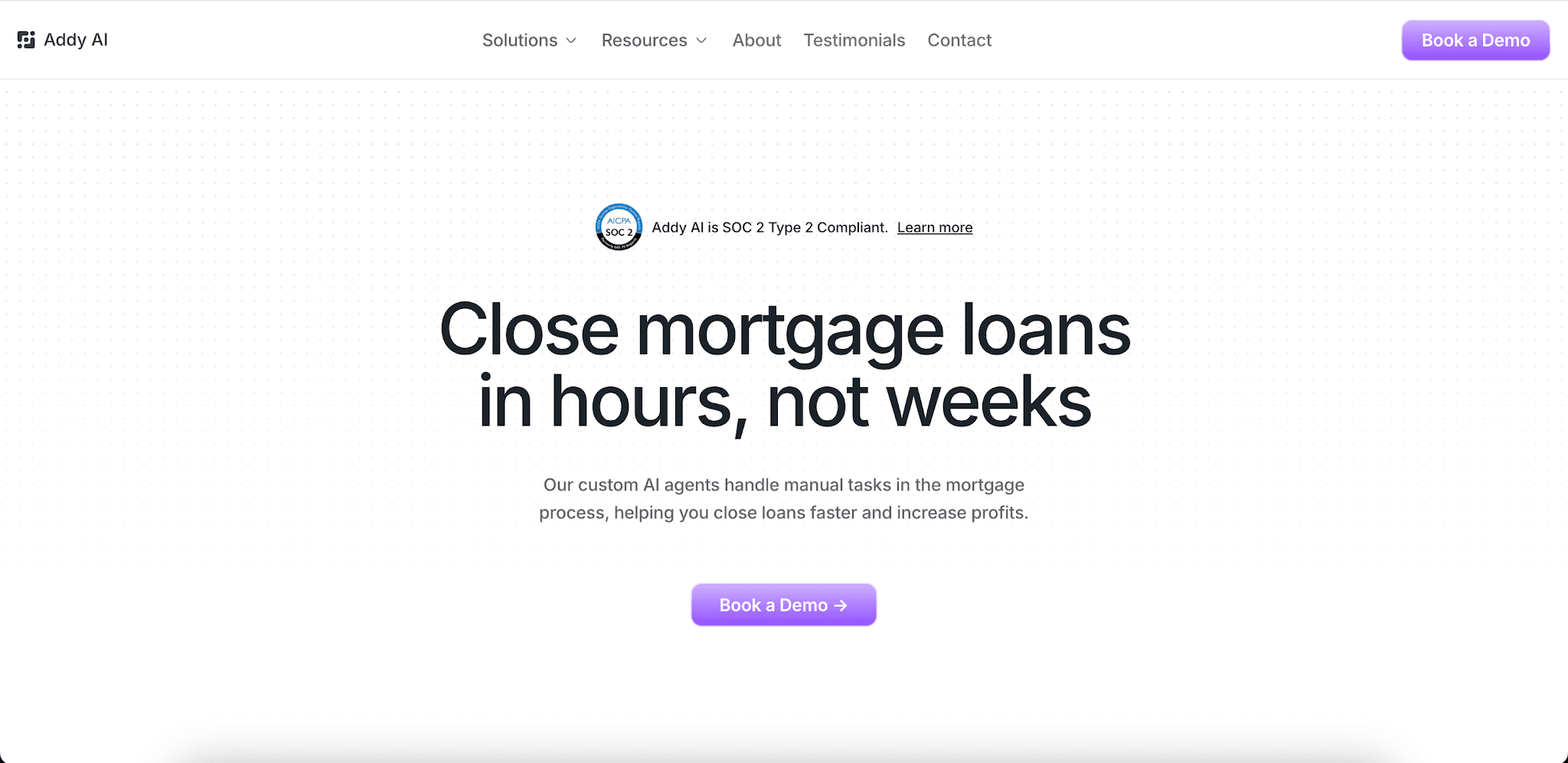
Addy uses AI agents to help lenders prepare mortgage files for underwriting. Its agents handle routine paperwork, giving loan officers and processors more time for borrower questions and cases that require closer attention.
Key Features of Addy's Loan Document Software
Document classification and extraction: Addy retrieves files from connected LOS and email inboxes. It identifies W-2s, pay stubs, bank statements, and tax returns, then extracts borrower data without requiring manual entry.
AI-powered document review: The platform compares submitted records to flag conflicting information or incomplete entries. Mortgage loan processors can investigate flagged details instead of reading every page for discrepancies.
AI Processing Checklist: Addy evaluates the file against automated underwriting system (AUS) findings and lender guidelines. In under five minutes, it produces a checklist showing satisfied requirements and outstanding loan conditions.
Automated borrower communication: AI agents send specific document requests through email, text, or phone when paperwork is missing. They also follow up on pending submissions, saving processors from contacting each borrower manually.
How Addy Helps Mortgage Processing Teams
Addy connects with LOS, point-of-sale (POS) platforms, and customer relationship management (CRM) software, including two-way synchronization with Arive. Its browser extension provides guideline search and file assistance within lending applications.
The agentic ChatGPT app offers another way to access Addy's AI capabilities. Lenders can analyze borrower income, assets, and credit information, explore loan scenarios, and receive pre-underwriting findings in approximately five minutes.
Addy is useful for lenders and brokers looking to shorten manual review time while retaining their LOS. It complements specialized platforms for disclosure generation, digital closings, and post-closing documentation.
2. Floify: Best for Borrower Document Collection

Image source: floify.com
Floify is a cloud-based mortgage POS platform that handles digital applications and borrower communication. It keeps borrower uploads in an online portal, where applicants can also monitor their loan status. Processors can access submitted paperwork without searching through separate email threads.
Key Features of Floify
Digital 1003 applications: Borrowers complete the Uniform Residential Loan Application online and electronically sign authorizations. Floify's Dynamic AI extracts information from uploaded records to prefill application fields, minimizing duplicate data entry.
Automated reminders: Lenders configure email and text notifications for outstanding paperwork and application milestones. These messages tell applicants what they still have to submit and provide progress updates.
Customizable application workflows: Dynamic Apps 2.0 lets lenders edit questions and sections for different loan products without coding. These include home equity lines of credit (HELOCs) and construction loans.
Floify focuses on digital borrower intake and application communication for independent brokers and lenders. Its role in investor package preparation is limited compared with its focus on borrower applications and communication.
3. LoanLogics IDEA: Best for Mortgage Document Indexing

Image source: loanlogics.com
LoanLogics IDEA (Intelligent Data Extraction and Automation) uses machine learning to classify and extract information from mortgage files. It prepares scanned and digital records for underwriting, quality control, and investor delivery during loan processing.
Key Features of LoanLogics IDEA
Automated classification and indexing: IDEA identifies individual forms within a mortgage package and categorizes them by type. Lenders can configure the stacking order according to investor requirements, instead of manually sorting pages.
Document versioning: The platform distinguishes revised paperwork from previous submissions. Processors can identify updated records when a file contains multiple versions of the same form.
Data extraction: IDEA captures key data from income and employment records, including W-2s and pay stubs. It converts extracted information into structured fields for connected systems to use during the origination workflow.
Rules-based validation: Configurable rules identify missing, mismatched, or invalid information and flag exceptions for further investigation. Reviewers can determine which entries require correction before further processing.
IDEA primarily handles back-office document preparation for lenders and quality control departments dealing with high volumes. It's not a borrower-facing application portal.
4. Ocrolus: Best for Mortgage Income and Asset Analysis

Image source: ocrolus.com
Ocrolus uses AI to analyze financial records and calculate borrower income for underwriting. Its tools help lenders evaluate applicants with multiple income sources or irregular earnings, providing information for credit decisioning.
Key Features of Ocrolus
Financial data extraction: Ocrolus captures figures from bank statements, pay stubs, and tax returns, then converts them into standardized fields. When the AI encounters uncertain information, it can route the entry for human verification.
Income calculation: The platform calculates qualifying earnings for salaried, self-employed, gig, and rental-income borrowers. Underwriters can inspect the source figures and adjust inputs through the Ocrolus dashboard.
Asset analysis and fraud detection: Ocrolus reviews account activity to assess available funds and flag unusual transactions. Detect identifies possible document tampering for further risk assessment.
Discrepancy and condition management: Ocrolus Inspect checks submitted information against the borrower’s 1003 application in ICE Mortgage Technology’s LOS. Its optional Conditions product helps lenders create and track conditions.
Ocrolus concentrates on borrower financial verification rather than managing the full origination process. Its calculations and flagged discrepancies inform underwriting, while lenders retain responsibility for final credit decisions.
5. Encompass by ICE Mortgage Technology: Best for Loan Document Management

Image source: mortgagetech.ice.com
Encompass is loan origination software that manages mortgage applications from intake through closing. It connects borrower paperwork with the associated application, giving processors access to loan records and outstanding tasks in one system.
Key Features of Encompass
Centralized document management: The platform’s eFolder provides document storage where processors can request, receive, and organize borrower paperwork. Records stay linked to applications for underwriting review.
Configurable workflows: Lenders can configure tasks and track conditions as applications progress. These document workflows help processors identify pending activities, such as appraisal reviews or outstanding income verification.
Loan data verification: ICE offers Data & Document Automation and Mortgage Analyzers as additional integrated solutions. They extract information from borrower records and compare it with Encompass fields, flagging discrepancies for further investigation.
Auditability: Encompass records changes to configured loan fields through audit trails. Teams can use these histories to investigate updates and retrieve information during regulatory compliance reviews.
The platform serves banks and credit unions, along with independent mortgage lenders seeking centralized origination management. It supports different lending models, including retail and correspondent origination.
Retail borrowers apply through the lender, while correspondent lenders deliver packages originated elsewhere. These channels involve different document handoffs during the lending process.
6. DocMagic: Best for Mortgage Document Generation

Image source: docmagic.com
DocMagic generates mortgage disclosures and closing packages using transaction information from the lender's loan file. Its software also tests that information against compliance rules before the paperwork goes to borrowers or settlement agents.
Key Features of DocMagic
Automated disclosure generation: DocMagic populates Loan Estimates and Closing Disclosures using borrower details, interest rates, and closing fees. Its generation engine also selects forms for different loan types and applicable state requirements.
Rules-based compliance audits: The Audit Engine tests transaction information for missing entries, incorrect formatting, and potential regulatory violations. Lenders receive reports explaining the issues and can configure warning severity within their compliance workflows.
Document delivery and LOS integration: DocMagic connects with LOS through APIs and offers browser-based data entry. Completed packages can be delivered electronically or through its print fulfillment service.
DocMagic also offers Compliance Edge, a separate resource covering evolving regulations, disclosure requirements, and mortgage compliance updates.
Its main function is preparing and validating lender-issued paperwork rather than analyzing borrower-submitted records.
7. Snapdocs: Best for Digital Mortgage Closings

Image source: snapdocs.com
Snapdocs coordinates mortgage signing activities between lenders, borrowers, and settlement agents. It helps participants complete their assigned tasks and exchange executed paperwork.
Key Features of Snapdocs
Multiple closing methods: Snapdocs handles traditional wet-ink signings, hybrid closings, and transactions involving electronic promissory notes (eNotes). It also accommodates remote online notarization (RON), depending on applicable requirements.
Borrower previews and eSignatures: The platform gives applicants access to closing packages before their appointments. Eligible forms can be signed electronically in advance, leaving documents that require physical signatures for the scheduled meeting.
Settlement coordination: Snapdocs shares closing materials with settlement agents and tracks signing progress. Lenders can monitor whether participants have completed their tasks and when executed paperwork has been returned.
Closing quality control: Snapdocs offers a separate quality control product that identifies missing pages, signatures, initials, and dates. These findings help closing teams locate execution errors before funding or further processing.
eVault management: Snapdocs offers an eVault for storing and transferring signed eNotes. It distinguishes authoritative copies and maintains transfer records for delivery to secondary-market partners.
Snapdocs concentrates on document handling during settlement rather than originating loans or generating disclosures. Its electronic signing options depend on transaction and notarization requirements.
8. Indecomm DocGenius: Best for Trailing Document Tracking

Image source: indecomm.com
After settlement, lenders may still be waiting for recorded mortgages and final title policies. Indecomm DocGenius tracks these outstanding records through an interactive platform that works alongside its post-closing services.
Key Features of Indecomm DocGenius
Document tracking and return dates: DocGenius shows outstanding items and recording status. It calculates expected return dates from historical turnaround data to help teams identify overdue files.
Settlement-agent follow-ups: Indecomm combines automated email reminders with live phone calls to request pending paperwork. Two-way communication lets agents and lenders exchange updates.
Reporting and performance monitoring: Users can filter records by state, investor, or settlement agent to find overdue submissions. Reports track return times and agent performance to identify recurring delays.
DocGenius pairs a document management system with Indecomm’s post-closing services to track outstanding recorded mortgage documents and final title policies. Loan servicing software handles payments, while portfolio monitoring tools track funded-loan performance.
This tracking helps with risk management, since delayed records can affect investor delivery even after funding.
Factors to Consider When Selecting Loan Document Software
Start with the loan types your team originates. Residential mortgages for salaried borrowers typically involve pay stubs, while income-producing commercial loans require rent rolls and property operating statements.
Community banks with commercial lending operations should also test real-estate-secured small business lending files containing business tax returns.
Next, consider monthly deal volume and how often borrowers replace records. Upload an original bank statement and a revised copy to see whether the system identifies the latest version.
Test LOS integration using a sample application. Correct an extracted amount and confirm it reaches the right field. If you use core banking systems, ask which information transfers beyond the LOS.
Confirm how lenders stay aligned with settlement agents on document status and responsibility for outstanding items.
Security also deserves attention. Verify who can access borrower records and whether audit logs identify changes. When evaluating fraud protection, ask the software provider to validate documents containing altered figures and explain what triggered the warnings.
Finally, compare processing times, accuracy, and manual corrections using identical applications. Request custom reporting by file type to identify where errors occur most often.
Choose based on how the software performs with your actual mortgage portfolio, rather than assuming it handles the entire loan lifecycle.
Prepare Mortgage Files for Underwriting With Addy
Receiving every requested document doesn't automatically mean a file is ready for underwriting. An unexplained deposit or insufficient income history can still leave conditions unresolved.
What lenders accept depends on the lending product and its guidelines. Regional banks and alternative lenders can also have different documentation policies.
These unresolved questions can delay the borrower's journey. Applicants might believe they've finished submitting paperwork, only to receive another request before their application can proceed.
Addy's AI Processing Checklist helps processors identify satisfied requirements and unresolved conditions. Its AI agents request additional information from borrowers so those outstanding items can be addressed before underwriting.
The lender still handles any manual underwriting and makes the final approval decision according to its lending policies and risk appetite.
Book a demo with Addy to see how your team can prepare more complete mortgage files with AI.
FAQs About Loan Document Software
Can loan document software read scanned or handwritten documents?
Yes. Many platforms in the mortgage industry use optical character recognition (OCR) to extract information from scanned pages and some handwritten entries. Commercial lenders should test sample property income statements, since unclear handwriting and poor image quality can affect accuracy.
Are electronic signatures legally valid for mortgage documents?
Yes. Electronic signatures are generally valid for mortgage transactions, including those handled by non-bank lenders. Lenders still have to obtain borrower consent and meet applicable identity verification, notarization, and recording requirements.
How much does loan document software cost?
Pricing varies by volume, integrations, and services. Fintech lenders can compare monthly subscriptions with usage-based pricing per file or transaction. Request quotes covering setup fees, minimum commitments, and extra processing charges.
Start closing more loans – Book your demo today
Stay ahead of the competition and discover how AI can accelerate your loan origination process, reduce manual work, and help you close more deals in less time. Book a demo today and start experiencing the future of lending.