Michael Vandi
Underwriting can slow down if teams take too long to review documents, calculate income, check guidelines, and assess credit risk. That pressure has made AI underwriting software a smart choice for lenders looking to improve the loan review process.
The right platform depends on where the workload is heaviest. Document extraction, credit analysis, and broader automation call for different AI capabilities. As AI underwriting expands into more loan review areas, lenders want technology that supports their improvement efforts.
Below, we compare the top six platforms and the role each plays in mortgage lending.
TL;DR
Here are the six best AI underwriting software platforms to consider in 2026:
Floify
Ocrolus
Zest AI
ICE Mortgage Technology
Tavant
What Does AI Underwriting Software Do?
AI underwriting software uses artificial intelligence to check borrower information, review financial records, and prepare findings for lending decisions. Depending on the platform, it can handle everything from document intelligence to risk assessment.
The software saves time by converting source files into usable information for underwriters. The output shows calculations, exceptions, and source-backed findings before a judgment call.
Common functions include:
Classifying 1003s, W-2s, tax returns, pay stubs, and bank statements
Turning file contents into structured data
Analyzing income, assets, liabilities, and credit history
Calculating ratios such as debt-to-income and loan-to-value
Comparing borrower details with lending criteria
Scanning automated underwriting system (AUS) findings and spotting missing items
Identifying inconsistencies through fraud detection
Sending exceptions for human review
These tools don't all solve the same problem. A document intelligence platform prepares borrower-file information for analysis, while a credit underwriting platform evaluates risk.
Pre-underwriting software checks files against guidelines and AUS before an underwriter reviews them.
How to Evaluate Mortgage AI Underwriting Software
The right tool should fix a specific issue in your underwriting process. It shouldn’t create extra work in other areas. Use these five criteria to compare what each platform can do.
Decisioning Depth
Start with what happens after information is captured. Entry-level systems stop at data extraction, while advanced options calculate income, apply lending criteria, assess credit, or produce pre-underwriting findings.
This distinction shows whether the software only prepares information or also contributes to the lending decision.
Document Analysis Quality
Accuracy depends on how well the platform interprets source files when formats vary, or the same figure appears in several records. It should recognize the file type, compare information between sources, verify calculations, and surface inconsistencies for closer attention.
That depth is especially important when income or asset figures depend on several documents rather than one source.
Integration Flexibility
Consider how easily the platform connects with your existing systems, including a loan origination system (LOS), AUS, point-of-sale (POS) system, or customer relationship management (CRM) platform.
Effective integration should let users transfer borrower and file information between apps. This way, they don’t have to enter the same details again.
Explainability
Important findings should be traceable to their source. Page references, calculation details, lending-rule citations, and an audit trail show how the system reached a result. This helps mortgage professionals verify the reasons behind a recommendation before making a lending decision.
Human-Review Controls
AI should flag uncertain or unusual cases rather than force an answer. Escalation paths, overrides, and exception routing help users make decisions when they require professional judgment. These controls help mortgage professionals fix any questionable findings before the file advances.
6 Best AI Underwriting Software Tools for Mortgage Teams in 2026
The AI underwriting tools below cover various steps in mortgage production, ranging from application intake and file analysis to credit decisioning and pre-underwriting. Their value depends on which part a lender wants to automate.
1. Addy for AI Pre-Underwriting and Guideline Review
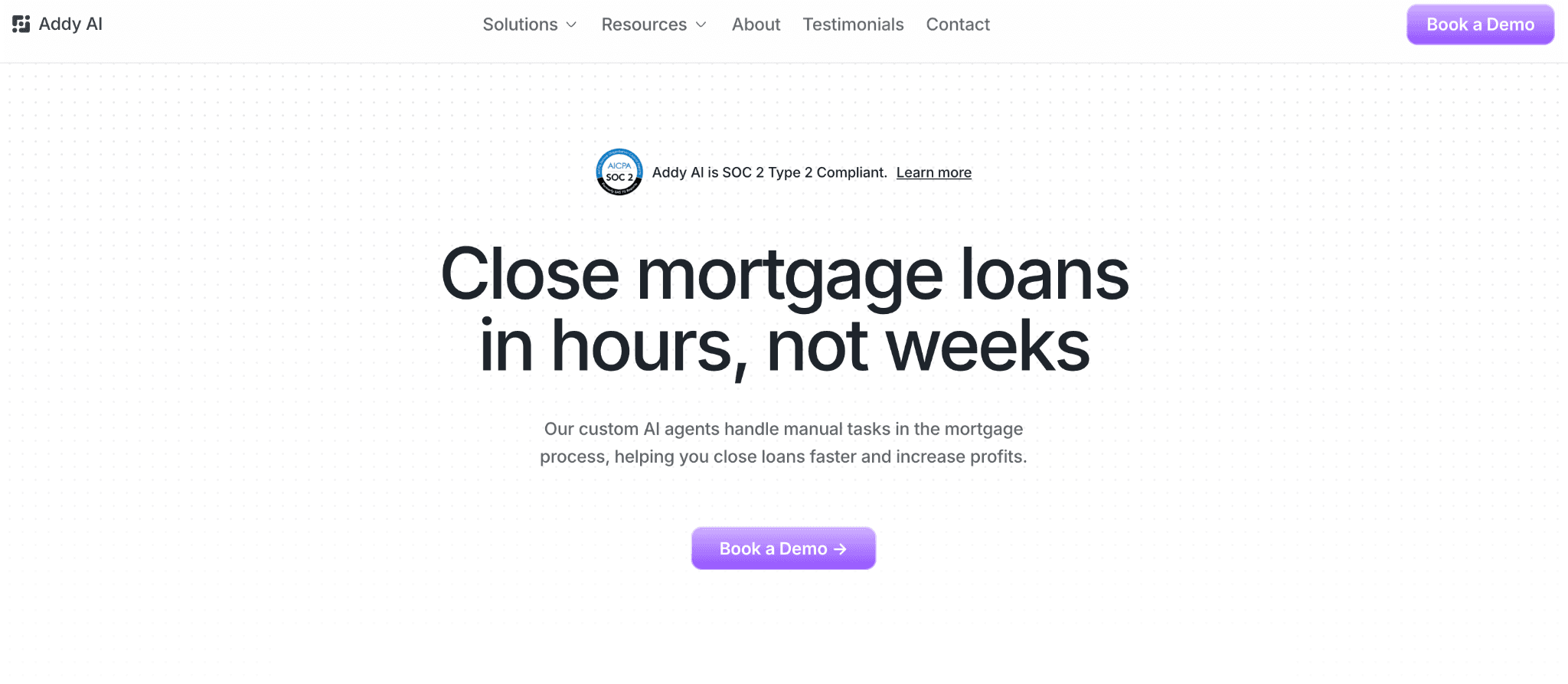
Addy applies AI to the work that happens before formal underwriting. It helps prepare findings for licensed mortgage professionals without taking over the final decision.
Its Document AI reads 1003s, W-2s, tax returns, pay stubs, bank statements, and credit reports. It converts unstructured file content into borrower information that Addy can verify and analyze.
That information feeds the Processing Checklist, which compares file contents with AUS findings and lender guidelines. It also runs product-specific conditions and identifies missing items that could hold up submission.
Key Features
Mortgage document classification and extraction
Income, asset, and credit analysis
AUS finding and lending guideline checks
Product-specific condition review
Missing-item identification
Pre-underwriting findings
Borrower and broker follow-up
Addy also offers a ChatGPT app for borrower pre-qualification, scenario analysis, financial review, and processing checklists that can pre-underwrite loans in under five minutes.
Addy’s Role Before Formal Underwriting
Addy is ideal for situations where processors or loan officers invest a lot of time preparing files for underwriting. It identifies missing records, unresolved conditions, or guideline issues before the file undergoes formal review.
This helps lenders cut down on repetitive file preparation while still involving professional judgment.
How Addy Works with Existing Mortgage Systems
Addy connects with an existing LOS, POS, CRM, email, Slack, and Microsoft Teams. Its browser extension gives users access to file analysis and guideline search within their existing underwriting workflow.
This approach lets lenders add AI-powered file analysis and guideline review without replacing their LOS or AUS.
2. Floify for AI-Assisted Application Intake
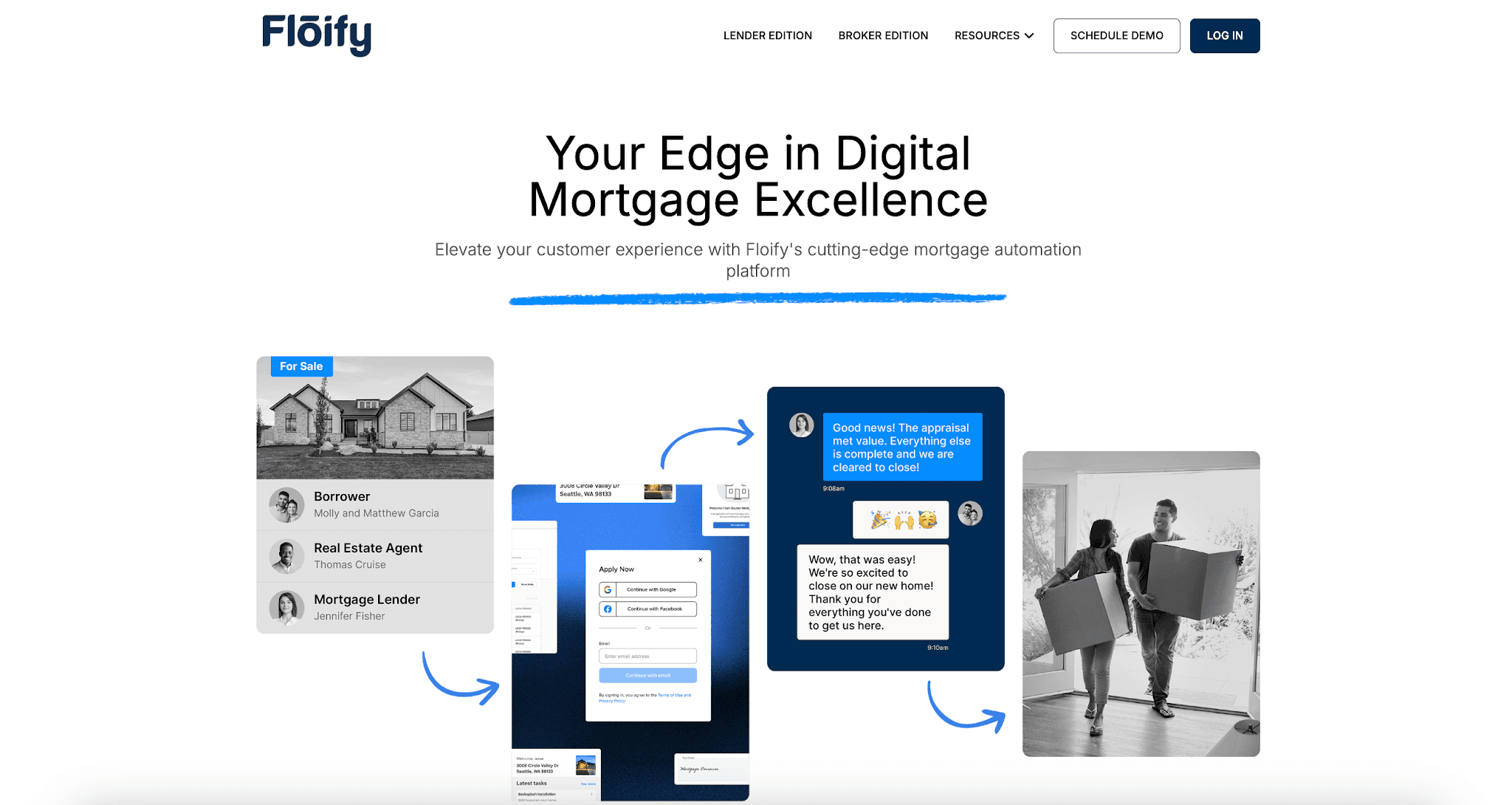
Image source: floify.com
Floify is a mortgage POS platform for borrower applications, communication, and file collection. Its Dynamic AI pulls information from uploaded records and uses it to prefill parts of the 1003.
That reduces manual data entry during intake and gives processors more complete borrower information earlier. Floify also checks uploads and assists with income calculations, helping catch missing or inconsistent information before later processing.
Dynamic Apps 2.0 lets lenders create application paths for different financing types without custom development. When a scenario requires more detail, the form can show additional questions and trigger the appropriate document requests or disclosures.
Key Features
Configurable borrower applications
AI-assisted data extraction
1003 prepopulation
Upload validation
Income calculation assistance
Automated document requests
Disclosure workflows
Floify’s Role in Application Intake
Floify places its AI capabilities near the start of origination. It turns borrower submissions into application information that processors can use during later file preparation.
That makes Floify more focused on intake and application setup than on evaluating credit risk or producing an underwriting decision.
3. Ocrolus for AI Document Analysis and Underwriting Data
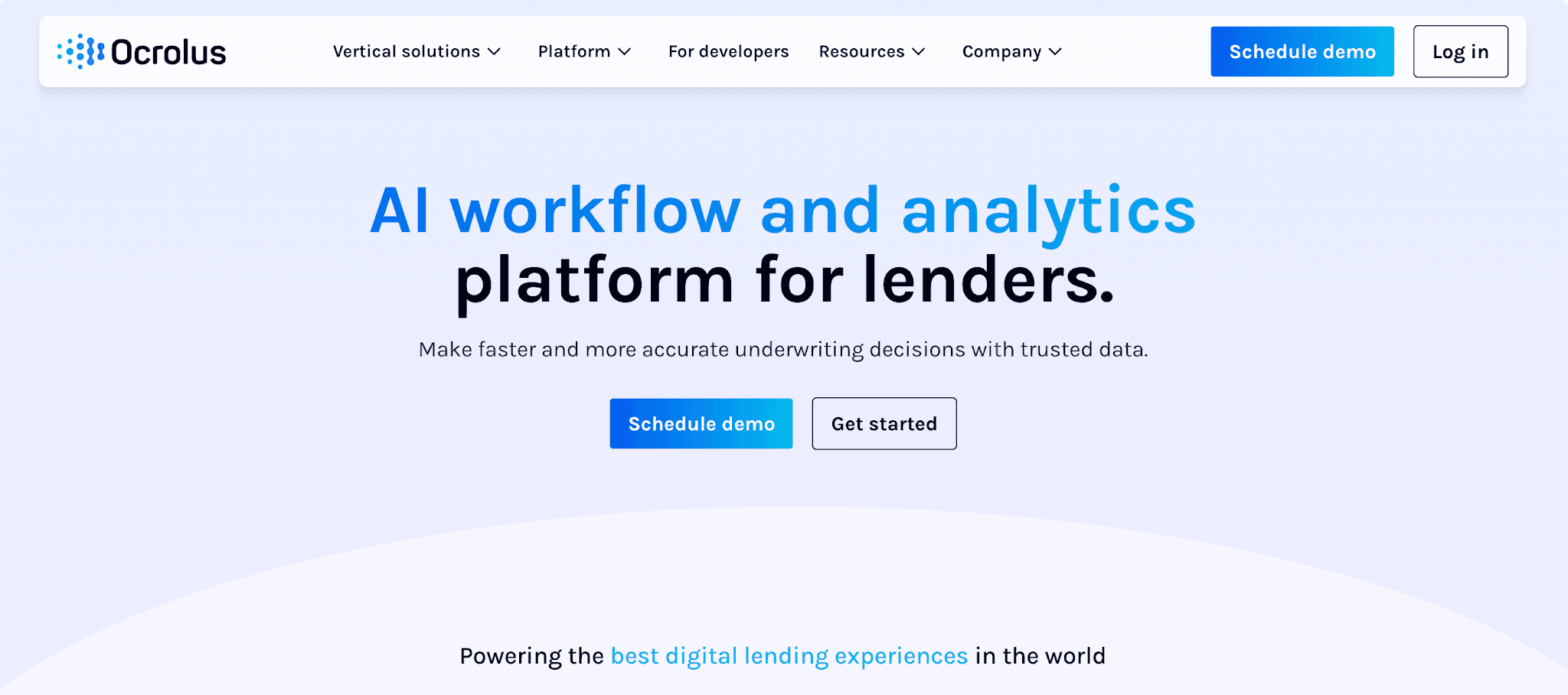
Image source: ocrolus.com
Ocrolus focuses on financial record analysis for credit and mortgage workflows. Its document intelligence converts unstructured files into structured data that can be used for income, asset, and cash-flow analysis.
The platform processes bank statements, pay stubs, tax forms, and more than 2,000 file types. It can compare figures between records, which is useful when income or asset calculations depend on information from several sources.
Ocrolus also applies forensic analysis to detect altered files, inconsistent amounts, unusual formatting, and other fraud detection signals. Its model orchestration selects an AI model for each task, while uncertain cases can move to additional AI checks or human assessment.
Key Features
File classification and structured extraction
Income calculations
Asset and cash-flow analysis
Credit, collateral, and AUS review
Fraud and tampering detection
Conditions management
Human-in-the-loop verification
Ocrolus provides API access and a direct Encompass integration. Extracted information can enter existing systems without adding the same manual work back into underwriting operations.
Ocrolus’s Role in Financial Document Analysis
Ocrolus is geared toward high-volume document intake, particularly when several financial records need validation before credit analysis. Its role is to turn those source files into verified information that later stages of the underwriting process can use.
4. Zest AI for Machine-Learning Credit Decisioning

Image source: zest.ai
Zest AI is built on machine-learning credit models rather than document extraction. Its technology assesses applicant risk using models tailored to a lender’s borrower population and credit policies.
Those models rank applicants by predicted risk and let lenders adjust policy thresholds based on expected performance. That places Zest within lender credit workflows, where risk scores and decision rules influence whether an application proceeds.
Fair-lending analysis is another part of the platform. Zest tests models for fairness and explains individual credit decisions, helping users trace why a particular result was produced.
Key Features
Custom machine-learning credit models
Borrower risk ranking
Automated underwriting decisions
Lending-policy optimization
Fairness testing
Portfolio intelligence
Zest also analyzes portfolio performance, applicant trends, profitability, and credit migration. Its use of historical data shows how risk patterns develop after origination and gives lenders information for ongoing business decisions.
LuLu Pulse adds generative AI models to the platform’s reporting capabilities. Users can access industry benchmarking and financial analysis through a conversational interface rather than sorting through those findings manually.
Zest AI’s Role in Credit Decisioning
Zest AI addresses risk modeling and automated credit decisions rather than mortgage file preparation. Its primary use is evaluating applicant risk, refining lending policies, and monitoring model fairness within the decisioning process.
5. ICE Mortgage Technology for Encompass-Centered Underwriting Automation
Image source: mortgagetech.ice
ICE Mortgage Technology brings underwriting automation into Encompass through its Mortgage Analyzers. The software evaluates borrower information automatically and sends exceptions forward when closer professional attention is required.
Income Analyzer calculates qualifying income from application details and source records. Credit Analyzer applies GSE, FHA, ATR, and lender-specific rules to credit information, helping identify issues that could affect loan eligibility.
Asset Analyzer looks for activity such as significant deposits and withdrawal patterns that require further attention. Audit Analyzer checks for missing records and inconsistencies that could create quality-control concerns.
Key Features
Automated income analysis
Credit assessment against lending rules
Asset and deposit analysis
Missing-file and inconsistency detection
Exception-based processing
Freddie Mac AIM Check integration
Freddie Mac’s AIM Check adds another income assessment within Encompass. Eligible sellers can compare AIM Check findings with ICE Income Analyzer results directly in the Income Analysis tab.
The side-by-side view keeps both calculations inside the same underwriting workflow. Files that fall outside the automated criteria can be routed for further review rather than forcing a result through rule-based workflows.
ICE’s Role in Encompass-Based Underwriting
ICE mainly addresses lenders already using Encompass as a core origination platform. Its analyzers act as an underwriting AI tool for income, credit, asset, and quality-control assessments inside Encompass.
That keeps those assessments within the origination system, so lenders don’t have to add a separate application for them.
6. Tavant for Touchless Mortgage Automation
Image source: tavant.com
Tavant’s Touchless Lending is an AI system that automates several parts of mortgage production. Rather than concentrating on one assessment, it connects file processing, verification, credit analysis, collateral, and decision-making.
Touchless Decisioning compares responses from multiple AUS platforms with investor guidelines and loan information. This helps lenders interpret findings from disparate sources within the same decisioning process.
Other Touchless modules prepare the information used in that process. Documents are classified and converted into usable information, income is verified, credit is evaluated, and collateral analysis covers appraisal review.
Key Features
Touchless Documents for classification and extraction
Touchless Income for employment and income verification
Touchless Credit for automated credit analysis
Touchless Collateral for appraisal review
Touchless Decisioning for multi-AUS and guideline comparison
Third-party service connections
FinConnect supplies information from external vendors used during origination. Its 130 connectors cover more than 60 services, including identity, credit, income, assets, and tax transcripts.
Those connections give Touchless modules access to source information without requiring every input to originate inside Tavant.
The wider scope also affects implementation, since lenders are connecting several production functions rather than adding one isolated tool.
Tavant’s Role in Touchless Lending
Tavant is geared toward lenders pursuing multi-stage mortgage automation. It’s more applicable to a wider origination initiative than to a lender trying to automate one isolated assessment.
Final Checks Before Choosing AI Underwriting Software
After comparing the core capabilities, check the operational details that affect day-to-day use.
Document coverage: Review which file types the software can analyze without custom training or added configuration.
Lender rules: Verify that it can apply your overlays, product conditions, and internal criteria correctly.
Model design: Find out whether it relies on large language models (LLMs) or combines AI with mortgage-specific rules and validation.
Model updates: Ask how new versions are tested, including stress testing for unusual files and exceptions.
Architecture: An AI-native platform may offer deeper automation, but architecture alone doesn’t determine accuracy or reliability.
Auditability: Confirm which findings, changes, overrides, and source references remain available for later examination.
Security and compliance: Review access controls, borrower protections, and applicable legal or regulatory requirements.
High automation percentages mean little when users can’t verify the output or correct an inaccurate finding.
Prepare Cleaner Files for Underwriting With Addy
The next step is to match those criteria to the part of production consuming the most time. Intake issues point to POS automation, while document-heavy files call for software that can interpret source records before deeper analysis starts.
Credit-modeling problems call for decisioning technology when risk scores or policy thresholds affect approvals. Encompass-centered lenders may prefer automation that keeps more analysis inside the system they already use.
For teams evaluating AI for underwriting, pre-underwriting is worth considering when file preparation takes too much time. It can provide decision support by identifying missing items, checking guidelines, and surfacing file-level insights before formal review.
Addy addresses that stage of the process. Its AI scans mortgage documents, checks guidelines and AUS findings, and prepares files for underwriting without replacing the existing LOS or AUS.
FAQs About AI Underwriting Software
How is AI used in underwriting?
AI reads borrower documents, calculates income, checks guidelines, and flags missing information before an underwriting decision. A lending company may pair these tools with mortgage-specific rules rather than relying only on general LLMs.
Will AI completely replace mortgage underwriters?
No. AI can automate document review, calculations, and routine checks, but underwriters still handle judgment-based decisions and exceptions. A lending firm still needs human review when borrower circumstances fall outside standard criteria.
Can AI underwriting software handle non-QM loans?
Yes, if the software can apply lender-specific guidelines, overlays, and product conditions. Non-QM files often require flexible rule handling because eligibility varies by program and borrower scenario.
Is AI underwriting software used outside mortgage lending?
Yes. Similar technology appears in insurance underwriting and commercial real estate (CRE), but the inputs and risk models differ. Mortgage-specific platforms are designed around borrower documents, lending rules, and AUS findings.
Start closing more loans – Book your demo today
Stay ahead of the competition and discover how AI can accelerate your loan origination process, reduce manual work, and help you close more deals in less time. Book a demo today and start experiencing the future of lending.