
Michael Vandi
How many times does a loan file get reviewed before it’s ready for approval? Income is re-entered, documents are checked again, and a missing item sends the file back for another round of emails.
Mortgage loan automation replaces those steps with AI that reviews files and checks them against lending guidelines before underwriting.
This guide explains how mortgage loan automation works and where it makes the biggest difference.
TL;DR
Mortgage loan automation uses AI to speed up document review, data extraction, and loan approvals.
It cuts hours from file setup by removing manual data entry and document checks.
Automation identifies missing documents early and keeps loan files complete.
Technologies like OCR, IDP, and RPA handle document processing and workflow tasks.
Addy AI applies mortgage loan automation to process files faster and improve loan accuracy.
What Is Mortgage Loan Automation?
Mortgage loan automation uses artificial intelligence (AI) and intelligent document processing (IDP) to move files through mortgage processing without constant manual work.
It reads mortgage documents like bank statements, tax forms, and pay stubs. It extracts borrower data and checks key details before anyone reviews the file.
In most mortgage operations, loan officers spend hours on manual data entry, document verification, and follow-ups. Mortgage processing automation takes over those repetitive tasks and flags missing items in loan applications.
Loan officers still handle judgment calls and borrower conversations. Automation clears routine work so they can focus on reviewing files and making approval decisions.
Where Mortgage Loan Automation Saves the Most Time
Most delays in mortgage lending don’t start at underwriting. They come from document review, data checks, and waiting on borrowers to send required documents.
Document Intake and Data Extraction
Loan files arrive with bank statements, W-2s, tax returns, and email threads. Each document needs someone to read it and pull out income figures, deposit history, and account balances.
With intelligent automation, those incoming documents get read as they arrive. The system captures income and asset details automatically, which improves data accuracy and cuts down data entry errors.
Loan File Analysis and Eligibility Checks
After the data is recorded, the file needs to be checked against lending regulations. This step often involves comparing income, credit reports, and asset information line by line.
Automation flags incomplete income entries, inconsistent figures, or missing sections early in the review process. Mortgage lenders can catch these issues before underwriting, which helps shorten loan processing time.
Condition Resolution and File Completion
Conditions from the automated underwriting system (AUS) findings often slow files down. Loan officers have to review the findings, search the documents, and confirm which required items are missing from the file.
Automation links each condition to supporting documents already in the file and identifies what still needs to be added, such as updated bank statements or signed disclosures.
Borrower Communication and Follow-Ups
Delays often happen while waiting for borrowers to send documents. Requests get missed or lack clear instructions.
Automation sends automated notifications based on file requirements. Borrowers get clear requests, like uploading a missing pay stub or providing an updated bank statement, which helps complete files faster.
How Mortgage Loan Automation Speeds Up File Processing
Faster file processing depends on key technologies that take over steps that once slowed loan approvals and increased human errors.
Optical Character Recognition
Loan files often include scanned PDFs that can’t be searched. Key details like income and balances stay buried in those files.
Optical character recognition (OCR) converts those documents into readable text. Income figures, transaction history, and account balances become searchable, which speeds up income verification and improves data accuracy.
Intelligent Document Processing
Mortgage files include tax returns, bank statements, and pay stubs, all with different formats. That makes document management difficult with manual review.
IDP extracts specific fields like income, assets, and liabilities. It organizes extracted data so it can be passed into a loan origination system (LOS) in the correct format.
Robotic Process Automation
After the data is ready, systems still need updates. Files need status changes, document requests need to go out, and tasks need to be assigned.
Robotic process automation (RPA) handles those steps. It updates records, triggers automated workflows, and routes files through existing systems without manual input.
Natural Language Processing
Loan files often include emails and written explanations. Important details often appear in those messages.
Natural language processing (NLP) reads that text and identifies relevant information. It can detect explanations for large deposits or employment notes that affect loan decisioning.
Machine Learning and AI
Once the file is complete, it needs to be reviewed for approval processes. Manual review can slow decisions and introduce inconsistencies.
Machine learning (ML) models learn from past loan outcomes. They help financial institutions improve decision-making, catch inconsistencies, and support more consistent loan approvals.
Where Mortgage Loan Processing Fails Without Automation
Without mortgage loan automation, manual processes stretch loan processing time and increase operational costs in the mortgage industry.
Slow file turnaround times: A single file can take hours to review. When multiple files pile up, loan approvals take longer, and the loan lifecycle extends beyond expected timelines.
Missed conditions and incomplete files: Conditions from the AUS often get addressed late in the process. Borrowers receive multiple requests for updated bank statements, pay stubs, or signed disclosures, which increases fallout risk and affects customer satisfaction.
Disconnected systems: Data stays in email threads, a LOS, and other legacy systems. Loan officers spend time searching for documents and verifying details, which slows the process.
Inconsistent guideline interpretation: Lending rules vary between Fannie Mae, Freddie Mac, and other investors. Manual comparison increases errors, which can lead to compliance violations.
How Addy AI Solves Mortgage Loan Automation Gaps

Addy AI handles document review, condition checks, and loan data organization so files don’t stall during processing. It analyzes borrower information, identifies missing requirements, and keeps everything connected in one place.
Automates Document Review and Data Extraction
Addy AI reviews bank statements, pay stubs, tax forms, and borrower emails. It extracts income, assets, and transaction details, then presents them in a structured summary.
It also highlights specific items that need attention, such as large deposits in a bank statement. Loan officers can review flagged transactions without scanning every page.
Resolves Conditions and Identifies Missing Requirements
Addy AI reads findings from the AUS and lists each condition required for the loan. It checks the file to confirm whether documents already support those conditions.
If a requirement is missing, it identifies the exact document needed, such as an updated bank statement or proof of income. It can also initiate follow-ups with the borrower.
Centralizes Data and Compares Lending Guidelines
Addy AI connects with LOS, customer relationship management (CRM) tools, and other digital tools. Loan data, documents, and communication stay organized in one location.
It also gives loan officers access to lending guidelines from Fannie Mae, Freddie Mac, and other investors. This helps with regulatory compliance and supports more data-driven decisions.
What Mortgage Loan Automation Looks Like in Practice
Time savings show up in tasks like data collection and file setup. These examples show what changes when those steps no longer rely on manual work.
Sphinx Capital worked with loan data scattered across emails, spreadsheets, CRMs, and its LOS. Loan officers had to collect details manually and build deal summaries for each file.
With Addy AI, that data became searchable in one place. The system also generated loan summaries using information from documents and applications.
Summaries that once took 10– 60 minutes now take about a minute, which leads to real cost savings and gives loan officers more time for higher-value tasks like working with clients.
PGS Home Loans dealt with long setup times for each file. Their team spent three to four hours reviewing documents and preparing files before sending pre-approvals.
After using Addy AI, the file setup dropped to about 45 minutes. Discrepancies get caught during review, which improves accuracy and gives borrowers more reliable pre-approvals.
One employee can now handle the workload of three to four people, giving the business a competitive advantage without adding staff.
Book a demo now and see how Addy AI can achieve the same results for you!
Turn Slow Loan Files Into Fast Approvals With Addy AI
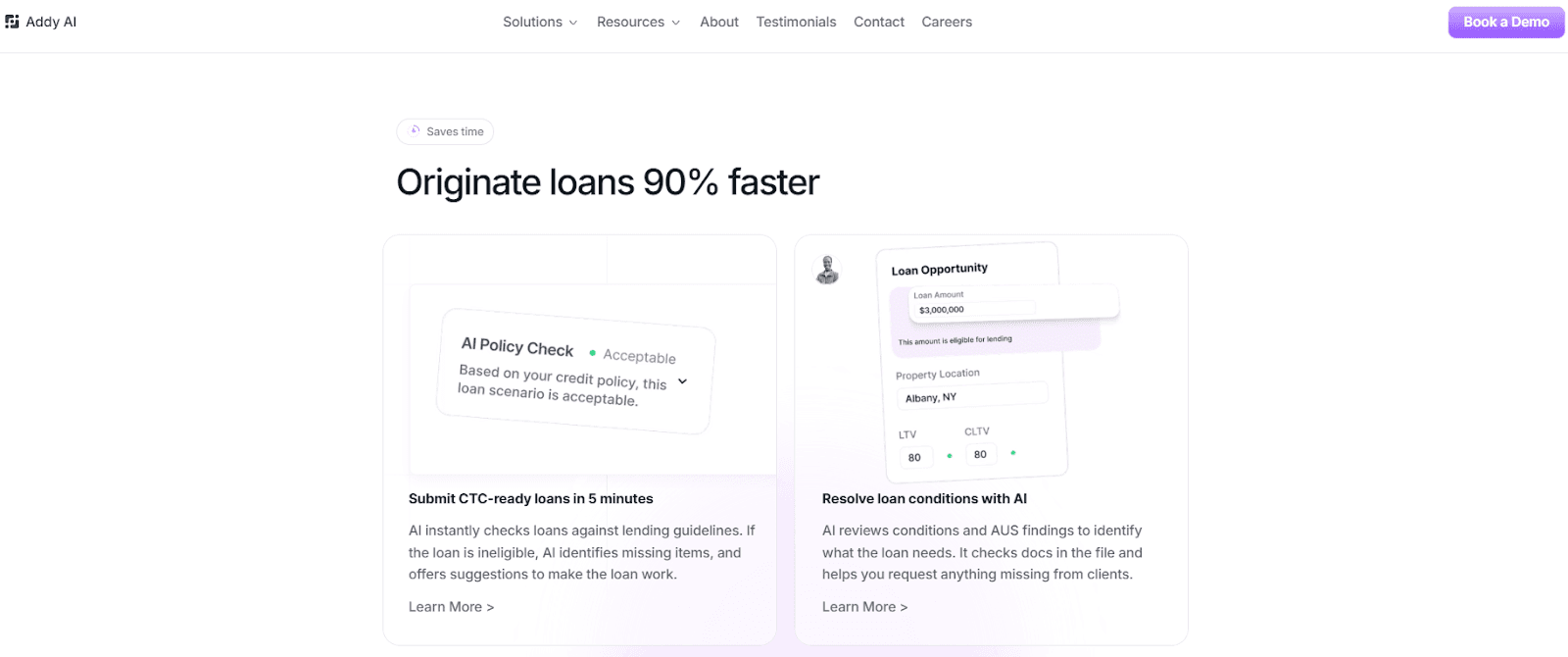
Loan speed and accuracy improve when document review, condition checks, and borrower follow-ups no longer rely on manual steps.
Automated mortgage processing solutions handle tasks like reviewing bank statements, verifying income, and requesting missing documents without manual input.
Addy AI is mortgage automation software that reviews borrower files, identifies required documents, and keeps loan data organized throughout the process.
That consistency improves audit readiness and helps reduce risk, including flagging unusual transactions that may require fraud detection review.
Lenders dealing with extensive documentation and high operational costs need a way to process more files without adding staff.
Customer expectations now center on faster approvals and fewer errors. According to TD Stories, 62% of consumers believe AI helps them make better decisions, which raises expectations for the digital mortgage experience.
FAQs About Mortgage Loan Automation
How much time does mortgage loan automation save?
Mortgage loan automation can cut hours from tasks like document review and file setup. In many cases, work that once took several hours per file can be completed in under an hour, depending on the complexity of the loan.
Can AI accurately process mortgage documents?
Yes, AI can process mortgage documents with a high level of accuracy. It reads bank statements, tax forms, and borrower data, which reduces errors during review.
Will AI replace mortgage loan officers?
No, AI won’t replace mortgage loan officers. It handles repetitive steps in the entire process, while loan officers focus on reviewing files, working with borrowers, and making final decisions.
Start closing more loans – Book your demo today
Stay ahead of the competition and discover how AI can accelerate your loan origination process, reduce manual work, and help you close more deals in less time. Book a demo today and start experiencing the future of lending.