
Michael Vandi
Mortgage teams are buried in document reviews, condition requests, compliance checks, and endless data entry. One missing file or overlooked guideline can stall approvals and leave borrowers waiting longer than expected.
That’s why loan officers are exploring AI agents for mortgage processing. These systems help with underwriting tasks, condition reviews, and borrower communication without switching between platforms.
This article explores how AI agents are being used in mortgage lending and what lenders should know before bringing them into their workflow.
Want to see how this looks in practice? Book a demo with Addy today!
TL;DR
AI agents for mortgage processing automate document reviews, condition tracking, and borrower follow-ups.
Lenders use AI agents to review mortgage files faster and reduce repetitive underwriting tasks.
AI agents can compare AUS findings against lender guidelines and flag missing loan conditions earlier.
Mortgage lenders also use AI agents to improve audit history, compliance reviews, and borrower communication.
Addy helps lenders automate mortgage processing inside their LOS with AI document reviews and condition management.
What Are AI Agents for Mortgage Processing?
AI agents for mortgage processing are software systems that automate common lending tasks. Lenders use them to review documents, monitor compliance checks, and manage loan conditions.
Older automation tools mainly scan files or extract text. AI agents can understand context inside mortgage documents.
They use large language models (LLMs), machine learning, computer vision, and natural language processing (NLP) to review:
Pay stubs
Tax returns
Income statements
Credit reports
Loan application data
AI agents can also organize structured data, review compliance requirements, and automate parts of loan processing.
Many AI-powered lenders also use AI agents for document collection, application status updates, and borrower communication during the loan application process.
Many lenders use AI agents inside loan origination systems (LOS), customer relationship management (CRM) platforms, email inboxes, and browser extensions.
This helps lenders accelerate approvals while keeping human review involved in final lending decisions.
Why Traditional Loan Processing Slows Approvals
Traditional loan processing still depends heavily on manual review. Underwriters often sort through PDFs, email attachments, bank statements, tax returns, and mortgage applications before they can review loan conditions.
That process takes time and increases the risk of manual errors.
According to Global Growth Insights, 61% of lenders say document handling and re-keying borrower information remain major pain points. Another 47% say older systems slow product and pricing updates.
Mortgage Documents Aren’t Easy to Review
Underwriters deal with repetitive tasks throughout the approval process. They often have to:
Verify assets and liabilities
Review income documents manually
Match the automated underwriting system (AUS) findings to lender overlays
Search for missing conditions
Re-enter borrower data into existing systems
Loan files rarely arrive in a consistent format. Borrower information may come from PDFs, pay stubs, tax returns, handwritten forms, email threads, and bank statements.
Underwriters then spend hours extracting data and reviewing documents manually. Even experienced mortgage professionals can interpret guidelines differently, which increases the risk of regulatory compliance issues.
Mortgage Compliance Reviews Leave Little Room for Error
Mortgage lenders now manage Fannie Mae requirements, Freddie Mac rules, investor overlays, and non-qualified mortgage (non-QM) guidelines at the same time.
Many regulatory requirements are embedded in lengthy policy documents that are difficult to review. Missing one outdated condition can trigger compliance issues, additional reviews, or approval delays later in the loan process.
How AI Agents Automate Mortgage Operations
AI agents help lenders automate parts of mortgage operations that often slow loan processing. That includes document verification, AUS reviews, loan status tracking, and borrower communication.
Mortgage Document Review and File Classification
Mortgage files rarely arrive in order. Borrowers may upload pay stubs first, email bank statements later, and submit tax returns days afterward.
AI agents can review documents as they arrive. They extract borrower data from 1003s, W-2s, tax returns, pay stubs, and bank statements, then organize that information inside the LOS.
That reduces manual effort, improves document verification, and lowers the risk of manual errors during mortgage processing.
AUS Findings and Guideline Reviews
Underwriters often spend hours comparing AUS findings against lender overlays and compliance standards.
AI agents can review those conditions automatically and flag missing documents, income issues, or eligibility concerns before human review starts.
That helps lenders improve risk assessment and maintain compliance standards during loan underwriting.
The best AI solutions also explain why a loan condition failed. Underwriters can trace decisions back to lender guidelines without searching lengthy PDFs manually.
Loan Updates and Borrower Follow-Ups
Borrowers often wait days for loan updates or missing document requests. AI agents can send reminders automatically through email, phone calls, or text messages.
That helps lenders keep the approval process moving and improves the borrower experience during mortgage applications.
Why Audit History Matters in Mortgage Processing
Mortgage lenders can’t afford incomplete loan records. During audits, investors and compliance staff may ask when a borrower uploaded a document, who approved a condition, or why underwriting requested additional paperwork.
Without a reliable audit history, staff often search through email threads, processor notes, and separate systems to reconstruct the file timeline.
AI-powered systems can record file activity automatically. They can log document uploads, underwriting comments, condition updates, and approval history with timestamps attached to every action.
That gives lenders a documented history for each mortgage file. It also helps human professionals review prior decisions during disputes or investor reviews.
Why AI Mortgage Platforms Need Strong Security Standards
Mortgage files contain sensitive borrower information, including payroll records, tax documents, banking information, and Social Security numbers. Lenders need strict security standards before they deploy AI agents inside mortgage operations.
A secure AI platform should include encryption, audit logs, role-based permissions, compliance monitoring, and secure system connections.
Lenders also need visibility into how AI-driven recommendations affect underwriting decisions and risk assessment.
That visibility helps compliance staff explain loan outcomes during audits, disputes, and investor reviews while maintaining customer trust.
Real-World Benefits of AI Agents for Mortgage Processing
AI agents help lenders shorten processing times by reducing repetitive underwriting reviews. Processors spend less time re-checking income documents and unresolved loan conditions.
That gives underwriters more time for complex tasks that require human expertise, like reviewing exception files or unusual borrower scenarios.
Lenders can process more loans without increasing staffing pressure at the same pace.
Borrowers notice the difference quickly. Faster approvals and quicker document requests improve customer satisfaction during the approval process.
Mortgage brokers also use AI solutions to reduce operational costs and handle complex workflows more efficiently.
AI agents also help lenders reduce operational costs linked to manual work and repeated document reviews. Intelligent mortgage automation software can manage routine tasks while staff focus on compliance reviews and decision-making.
How Addy Uses AI to Automate Mortgage Processing
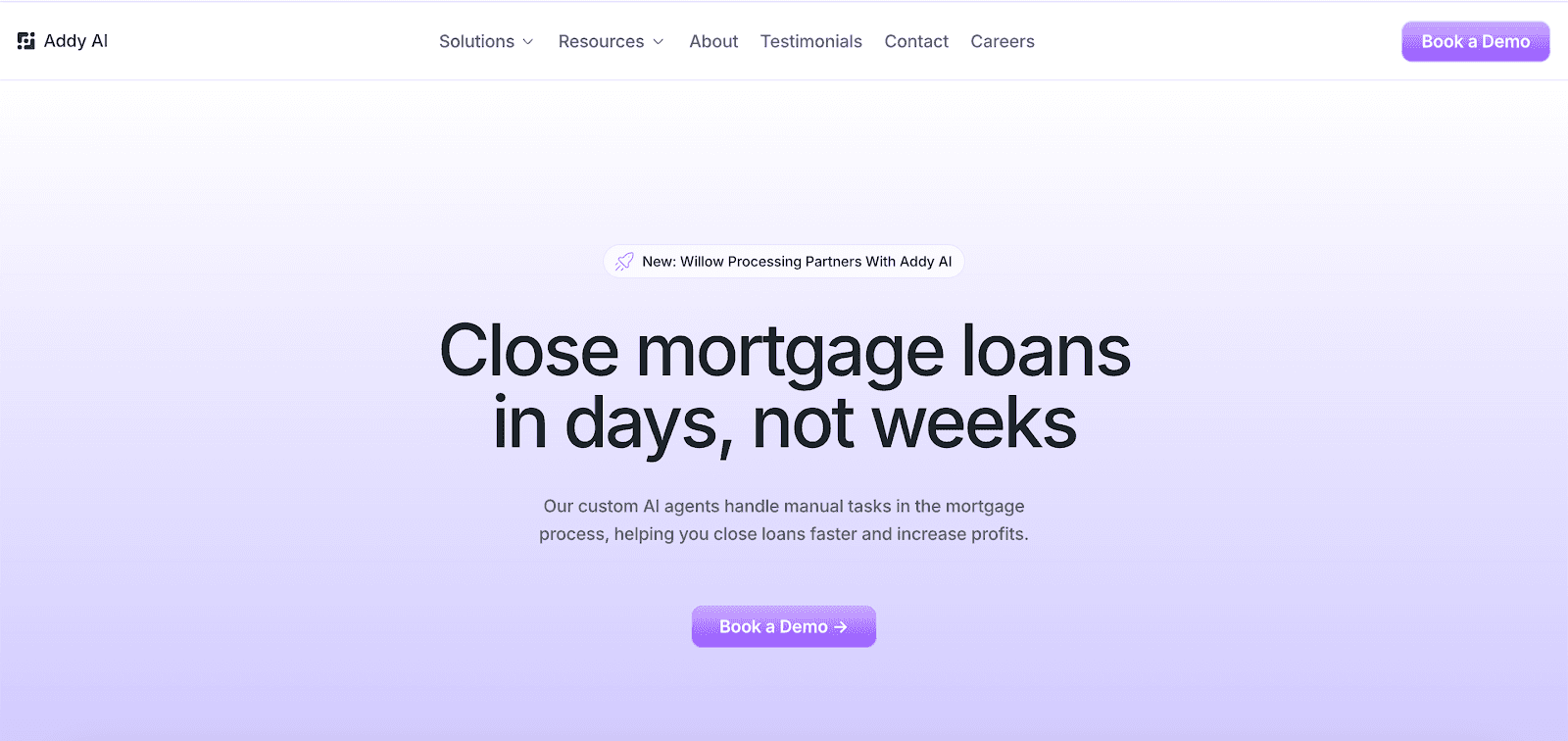
Addy uses intelligent agents to automate mortgage tasks that usually consume processor and underwriter time.
The platform can extract borrower data from 1003s, W-2s, pay stubs, tax returns, and bank statements, then sync that information with the LOS.
Addy also reviews AUS findings against lender guidelines and loan conditions. When documents are missing or a file fails guideline checks, the system identifies what still needs attention before underwriting continues.
Lenders can use pre-built AI agents for mortgage lead qualification, customer service, document processing, and borrower retention. Addy also connects with existing systems used throughout mortgage operations.
Lenders can deploy AI agents inside an AI platform that helps automate complex workflows, maintain regulatory standards, and close more loans.
Turn 4 Hours of Loan Setups Into 45 Minutes With Addy
AI agents for mortgage processing help lenders review files, manage loan conditions, and communicate with borrowers faster.
Lenders still need accurate records and visibility into underwriting decisions. In the mortgage industry, missing documents and disconnected data sources can stall approvals and leave processors waiting on incomplete files.
Addy combines AI document extraction, guideline reviews, automated condition management, and LOS-connected workflows.
PGS Home Loans integrated Addy with Arive and cut loan setup time from 3–4 hours to roughly 45 minutes. The brokerage also achieved faster approvals and reduced errors during underwriting reviews.
FAQs About AI Agents for Mortgage Processing
Can AI agents replace mortgage underwriters?
No. AI agents help underwriters by automating tasks like document reviews, condition tracking, and borrower follow-ups. Underwriters still handle exception files, review risk, and make final lending decisions.
How do AI agents improve mortgage compliance?
AI agents can compare loan files against lender guidelines and flag missing conditions earlier in the process. They also record file activity automatically, which helps lenders reduce errors during audits and underwriting checks.
Are AI agents secure enough for mortgage lending?
They can be, but lenders should review security standards before adopting a platform. Strong systems include encryption, audit logs, role-based permissions, and SOC 2 compliance.
Many AI-driven platforms also use natural language tools to review mortgage data while maintaining compliance controls.
Start closing more loans – Book your demo today
Stay ahead of the competition and discover how AI can accelerate your loan origination process, reduce manual work, and help you close more deals in less time. Book a demo today and start experiencing the future of lending.